From Giannis Antetokounmpo adding size to Charles Barkley shedding excess weight, these players became physically very different from the youngsters who entered the league
Looking at Giannis Antetokounmpo, it is hard to imagine him needing help to get bigger. For a skinny teenager struggling to fill out a basketball jersey, his early NBA photographs might be a little reassuring. Even one of the most physically imposing players in basketball started with a body that needed considerable development.
Charles Barkley faced a different problem. He already had plenty of size when he arrived in Philadelphia, but improving his conditioning meant losing some of it. His transformation would take him in the opposite direction to Giannis, with an experienced teammate helping him along the way.
That is what makes these stories interesting. There was no single physique they all needed to achieve. Some became substantially bigger and stronger. Others became leaner and better equipped to keep up with the demands of NBA basketball.
The players below underwent particularly remarkable positive transformations after entering the league. Behind the before-and-after photographs are years of work, changes in eating habits, difficult adjustments and people who helped. Their starting points make the finished results all the more impressive.
The main list focuses on substantial, visible changes during a player’s NBA career, supported by reported weights and accounts of the work involved. The honorable mentions cover other notable changes, including stories whose starting points are less clear.
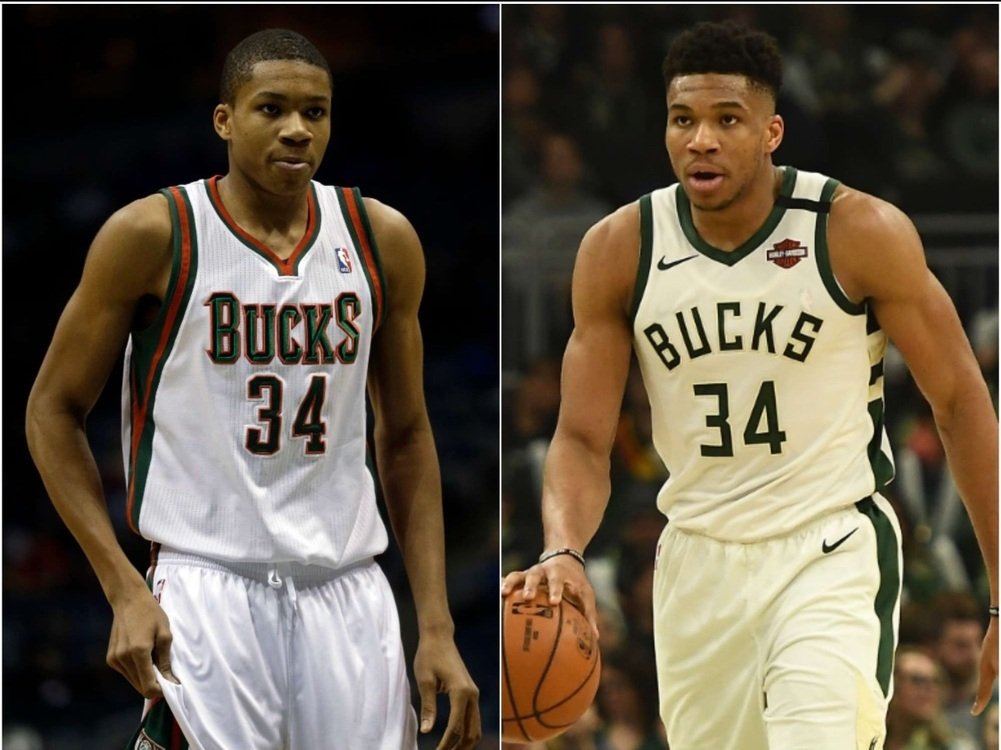
Giannis Antetokounmpo
Giannis Antetokounmpo was just 18 when Milwaukee drafted him in 2013. A draft-night Sports Illustrated profile listed him at 6’9” and 196 pounds. His exceptionally long arms were obvious, but they were much thinner than the muscular arms basketball fans would eventually become familiar with.
Interestingly, Giannis did not arrive knowing much about lifting weights. According to Mirin Fader, author of Giannis: The Improbable Rise of an NBA MVP, Bucks strength coach Robert Hackett had to teach him how to bench press, including where to place his hands on the bar.
There was also a reason he had so much filling out to do. Growing up in Greece, Giannis and his brothers shared food and shoes as their family struggled financially. Getting enough to eat was a more immediate concern than eating to build an NBA physique.
By September 2018, Milwaukee’s training-camp roster listed him at 242 pounds. This was approximately 46 pounds heavier than his reported draft weight. His later listing also put him at around 6’11”, compared with 6’9” at the draft. The change included growth as well as training, so it would be inaccurate to describe the entire weight increase as muscle.
Strength coach Suki Hobson later recalled personally supervising approximately 800 lifting sessions with him. That gives some idea of how much work went into the change. Looking at two photographs taken years apart, it is easy to forget how many times Giannis had to return to the gym between them.
His increasing strength also gave defenders another problem. Giannis already had the length to cover a surprising amount of ground with a few strides. As he became bigger and stronger, he could keep going when opponents made contact with him. His improving skill and decision-making were important as well, but he now had a body that made it much harder to stop him.
The teenager who needed someone to show him where to put his hands on a bench-press bar had become one of basketball’s most physically imposing players.
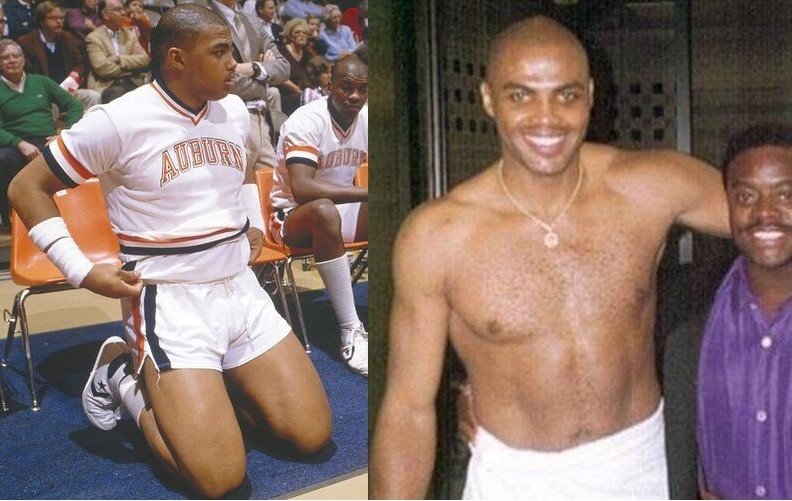
Charles Barkley
Charles Barkley was already an unusually powerful athlete when he entered the NBA. He could compete with much taller players and was surprisingly quick for someone carrying so much weight. However, the extra weight was becoming a problem.
By his own account, Barkley arrived in the league weighing close to 300 pounds.
He had not always been trying to lose it. By his own telling, Barkley deliberately gained weight before the 1984 draft because he wanted to discourage Philadelphia from selecting him. The Sixers picked him fifth anyway. He would now have to get into shape for the team he had tried to put off.
Moses Malone became an important part of that process. When Barkley asked why he was not getting more playing time, Malone told him he was overweight and not working hard enough.
That was probably not the answer the talented young player wanted to hear. However, Malone did more than point out the problem. He worked with Barkley before and after practice to help him improve his conditioning.
Barkley remembered losing the weight ten pounds at a time, progressing through 290, 280, 270 and 260 until he reached roughly 250–255 pounds. He gave the endpoint as 250 in one account and 255 in his interview with ESPN. Malone kept encouraging him to lose another ten rather than asking him to think about the whole amount at once.
Barkley later recalled trying an even lower weight of 240 pounds, only to find that he felt too weak. He went back up to around 250, which Malone identified as his playing weight. Losing more weight was no longer making him better. He still needed the strength that allowed him to establish position and rebound against bigger men.
Barkley did not have to become thin to get into excellent basketball shape. He needed to lose enough weight to keep moving comfortably without giving up the power that made him such an unusual player.
Years later, he continued to describe Malone as a father figure. The young Barkley had plenty of talent, but he was fortunate to have an experienced teammate willing to spend so much time helping him.
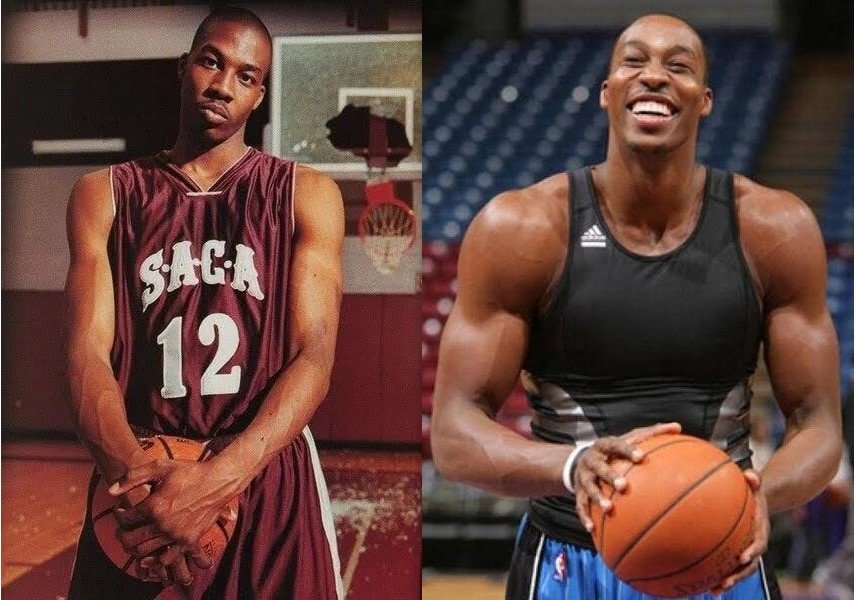
Dwight Howard
Dwight Howard was quite happy for people to notice his physical transformation. Before going out with friends, he would sometimes do 30 push-ups. He also liked wearing tight shirts that showed how much his upper body had developed.
“I used to be the skinniest person in the world,” he told Sports Illustrated, explaining why he now wanted to take his shirt off.
Howard was clearly exaggerating, but his early NBA photographs show what he meant. The teenager who arrived in Orlando had much narrower shoulders and thinner arms than the center who later became known for his enormous upper body.
A February 2005 Los Angeles Times profile described Howard as weighing 240 pounds when Orlando drafted him the previous summer. By September 2010, an Orlando team feature described him training at 275 pounds. This was an increase of roughly 35 pounds over six years, with a particularly noticeable difference across his shoulders, chest and arms.
Howard also came to enjoy lifting weights. It was more than something he had to do as part of being an NBA player. Sports Illustrated reported that he could bench press 225 pounds for 25 repetitions, which helps explain why he was so pleased with the results.
His training was not limited to getting stronger in conventional lifts. Performance coach Bryan Meyer described the aim as making Howard the best movement athlete possible. His exercises included single-leg work and demanding body-weight movements that challenged his balance, stability and control.
This was important for a player who still needed to jump, change direction and control his body while opponents leaned into him. Adding size would only be useful if Howard could continue moving effectively with it.
The change was especially obvious beside his rookie photographs. Howard was always tall and athletic, but much of the muscular body people remember developed during his Orlando years.
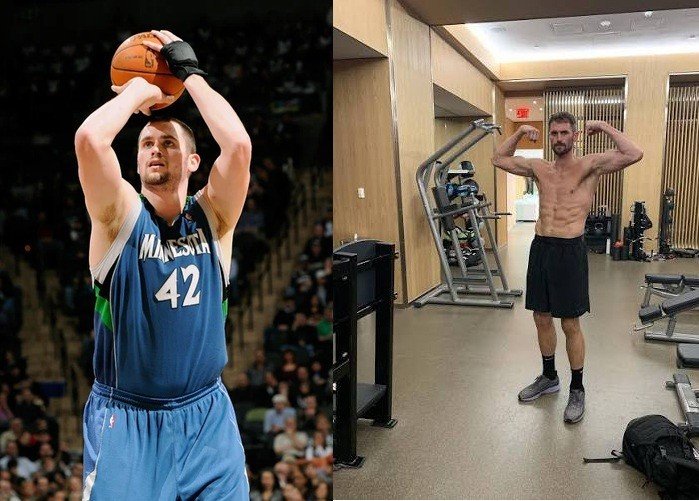
Kevin Love
Kevin Love was already an outstanding player before he became much leaner. His heavier frame had not stopped him from rebounding or scoring at an exceptional level.
However, he wanted to become more versatile. Facing big men such as Dirk Nowitzki helped him appreciate how difficult it was to defend someone who was comfortable both near the basket and farther out. Love wanted to develop more of that ability himself.
Yoga became part of his training routine, giving him another way to improve his balance, strength and endurance. He later spoke about how it helped him both on and off the court.
Love said he was 240–245 pounds in December 2011; the same report put his NBA-entry weight at 275–280. The Star Tribune’s 25-pound headline referred to his loss over that summer, not the full change since he entered the NBA.
The change was particularly noticeable in his face and upper body. The heavier youngster from his early Minnesota seasons had become considerably leaner. His game was developing too. In 2011–12, he averaged a then career-high 26 points. His three-point attempts rose from 2.9 per game in 2010–11 to 5.1, giving him a much larger role away from the basket.
Love would later discover that he could become too light. Looking back at photographs from his introduction to the Cavaliers, he felt he had taken the weight loss too far.
“I got too skinny,” he admitted.
He subsequently worked on adding size again. When he returned to Cleveland’s facility in 2016, Sports Illustrated reported him at a muscular 248 pounds.
Love needed to move comfortably on the perimeter while still being strong enough to compete for position inside. A lower number on the scales did not necessarily help him do both.
His early and later photographs show a remarkable difference, but finding the right physique involved more than simply losing weight. Even after becoming much leaner, he was still working out how much size suited his game.
Gordon Hayward
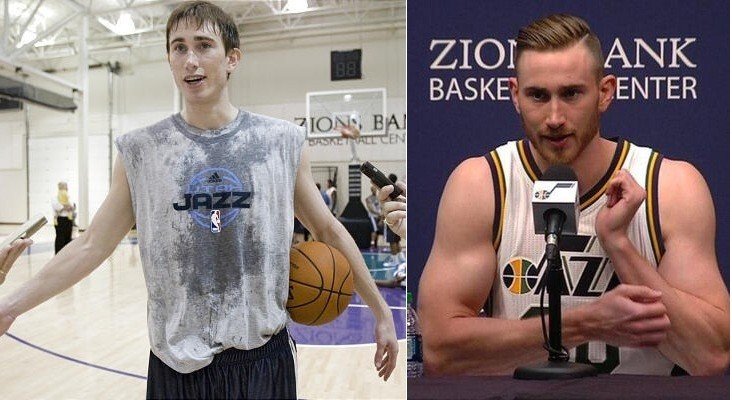
Gordon Hayward’s transformation became so noticeable that his arms were a talking point at Utah’s media day in 2015. Comparisons with his early NBA appearance prompted references to Captain America. His new haircut attracted some attention as well.
Hayward had an explanation for at least part of the change: “I got married. My wife has changed my appearance a bit.”
His wife may have helped with the appearance, but developing the body had taken several years of work.
Hayward was listed at 207 pounds when he entered the league in 2010. By December 2011, contemporary reporting put him at 220 pounds, following an offseason spent working on his body. He was already beginning to fill out, although the full difference would take longer to become apparent.
Trainer Greg Moore began working with Hayward as he prepared for the NBA. They continued building on that work over subsequent offseasons, focusing on strength that would help him on the court.
“I train him to be a basketball player, not a bodybuilder,” Moore explained. Hayward said the added strength helped him stay on balance and stand up to opponents more effectively.
Hayward also had to pay more attention to his food. He hired a chef for part of a season and became more focused on nutrition. Maintaining the weight through the demands of basketball was part of the work.
By July 2017, seven years after his 207-pound rookie listing, Boston listed Hayward at 226 pounds when announcing his signing. He had just completed his first All-Star season.
Kendrick Perkins
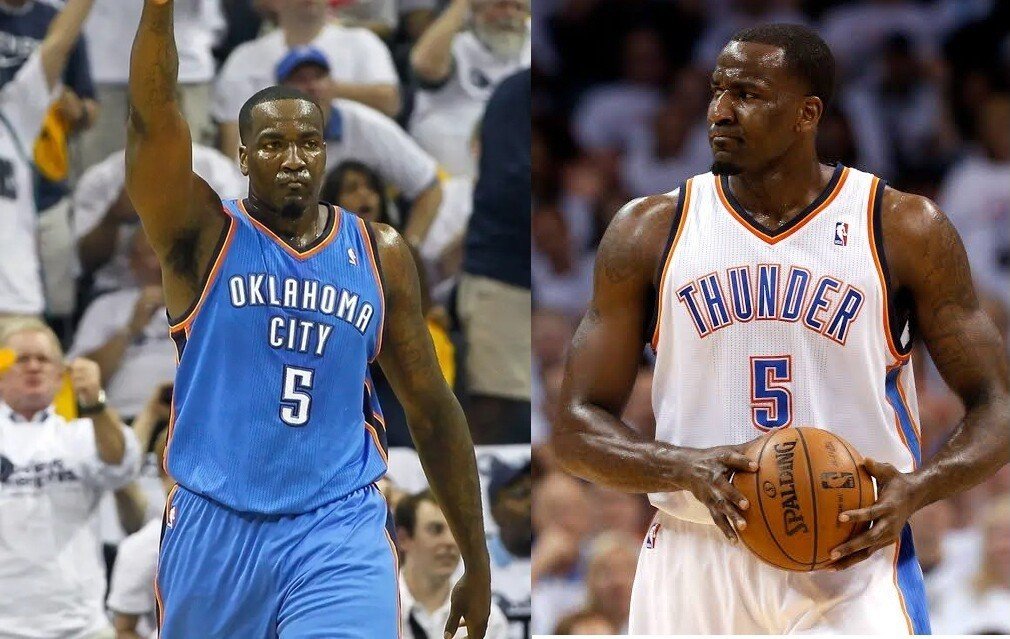
Danny Ainge’s office overlooked the Celtics’ weight room. One day, he noticed Kendrick Perkins standing shirtless in front of a mirror, looking at his own body. Perkins did not know anyone was watching. Ainge remembered how pleased the young player seemed with the results of his work.
There had been quite a bit to change. Perkins entered the NBA straight from high school in 2003, aged 18. Memphis drafted him 27th and traded him to Boston on draft night. Looking back on his first training camp, he recalled weighing around 320 pounds, with 24% body fat.
Boston gave him time to get into shape. He played just 35 minutes across ten games in his first season, with much of his time going into preparing his body. After being good enough to go straight from high school to the NBA, he was barely getting onto the court.
Perkins later admitted that it was difficult, but something he needed to do to get his career going.
By early 2006, the Celtics reported him at 260 pounds, following substantial fat loss over the preceding three years.
He was still a very big man, but his body had changed considerably from the one he brought into his first training camp.
His playing time began to change too. In his third season, Perkins made 40 starts, averaging 19.6 minutes and 1.5 blocks per game. He had become a regular part of Boston’s rotation.
When Kevin Garnett arrived, Perkins became his partner inside. He defended opposing centers, absorbed contact and set screens to help free Boston’s scorers, allowing Garnett to spend more time at power forward. In 2008, they won a championship together.
Perkins had gone from barely appearing as a rookie to starting for a championship team. Getting into shape had helped make that role possible. For other players, conditioning became a barrier to getting on the court at all. NBA players who had to lose weight to keep playing examines cases involving suspensions, delayed returns and attempts to earn another opportunity.
Anthony Davis
Davis had already undergone one major physical change before reaching New Orleans. His teenage development features among NBA growth spurts that changed careers; adding strength to that taller frame became his next challenge.
Anthony Davis liked pizza so much that Monty Williams joked that merely mentioning it would get his attention. His preferred order from Reginelli’s in New Orleans was a large with double pepperoni and double sausage. Despite this, putting weight on his slender frame remained a struggle during his rookie season.
A game against Carlos Boozer in February 2013 showed why the team wanted him stronger. Davis finished with 15 points and ten rebounds, but Williams was concerned by how easily the more experienced player could move him around.
For the time being, his advice was to use his quickness. Davis was not yet strong enough to overpower established NBA big men.
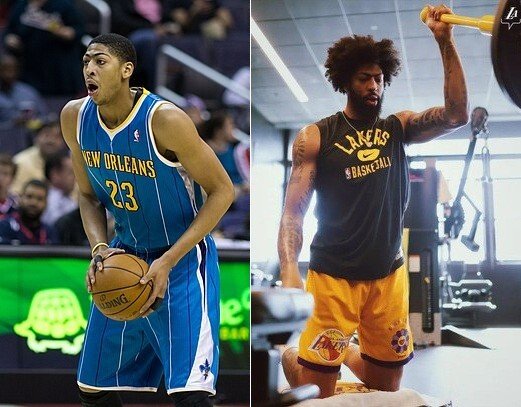
According to a subsequent Sports Illustrated profile, he had arrived in New Orleans weighing around 215 pounds. His length allowed him to contest shots that other players could barely reach, but holding his position against a heavier opponent was a different problem.
Carlos Daniel, the team’s director of athletic performance, helped him work on his strength. The program included squats, curls, bench presses and leg presses.
Davis also began to enjoy seeing the difference. He started arriving at the training room in sleeveless shirts and checking himself in the mirror as his body developed.
By his second season, he was better able to maintain his position inside. He still had the quickness to run past bigger players, but now had more strength when he needed to deal with their contact.
By August 2015, New Orleans reported him at 253 pounds, roughly 38 pounds heavier than his reported arrival weight three years earlier.
Davis had been conscious of the balance from the beginning. As a rookie, he explained that he wanted to hold his own without getting so big that he lost the things that had brought him to the NBA.
His later physique was considerably broader through the shoulders, chest and arms. He had always possessed exceptional length, but it was now accompanied by much more size and strength.
Wilt Chamberlain
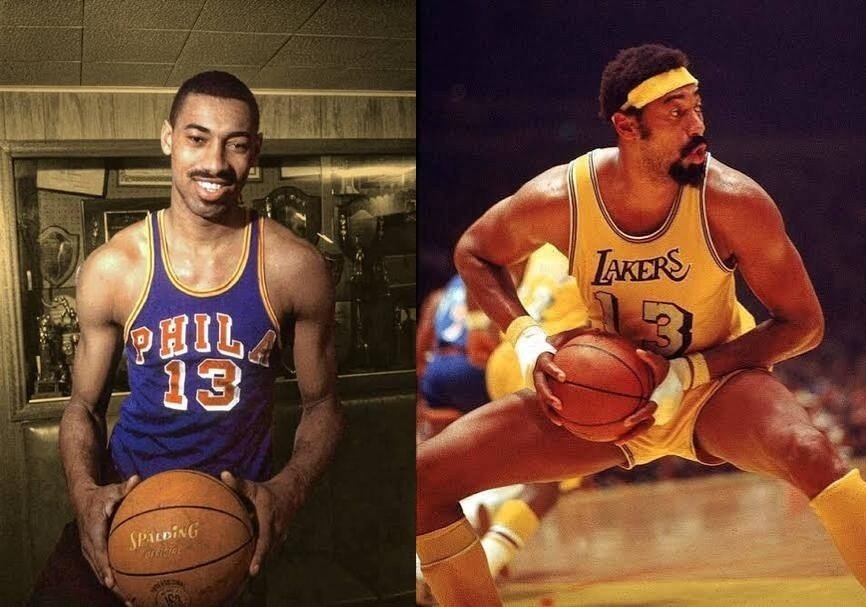
Wilt Chamberlain already stood 7’1” when he entered the NBA. ESPN puts his rookie weight at around 250 pounds, while NBA.com’s review of that season describes him as nearly 275 pounds. The historical accounts do not agree. He was exceptionally big even then. However, the young player in a Philadelphia Warriors jersey looked noticeably leaner than the much broader center who later played for the Lakers.
His size did not spare him a difficult introduction to the league. Opponents hit him hard, and the punishment contributed to him considering retirement after his first season. He responded in part by training with weights and developing an already powerful body further.
In a 1982 UPI interview later quoted by Sports Illustrated, Chamberlain recalled weighing approximately 300 to 305 pounds when he retired in 1973. His later size was substantial, but the conflicting rookie figures make a precise gain difficult to establish. These are historical accounts and a later recollection, rather than two recorded weigh-ins.
Arnold Schwarzenegger remembered training alongside Chamberlain at Gold’s Gym during his Lakers years. Even he was impressed by Wilt’s strength.
The two would later appear together in Conan the Destroyer. However, Chamberlain had already spent years developing his body while still playing basketball. His muscular physique was not something he acquired entirely after retirement.
The additional size had not stopped him from handling a remarkable workload either. In his final NBA season, aged 36, he played all 82 games, averaging 43.2 minutes and 18.6 rebounds.
Wilt was already unusually big and strong as a rookie. His later size developed over a long career; these figures do not tell us how steadily he gained it, or how much of the increase was muscle.
Honorable Mentions
These players also made notable changes. The main list emphasizes visible changes in physique; improved conditioning alone does not determine placement. Jokić’s progress, for example, stands out especially in what he could sustain on the court. Other entries have a less pronounced physical contrast or a starting point that is harder to establish.
Julius Randle
Julius Randle was already strong when he began working with trainer Amoila Cesar in 2017. Lifting heavier weights was therefore not the main priority. They focused more on his conditioning, agility and recovery.
Muscle & Fitness reported that he lost 17 pounds during his transformation. A more consistent meal plan accompanied the workouts, and the difference was particularly noticeable around his midsection. Randle still had his powerful frame, but it had become considerably leaner.
Victor Oladipo
After Oklahoma City’s first-round playoff exit in 2017, Victor Oladipo felt he was nowhere near the player he wanted to become. In May 2017, he went to Miami to work with trainer David Alexander and told him he wanted to be an All-Star.
According to Sports Illustrated, he arrived weighing 222 pounds and was down to 205 three weeks later after changes to his training and diet. His before-and-after photographs showed a noticeably leaner physique. His move to Indiana became official on July 6, after that work had begun, and he attended his first All-Star Game the following February.
Naz Reid
Naz Reid admitted that he had not paid enough attention to his diet as a younger player. Preparing for professional basketball made him take it more seriously, and he continued that work after Minnesota signed him.
He later described focusing on his food, weight training and conditioning, particularly the fitness needed to move laterally. He also spent summers working in Minnesota rather than always returning home to New Jersey. His transformation began before his NBA debut and continued afterward, so the starting point is less straightforward than those of the main entries.
Kyle Lowry
When a photograph of Kyle Lowry appeared online in August 2015, J.J. Redick had to ask whether it was really him. The familiar stocky guard had become noticeably leaner.
Lowry was 29 and wanted to play lighter after his performances dropped off during the second half of the previous season. His summer included early-morning hill runs, court sessions, weights and Pilates, along with changes to his meals. His trainer, Joe Abunassar, put his weight at a little over 190 pounds afterward.
De’Aaron Fox
De’Aaron Fox weighed 169.6 pounds at the 2017 draft combine. By September 2021, he said he was around 197 pounds, an increase of roughly 27 pounds.
The difference was visible in his shoulders, chest and limbs. Fox said gaining weight had initially been difficult, but became easier as he got older. He also felt stronger and more explosive without feeling weighed down, which was important for a player whose speed was such a large part of his game.
Nikola Jokić
One of Nikola Jokić’s early conditioning tests in Denver was a plank. He lasted about 20 seconds. Remembering it years later, he described himself shaking and telling the staff he could not continue.
ESPN reported that he arrived in 2015 at approximately 292 pounds. By the 2019 playoffs, he said his preferred playing weight was around 275–280 pounds, crediting Denver’s conditioning staff with helping him reduce body fat and develop strength. During those playoffs, he played nearly 65 minutes in a four-overtime game against Portland. That was quite an improvement for someone who had struggled so much with a plank.
The Transformations, by the Numbers
The reported weights help show how much these players changed. The figures come from team listings, contemporary reporting and players’ recollections, so they should be treated as approximate weights at particular points in their careers.
| Player | Starting point | Later point | Approximate change | Evidence behind the weights |
| Giannis Antetokounmpo | 196 lb, 2013 draft | 242 lb, 2018 camp | Gained 46 lb | Sports Illustrated draft profile; team roster reported by Eurohoops |
| Charles Barkley | Close to 300 lb, 1984 arrival | About 250–255 lb after early conditioning work | Lost roughly 45–50 lb | Barkley’s accounts to Club Shay Shay, Cigar Aficionado and ESPN |
| Dwight Howard | Around 240 lb, 2004 draft | 275 lb, September 2010 | Gained roughly 35 lb | Los Angeles Times profile; Orlando Magic feature |
| Kevin Love | Entry weight reported as 275–280 lb, 2008 | Self-reported 240–245 lb, December 2011 | Lost roughly 30–40 lb | Star Tribune entry-weight report and later self-report; change covers 2008–11, not one summer |
| Gordon Hayward | Listed at 207 lb, 2010 | Listed at 226 lb, July 2017 | Gained 19 lb | Utah rookie listing; Celtics signing announcement |
| Kendrick Perkins | Recalled about 320 lb at first camp, 2003 | Reported at 260 lb, early 2006 | Lost roughly 60 lb | Perkins’s recollection; Celtics feature |
| Anthony Davis | Arrival weight reported as 215 lb, 2012 | Reported at 253 lb, August 2015 | Gained roughly 38 lb | Sports Illustrated profile; Pelicans feature |
| Wilt Chamberlain | Conflicting rookie reports: about 250 lb (ESPN); nearly 275 lb (NBA.com) | Recalled 300–305 lb at retirement, 1973 | Exact gain uncertain | Conflicting retrospective accounts; 1982 UPI recollection quoted by SI |
These figures show changes in total body weight. They do not tell us exactly how much muscle the players gained or how much fat they lost. Listed weights may be rounded or left unchanged as a player’s body develops, and recollections are not recorded weigh-ins. The comparisons cover different lengths of time and should not be taken as targets for another player or reader.
A Different Starting Point
Giannis needed help learning to lift weights. Barkley needed someone to tell him he was carrying too much weight and then help him lose it. Perkins spent most of his first NBA season preparing his body so he could play more than a few minutes.
It is easy to forget these beginnings when we are so familiar with how the players looked later in their careers.
For a skinny youngster struggling to fill out a jersey, or someone trying to improve their conditioning, those earlier versions might look more familiar. NBA players have access to resources most people do not, and there is no guarantee of getting the same results. However, even these extraordinary athletes had to work with the bodies they started with.
Voted “Someone else”? Tell us who—and what stood out about their transformation—in the comments.
Sources
- Wisconsin Life: The Humble Superstar – Mirin Fader interview
- ESPN: How Moses Malone mentored a young Charles Barkley
- Sports Illustrated: Dwight Howard – The happy dunker
- Sports Illustrated: The Biggest Stop of Kevin Love’s Life
- Salt Lake Tribune: Gordon Hayward bulks up for new season
- Boston Celtics: High Definition – Perkins’ body and game
- Sports Illustrated: The rapid rise of Anthony Davis
- Sports Illustrated: When the Cavaliers made a run at Wilt
- Sports Illustrated: Victor Oladipo’s first All-Star Weekend
- ESPN: Inside Nikola Jokić’s first postseason