
The famous story says Cliff Young shocked ultrarunning because he did not know he was supposed to sleep. The surviving race record tells a more interesting story: the awkward-looking farmer was already an accomplished endurance athlete, and his famous victory was only one part of an extraordinary career.
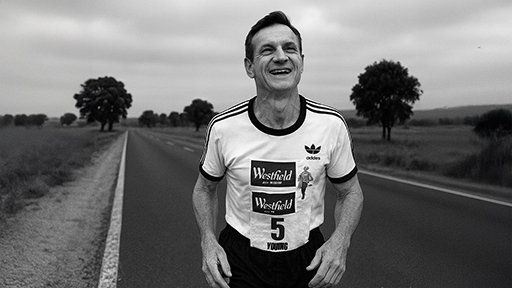
Twenty minutes into the race that would make him famous, Cliff Young was going the wrong way.
The 61-year-old Australian farmer had become separated from the other runners in Sydney traffic and headed off course. George Perdon, one of the men he was supposed to be racing, spotted him and called him back.
Young turned around.
Five and a half days later, Young would win, and Perdon would finish second.
Almost everything about Young seemed wrong for a serious ultramarathoner. He was 61. He was a potato and sheep farmer from Victoria. He was known for training in gumboots. And when he ran, he did not really look like he was running.
He shuffled.
His steps were short and low, his feet barely appearing to leave the road. Beside younger, more conventional runners, Young looked painfully slow.
Then he won the approximately 875-kilometre Sydney-to-Melbourne ultramarathon in 5 days, 15 hours and 4 minutes.
The runner-up arrived almost 10 hours later.
Australia fell in love with the old farmer who had somehow beaten the ultrarunners. Over the decades, an irresistible explanation grew around the victory: Young was so inexperienced that nobody had told him ultramarathoners were supposed to sleep. While the professionals stopped each night, the farmer simply kept shuffling.
It is a wonderful story.
It also hides something far more interesting.
Cliff Young was already an accomplished endurance athlete.
The trouble with the familiar explanation is not only what Young had done before Sydney-to-Melbourne. It is what he kept doing afterward. The deeper you look at his career, the harder it becomes to reduce him to folklore.
A Three-Hour Marathoner Behind the Shuffle
A contemporary masters-athletics report credited Young with an approximately 2:58 marathon at the 1981 World Veterans Games in Christchurch, when he was around 59. ABC, however, reports that Young ran the Melbourne Marathon every year from 1979 through 1982 and gives his personal best as 3:02:53 at age 58.
Those two claims cannot both describe his career best. If the reported 2:58 at Christchurch is accurate, it would be faster than the 3:02:53 ABC identifies as his personal best. Because the official Christchurch result sheet has not been located, the 2:58 is best read as a contemporary reported result rather than a verified personal best.
What the disagreement does not change is the broader point: Young was a roughly three-hour marathoner approaching 60.
His appearance had been misleading people for years. At the inaugural Melbourne Marathon in 1978, Young turned up in Fletcher Jones dress trousers and a thick woollen jumper. He then easily won his age group.
It would become a recurring pattern. Young frequently looked less like an athlete than the people around him.
The stopwatch kept disagreeing.

Twenty-Five Days Earlier, He Won a 100-Mile Race
On April 2, 1983, Young ran 100 miles at Manly in 14 hours, 37 minutes and 54 seconds. Contemporary National Masters News reporting says he won the annual 100-mile track race, beating fellow Sydney-to-Melbourne entrant Joe Record.
That works out to roughly 5:27 per kilometre for 160.9 kilometres.
It was not even his first major performance at the distance. The previous year, Young had completed 100 miles in 14:46:00.
At 61, Young won a 100-mile race in 14:37. Twenty-five days later, he started Sydney-to-Melbourne.
Months Before, He Had Tried to Run 1,600 Kilometres
In late 1982, only months before Sydney-to-Melbourne, Young attempted a 1,600-kilometre record at Memorial Square in Colac.
The inscription on the Cliff Young Track memorial records 800 kilometres in 8 days, 4 hours and 46 minutes, including a 500-kilometre split of 3 days, 16 hours and 20 minutes.
A history published by the Sri Chinmoy Marathon Team puts his eventual distance at approximately 500 miles, roughly 805 kilometres. In other words, the surviving accounts broadly agree on how far Young travelled.
They differ principally on why he stopped.
The Sri Chinmoy history attributes the end of the attempt to a back injury. A December 1983 National Masters News report attributes the end of Young’s 1982 attempt to summer heat of around 90°F.
What is not in doubt is the experience. Before Sydney-to-Melbourne, Young had already spent days pursuing an extreme-distance target and failed to complete it.
The familiar story makes inexperience part of the explanation for victory. Young’s earlier attempt suggests a different possibility: he arrived with experience of failure over several days.
We cannot know exactly what he learned from it. We can say that Sydney-to-Melbourne was not his first encounter with multiday endurance.
Two Cliff Youngs
Young did not suddenly emerge from a farm and discover that he could run forever. Before Sydney-to-Melbourne he had raced marathons and ultramarathons, produced major 100-mile performances, attempted a 1,600-kilometre challenge and accumulated enormous training volume.
Some people in Australian ultrarunning knew this. Tony Rafferty had raced Young before and understood that the farmer was dangerous. Rafferty later recalled being almost certain Young would finish and thinking the race might come down to the two of them.
A contemporary National Masters News report found perhaps the perfect description for Young:
the “dark horse.”
Young was not the obvious favourite, but neither was he an athletic nobody stumbling into an unfamiliar sport. His appearance made him easy to dismiss. His results made that dismissal increasingly difficult.
Two versions of Cliff Young were already separating in 1983. One was a roughly three-hour marathoner, accomplished ultrarunner and veteran of an attempted 1,600-kilometre challenge. The other was the 61-year-old farmer in odd clothing whose shuffle looked hopelessly slow beside conventional runners.
The second version offered the cleaner underdog story. It became the version most often repeated.
Young’s training makes that split even harder to sustain. The nearest major town, Colac, was about 40 kilometres from his home in Beech Forest, and ABC reports that Young thought little of running there and back. That meant an approximately 80-kilometre round trip simply to reach town and return home. Accounts also describe him running through the wet Otways in gumboots.
A contemporary National Masters News report went further. It reported that fellow ultrarunner Joe Record had spent the preceding three months running as much as 300 miles per week with Young, roughly 483 kilometres.
That extraordinary figure should be treated cautiously because detailed training logs independently confirming sustained 300-mile weeks have not surfaced. The exact mileage is uncertain, but that Young trained extensively is not.
The enduring public image was the farmer. The race history reveals how much that image left out.
An Experienced Field
Even Young’s age had been tested before organisers allowed him into Sydney-to-Melbourne. Westfield executive Martin Noonan was sent to assess whether a 61-year-old could safely attempt the race. Noonan, then 27, later recalled running with Young for about three hours and increasing the pressure on a hill, only to find Young still beside him.
Noonan remembered his reaction:
“This is an outlier.”
The field itself included experienced ultradistance and transcontinental runners, among them George Perdon, Tony Rafferty, Siegfried Bauer, John Hughes and Joe Record.
Contemporary National Masters News coverage described Perdon as a transcontinental runner who had covered 2,800 miles at an average of 62 miles per day, while Rafferty had covered 3,400 miles at 40 miles per day.
This was not a field of people discovering extreme endurance for the first time. The supposedly naïve farmer was racing people who already understood it.
The First Night Changed the Race
On April 27, 1983, Young set off from Westfield Parramatta at 10:30 a.m. His early wrong turn had already cost him distance, but it soon became the least consequential mistake of his opening day.
Accounts describe Young falling and damaging his shoulder early in the event. After running for almost 13 hours, he stopped at about 11:30 p.m. and went to sleep.
Then somebody woke him too early.
David Hill’s reconstruction gives Young’s own version: he was awakened believing it was 5:30 a.m., headed back onto the road and only afterward learned that it was actually about 2:30 a.m.
He returned to the race while many rivals were still sleeping. By the time the mistake became obvious, he had gained valuable distance. Going back to bed would simply surrender it, so he kept moving.
Tony Rafferty later summarised the consequence for the men chasing him in an interview for ABC’s Australian Story:
“That was the finish of the sleep for all of us.”
That line gets closer to the strategic significance of the episode than the familiar claim that Young discovered ultrarunners did not need sleep. Experienced multiday runners already understood that less time stopped could mean more distance covered.
What Young changed was the competitive price of rest.
Hill’s reconstruction estimates that Young stopped to rest for about 12 hours in total across the 5-day, 15-hour race. The estimate is approximate, not a verified accounting of every stop.
Even so, the tactical problem was obvious. Rivals could rest longer and recover better while losing distance, or sleep less and chase while accepting the physiological cost. The objective was neither maximum speed nor minimum sleep. It was the greatest sustainable progress.
Some rivals initially expected Young’s approach to become unsustainable. If it was, chasing him would only waste energy.
Except he kept moving.
And the first-night accident did not simply carry him to Melbourne.
Young slept again. While he rested, Joe Record, who had trained with him before the race, moved ahead. The accidental advantage was gone.
Young woke, discovered what had happened and went after him.
He caught Record.
He moved ahead again.
This time, he was not caught.
That sequence matters because it shows why the familiar sleep story is incomplete. The premature awakening altered the strategy of the race. It did not explain five and a half days of performance.

Five Days, 15 Hours and 4 Minutes Later
Young reached Melbourne in the early hours of May 3 in 5 days, 15 hours and 4 minutes.
The strange farmer who had begun the race by heading in the wrong direction had won it.
Contemporary Victorian Marathon Club reporting lists George Perdon second in 6 days, 1 hour, a difference of 9 hours and 56 minutes.
When an ABC reporter asked Young how he felt at the finish, his answer contained none of the mythology that would later surround the performance.
“Blistered. And stiff.”
Was it the worst he had ever felt?
“Yeah.”
There was nothing effortless about the victory. Young arrived blistered, stiff and physically spent.
But the humility should not be mistaken for a lack of competitive ambition. David Hill quotes Young much more directly:
“I run to win.”
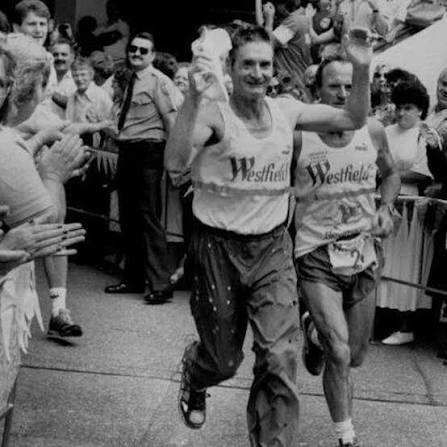
Faster Runners Kept Losing to Him
John Connellan was a 2:35 marathoner. Young was roughly a three-hour marathoner. At conventional marathon distance there was little mystery about which man possessed more speed.
Yet Connellan’s Sydney-to-Melbourne ended on day four. Charlie Lynn, a member of his support team, wrote that Connellan stopped at Tumblong after approximately 373 kilometres and just over three days.
Marathon speed and multiday performance were not the same thing.
George Perdon showed another version of the same problem. Contemporary Victorian Marathon Club reporting observed that Perdon could travel at a much faster rate than Young, yet could not recover the hours lost earlier in the race.
Perdon finished second.
Young won.
Looking back on Connellan’s attempt, Lynn recalled one of the team’s conclusions:
“We train to run fast for an hour; they train to run all day.”
The source matters here. Lynn was writing from the perspective of someone involved with Connellan’s support team, not as a detached historian. His webpage is dated August 9, 1983, although biographical material on the page was clearly updated much later. The observation is therefore best treated as Lynn’s first-person account rather than relying on the webpage date to establish when every part of the text was written.
Across several days, raw running speed was only one component of race performance. Time spent moving, rest, fuelling, pacing, physical deterioration and the ability to finish all entered the calculation.
The athlete who could run a marathon faster was not necessarily the athlete who would reach Melbourne first.
The Modern Question: Durability
Sports science traditionally gives enormous attention to what an athlete can do while relatively fresh: VO₂ max, running economy, lactate threshold and maximum sustainable speed.
In a 2021 review in Sports Medicine, Ed Maunder and colleagues argued that endurance profiling should also account for durability: the timing and magnitude of deterioration in physiological characteristics during prolonged exercise.
Two runners who look similar while fresh can therefore look very different after hours of accumulated work. Sustainable speed, thresholds or running economy may not deteriorate at the same rate from one athlete to another.
The historical record does not contain the measurements needed to assess Young’s physiological durability. His performances make it a compelling question, not an explanation we can establish.
The question is especially interesting because Young’s movement began from such an unusual place. His shuffle looked inefficient beside a fresh, faster runner. But Sydney-to-Melbourne did not end while anyone was fresh.
After several days, the relevant comparison was no longer Young’s awkward stride against another athlete’s best stride. It was Young’s exhausted movement against whatever remained of everyone else’s.
What the race shows is that Young kept making forward progress while faster athletes lost time, stopped or failed to finish. In a multiday event, avoiding one disastrous episode can be worth more than producing several spectacular hours.
An ultramarathon eventually asks not only how much performance you can produce, but how much you can keep.
Chris Nikic’s first Ironman presented a different endurance challenge: after swimming 2.4 miles and cycling 112, he still had to sustain enough movement to complete a marathon inside the race’s cutoff.
The Career Did Not End in Melbourne
Young’s Sydney-to-Melbourne victory could have been dismissed as a perfect convergence of tactics and circumstance. His subsequent career made that harder.
In November 1985, at 63, Young covered 235.969 kilometres in 24 hours. Surviving sources agree on the distance but differ on the exact November date.
In 1987, at 65, he covered 197.115 kilometres in 24 hours at Box Hill. In November 1992, at 70, he covered 653.6 kilometres in six days at Colac. In February 1993, at 71, he covered 171.65 kilometres in 24 hours at Coburg and finished third overall.
And in 1999, at 77, he covered 147.487 kilometres in 24 hours at Coburg. More than a quarter-century later, AURA’s December 2025 age-group table still listed that performance as the Australian M75 24-hour record.
The distances themselves tell the story. At 77, Young was still capable of covering nearly 150 kilometres in a day.
His six-day performances show the same extraordinary longevity. In 1984, at approximately 62, Young covered 749.6 kilometres at Colac. Fifteen years later, at 77, he returned and covered 492.4 kilometres.
These are selected performances, not a complete inventory of Young’s races. They document athletic longevity, not the physiological mechanism behind his Sydney-to-Melbourne victory.
What they establish is simpler: Young remained an unusually capable ultrarunner deep into old age.
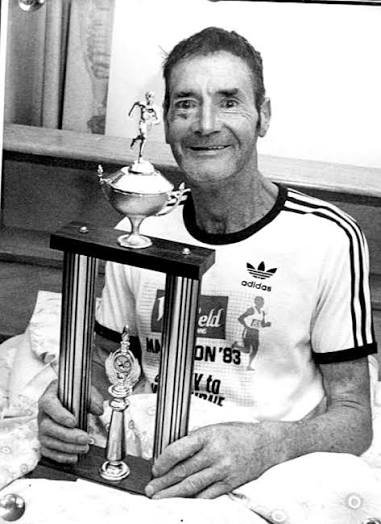
Cliff Young Across the Years
| Year | Age | Performance |
| 1981 | ~59 | Marathon — ~2:58 reported in contemporary masters source |
| 1982 | 60 | 100 miles — 14:46:00 |
| 1983 | 61 | 100 miles — 14:37:54, 1st |
| 1983 | 61 | Sydney–Melbourne — 1st |
| 1984 | 62 | Six days — 749.6 km |
| 1985 | 63 | 24 hours — 235.969 km |
| 1987 | 65 | 24 hours — 197.115 km |
| 1992 | 70 | Six days — 653.6 km |
| 1993 | 71 | 24 hours — 171.65 km, 3rd overall |
| 1999 | 77 | 24 hours — 147.487 km |
| 1999 | 77 | Six days — 492.4 km |
He Won A$10,000 and Wanted to Share It
Young’s victory came with an A$10,000 winner’s cheque.
What happened to every dollar is less clear than the legend sometimes suggests. Contemporary National Masters News reporting said Young and Joe Record had made a pre-race pact to share the prize if either man won. Other accounts describe Young distributing money more broadly among runners who were still on the road.
Archival footage leaves little doubt about the underlying impulse. At the finish, when asked about the prize, Young immediately talked about creating prizes for the other runners and making sure the finishers received something.
After spending five and a half days trying to beat them, Young wanted the other runners to share in the reward.
Beyond the Legend
The famous story gives us a farmer who won because he did not understand the sport. The available record gives us something considerably harder to reduce to folklore: an experienced competitor whose career extended far beyond one astonishing week. Athletic legends often preserve the version of a person that makes the cleanest story, and in Young’s case the image of the naïve farmer made a cleaner story than the experienced ultrarunner.
We cannot reconstruct Young’s physiology from the stopwatch. We can reconstruct the athlete the legend obscured.
Cliff Young did not stop being a farmer when he became a serious ultrarunner.
The mistake was assuming he could not be both.
Sources and Historical Notes
This article was researched using contemporary race reporting, archival interviews, historical results databases, sports-science literature and later reconstructions of Cliff Young’s career. Young’s career predates modern online results databases, and the surviving record is not perfectly consistent. Sources disagree on his exact marathon best, the reason his 1982 1,600-kilometre attempt ended and the precise date of his 235.969-kilometre performance in November 1985. Where those differences materially affect the story, they are identified rather than silently resolved.
Selected Sources
Victorian Marathon Club, Road Runners Newsletter, 1983
Contemporary Sydney-to-Melbourne reporting. Used for Young’s winning time, George Perdon’s runner-up time and the contemporary assessment that Perdon could travel faster than Young but could not recover the lost hours.
Jack Pennington, National Masters News, July 1982
Used for Young’s early masters and ultradistance background, including his early 100-mile performances.
Jack Pennington, “Australian Veteran ‘Shuffles’ To National Fame,” National Masters News, 1983
Contemporary reporting used for the approximately 2:58 Christchurch marathon, the “dark horse” description, the credentials of the Sydney-to-Melbourne field, Young’s victory in the 100-mile race shortly before Sydney-to-Melbourne, the reported training involving Joe Record and the pre-race prize-sharing pact.
National Masters News, December 1983
Used for the account attributing the end of Young’s 1982 1,600-kilometre attempt to approximately 90°F summer heat.
Greg Hassall and Stephen Peters, ABC News / Australian Story, “Potato farmer Cliff Young shuffled his way into Australian folklore at 61,” March 2025
Used for Young’s Melbourne Marathon history and 3:02:53 personal best, the Fletcher Jones dress trousers and age-group victory, the Beech Forest-to-Colac training runs, Martin Noonan’s assessment, Tony Rafferty’s recollections and sleep quote, Connellan’s marathon ability and other archival material surrounding the 1983 race.
ABC, Australian Story, “Born to Run | Cliff Young,” March 2025
Archival footage and interviews with Young and people involved in the race. Used particularly to cross-check the finish and Young’s comments about the A$10,000 prize.
David Hill, The Fair and the Foul, Penguin Books Australia, published extract
Used for the 10:30 a.m. start, Young’s 11:30 p.m. first stop, mistaken 2:30 a.m. awakening, the later Joe Record chase, the estimate of approximately 12 total hours of rest and Young’s statement, “I run to win.”
Charlie Lynn, “Cliff Young: Australia’s Most Humble Hero Ever”
A first-person account by a member of John Connellan’s support team. Used for Connellan’s withdrawal at Tumblong after approximately 373 kilometres and Lynn’s recollection that conventional distance runners trained “to run fast for an hour” while ultrarunners trained “to run all day.” The webpage is dated August 9, 1983, but contains biographical material added decades later, so it is not treated here as an untouched contemporary document.
Sri Chinmoy Marathon Team, “The History of the 1,000 Mile Race — from 1758 to 1986”
Used for the account that Young’s 1982 solo 1,000-mile attempt ended at approximately 500 miles because of a back injury.
Cliff Young Track memorial, Colac
Used for the 1982 1,600-kilometre attempt, including the recorded 800-kilometre distance and intermediate split.
Australian 100 Mile Track Rankings
The historical ranking document records Young at Manly on April 2, 1983, in 14:37:54. Contemporary National Masters News reporting independently describes Young as the winner of the race.
Australian Ultra & Trail Runners’ Association, Age Group Records – Men, December 2025
Used to cross-check Young’s later age-group performances. The table still lists his 147.487 kilometres at Coburg on May 9, 1999 as the Australian M75 24-hour record.
DUV Ultra Marathon Statistics and compiled historical results
Used to cross-check Young’s later ultramarathon performances, including his Colac six-day results and individual 24-hour performances.
Ed Maunder, Stephen Seiler, Mathew J. Mildenhall, Andrew E. Kilding and Daniel J. Plews, “The Importance of ‘Durability’ in the Physiological Profiling of Endurance Athletes,” Sports Medicine, 2021, 51(8): 1619–1628.
Used for the discussion of durability as the onset and magnitude of deterioration in physiological-profiling characteristics during prolonged exercise. DOI: 10.1007/s40279-021-01459-0.