
Some became smaller, others heavier, and some retained their muscular builds. Dated comparisons reveal individual stories that a simple before-and-after photograph cannot explain
At a reported 244 pounds, Alistair Overeem was still answering questions about looking small. That gives some idea of the heavyweight fans remembered.
Vitor Belfort’s reduced muscular fullness became a recurring talking point. Rashad Evans eventually walked around below the limit he once cut weight to reach. Quinton “Rampage” Jackson moved in the other direction, arriving for a heavyweight fight at 265 pounds. Meanwhile, Yoel Romero and Tyron Woodley retained imposing muscular physiques.
These comparisons draw on dated photographs, contemporary reporting, weigh-ins and firsthand accounts. They describe appearance across particular periods, not measured muscle loss. Photographs alone cannot establish drug use or explain a physical change.
The UFC’s USADA-administered testing program ran from July 1, 2015, through December 31, 2023. The comparisons here span roughly 2012–21: some changes began before that date, while others occurred after retirement or outside the UFC. USADA’s arrival is a reference point, not a common explanation.
Age, diet, injuries, camp demands and photographic conditions all affect what a comparison can show.

Vitor Belfort
Comparison: Belfort’s middleweight appearances in 2013, particularly before the Luke Rockhold fight, against his 2015–16 middleweight appearances.
In the year he turned 36, Vitor Belfort had the kind of run most fighters would happily take at any age. He stopped Michael Bisping, Luke Rockhold and Dan Henderson in 2013, with head kicks featuring in all three finishes—including the spinning heel kick that knocked out Rockhold. The speed was still there. So was the power. His muscular physique completed the picture.
Belfort remained recognizably athletic, but his later appearances showed less of the muscular fullness that had made him look so imposing. This was more than a different haircut or an unflattering photograph. His changing appearance became a recurring subject of coverage, with comparisons following him through the next several years.
For a fair comparison, his middleweight appearances against Bisping and Rockhold are more useful than his larger light-heavyweight appearance against Jon Jones. By 2017, Combate had assembled a photographic record of his changing physique using official portraits and event photographs. The difference had become a story of its own.
Belfort’s timeline also starts earlier than the official USADA launch. He had used testosterone replacement therapy with therapeutic-use exemptions for earlier fights in Brazil. In his own account, he had not formally applied for a Nevada exemption when tested in February 2014; he later disclosed that the result was above the therapeutic range. The Nevada State Athletic Commission voted to ban TRT exemptions that month, and Belfort said he stopped treatment the same day. By October, his former wrestling coach Kenny Monday was already discussing the physical change.
“His physique did change quite a bit,” Monday acknowledged, while maintaining that Belfort’s strength had stayed the same. Monday suggested water retention had contributed to the difference, although that was his assessment rather than a measurement of Belfort’s body composition.
The smaller Belfort remained dangerous. In November 2015, Belfort faced Henderson again and finished him in the first round, once more landing a head kick before the stoppage.

Alistair Overeem
Comparison: Overeem’s larger heavyweight physique in early 2013 against his smaller appearance during his 2016 title-challenge year.
Overeem explained his smaller physique through the demands of a different kind of fight. During his K-1 days, he had prepared for three rounds of three minutes. A five-round MMA contest could require 25 minutes of striking, clinching, wrestling and getting back to his feet.
In a May 2016 social-media post, he addressed the comments about his reduced size. Once, he had wanted to be “as strong as possible.” Now, he wrote, the aim was to be “as small as possible.” He reported weighing 244 pounds.
The earlier Overeem had carried a combination of muscular size and definition that stood out even among heavyweights.
Overeem’s testing history is also relevant context. In 2012, Nevada recorded a testosterone-to-epitestosterone ratio of 14:1, above its then-permitted 6:1 threshold. The commission denied his licence application and set a nine-month waiting period before he could reapply. That decision belongs in his timeline, though it does not establish the cause of his later change in size.
The change had also been developing for longer than a simple before-and-after-USADA caption might suggest. In August 2013, MMA Fighting was already describing a softer physique than the one he had previously presented. His appearance continued to change across the following years, into the period when the new testing program was operating.
By September 2016, Overeem weighed 248.5 pounds for his UFC title challenge against Stipe Miocic. That was still heavyweight size, but the figure on the scale did not recreate the muscular appearance fans associated with his earlier years.
His results had remained formidable. His stoppage of Andrei Arlovski in Rotterdam was his fourth consecutive win before the Miocic title challenge. The smaller Overeem was still capable of beating leading heavyweights—even while people were asking what had happened to the larger one.

Erick Silva
Comparison: Silva’s muscular UFC appearances in 2014 and early 2015 against his appearance for the Neil Magny fight in August 2015.
Erick Silva’s changing physique was being discussed before his fight with Neil Magny had even become a memory.
“Silva definitely looks very different physically,” Kenny Florian wrote during the August 2015 event. Other fighters noticed too, and before-and-after comparisons were circulating that night. The Brazilian who had built a reputation for explosive finishes suddenly looked different enough to become a talking point alongside the action.
Earlier appearances had shown a muscular, sharply defined welterweight. Against Magny, Silva looked softer and less full. He was still competing in the same division, making the comparison more direct. This was not a heavyweight appearing smaller after moving down two weight classes.
Silva did not dispute that his body had changed. In an October interview with Combate, he acknowledged entering the fight in a substantially different condition from his usual one. He also described how quickly the situation had developed.
He said he had been strong and well prepared for a June booking that was postponed when his opponent was injured. Silva then suffered an injury himself, leaving him unable to maintain his normal preparation for the rearranged fight.
No public measurement established how much muscle Silva had lost. Nor does his appearance explain his defeat. Magny won a split decision; Silva’s physique was a separate, conspicuous part of the evening’s discussion.
By October, Silva had undergone surgery on his right elbow and begun rehabilitation. He told Combate that he already looked more in shape than he had for the Magny fight.

Johny Hendricks
Comparison: Hendricks’s stocky, muscular physique in 2013–14 against his smaller appearance at UFC 200 in July 2016.
Johny Hendricks did not need a bodybuilder’s waist to look powerful. His thick torso, broad shoulders and wrestling build suited a fighter who could send opponents backwards with one left hand. After facing him in 2013, Georges St-Pierre offered a rather straightforward description: “He hits like a truck.”
There was considerable work behind that power. Strength coach Adrian Ramirez described heavy lifting three times a week between camps, followed by circuit training as fights approached. The aim was to build someone who could physically challenge St-Pierre throughout five rounds. Ramirez said Hendricks had been exceptionally strong before they even started working together.
By July 2016, the contrast with that familiar physique was attracting attention. At UFC 200, Hendricks appeared smaller and less muscularly full than the welterweight fans remembered from his championship run. Contemporary comparisons placed his earlier stocky frame beside his newer appearance.
But there had been another stage between those photographs.
In January 2016, Hendricks had attracted attention for looking unusually lean and defined. Following the weight-cutting emergency that had cancelled his fight with Tyron Woodley the previous October, he hired nutritionist Louis Giordano and changed how he managed his weight.
MMA Fighting reported that, about two weeks before his February 6, 2016 fight with Stephen Thompson, Hendricks was walking around in the low 180s. The outlet described his recent photographs as showing a shredded physique—a substantial departure from his previous approach of arriving at fight week with much more weight left to lose.
That sequence makes Hendricks’s transformation more interesting than a single comparison suggests. The thickly built title contender, the sharply defined fighter photographed in January, and the smaller-looking figure at UFC 200 were different stages of a changing physique.
The January photographs matter here. Becoming smaller initially made him look more defined; his later appearance drew attention for looking flatter. Putting all his 2016 photographs under one “after” label would miss the difference.
His earlier approach involved a reported outside-camp weight of approximately 210 pounds, placing him among 17 of the biggest weight cuts by UFC fighters when compared with the welterweight limit.

Junior dos Santos
Comparison: Dos Santos’s muscular heavyweight physique in 2012–14 against his substantially slimmer appearance in April 2020.
Junior dos Santos posted a photograph in April 2020 that had people wondering whether the heavyweight division was about to lose a former champion.
He looked considerably smaller. The broad, muscular figure fans remembered had given way to a leaner silhouette, prompting speculation about a move to light heavyweight. MMA Mania’s coverage compared his new appearance to a taller José Aldo—a rather different association for someone who had spent years fighting the UFC’s biggest men.
Dos Santos reported weighing 238 pounds, down from the 247 he had weighed for his fight with Curtis Blaydes that January. He was still comfortably heavyweight-sized. The photograph nevertheless suggested a much greater departure from his familiar appearance than those nine pounds alone might lead someone to expect.
His physique had attracted attention in the opposite direction years earlier. Ahead of his December 2012 rematch with Cain Velasquez, his muscular appearance was prominent enough to become an interview topic. That version of dos Santos provides a useful contrast with the much slimmer man who appeared during the 2020 lockdown.
The later change began with something quite ordinary: he had gained unwanted weight while unable to follow his usual training routine. He contacted his doctor and nutritionist, who recommended a short ketogenic diet. The results attracted enough attention that he subsequently discussed both his new physique and the possibility of fighting at 205 pounds.
His immediate ambition was more modest. He wanted to remain around 238–242 pounds and felt that carrying less weight would suit the movement and speed his boxing depended on.
“My goal is to stay light,” he explained.
The light-heavyweight speculation went further than his actual plans. Dos Santos said making 205 would be extremely difficult, although the prospect of facing Jon Jones interested him. For the moment, the former champion was preparing to remain a heavyweight.
Rashad Evans
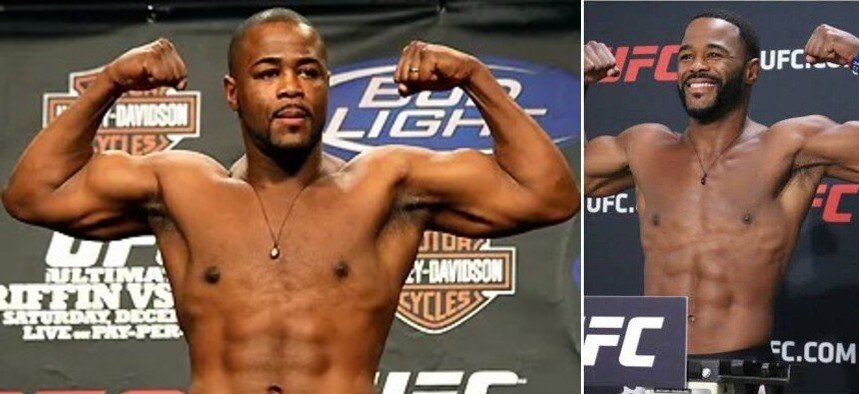
Comparison: Evans’s muscular light-heavyweight physique in 2012–14 against his much smaller appearance in 2019–20, after retirement.
Rashad Evans had spent years preparing to get down to 205 pounds. By February 2020, he said he was walking around at approximately 200.
For someone who remembered the thickly muscled former light-heavyweight champion, that was quite a change. Evans had carried a powerful upper body, with the shoulders and arms of a wrestler accustomed to moving other men against their wishes. The later version looked substantially lighter, with much less of that familiar bulk.
During his conversation with Joe Rogan, Evans recalled previously walking around at 225–230 pounds. His new everyday weight was below the limit of the division in which he had won his UFC championship. This was no temporary weigh-in appearance before an overnight recovery. He was describing the size he now maintained.
Evans had already acknowledged the transformation publicly in September 2019, while considering a return to fighting.
“I changed my diet after I retired, and it’s drastically changed my body and how I feel,” he said.
By the following February, he was discussing his plant-based diet and the difference he felt in training. He described having more energy and being able to sustain longer sessions. The smaller body surprised people who remembered his fighting years; Evans himself sounded pleased with it.
That distinction gives his story a different character from some of the others here. The loss of muscular size was conspicuous, but he did not describe himself as physically diminished.
It also belongs to a specific stage of his life. The strongest contrast comes after his 2018 retirement, several years into the USADA era. Comparing his 2012–14 appearances with those from 2019–20 captures that substantial change without suggesting he suddenly shrank when testing began.
Quinton “Rampage” Jackson
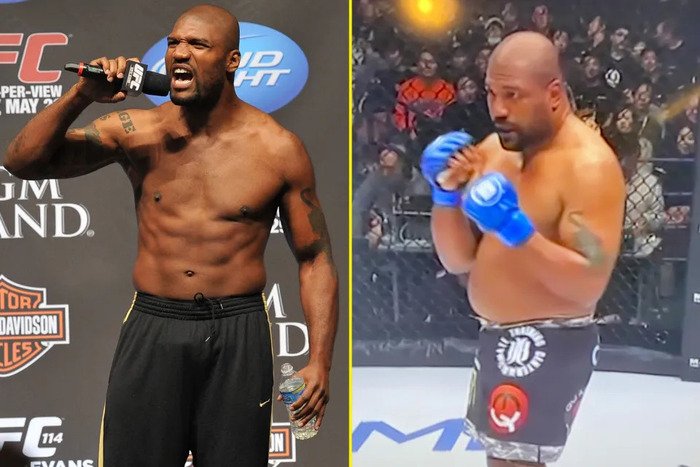
Comparison: Jackson’s light-heavyweight appearance in 2013–14 against his heavyweight physique for the Fedor Emelianenko fight in December 2019.
By December 2019, Rampage Jackson weighed 265 pounds for a heavyweight fight with Fedor Emelianenko. The comparison spans promotions: both Lawal fights and the later heavyweight appearances were in Bellator, with one UFC bout in between.
The former light heavyweight had carried thick arms, powerful shoulders and a muscular frame that suited his reputation for strength. Against Fedor, he presented a heavier, softer physique.
The change had unfolded across several appearances. Jackson weighed 205.9 pounds for his May 2014 fight with Muhammed Lawal, 216 pounds at the UFC 186 weigh-in for his April 2015 return against Fabio Maldonado, a bout contracted at 215 pounds, and 253 pounds for the Lawal rematch in March 2017. A contemporary photographic comparison documented those increasingly heavy versions of the same fighter.
There was also a medical issue in the background. In June 2016, Jackson disclosed that he had been diagnosed with an underactive thyroid. He described gaining weight rapidly between fights and said returning to light heavyweight might require substantial changes to his lifestyle and eating habits.
“If I don’t stay on top of it, I gain weight really fast,” he explained.
By the Fedor fight, the contrast with his earlier competitive physique was unmistakable. This was the body he brought into a professional contest, rather than an offseason photograph taken months before preparation began.
Fedor stopped him in the first round. Afterwards, Jackson made his own dissatisfaction clear: he wanted to lose weight and leave heavyweight behind.
“I’ve got to lose this weight,” he said.
Another Notable Change: Gleison Tibau
Comparison: Tibau’s heavily muscled lightweight appearances in 2012–15 against his January 2018 return.
Gleison Tibau had the sort of build that made the lightweight label seem surprising. His thick torso and muscular arms belonged to a fighter who routinely looked enormous for the division.
When he returned in January 2018, he was carrying less weight. A UFC feature explicitly noted the physical change, and Tibau described a practical difference: on the Wednesday before a fight, he previously would have needed to lose approximately 22 pounds (10 kg). This time, he said, he had about 11 pounds (5 kg) remaining.
He had changed his eating habits during his absence and could now eat regular meals during fight week instead of severely restricting food. That account supports a lighter starting point, although it does not tell us how much muscle he had lost.
His absence followed a two-year USADA suspension for EPO use, which he admitted. The suspension is part of his timeline, not an established explanation for his 2018 appearance. His comeback preparation was also troubled: he later disclosed a fractured left hand and torn right biceps before facing Islam Makhachev. Those injuries make that particular appearance a less straightforward comparison than it might initially seem.
The clearest change was the one Tibau himself described. He was still making the lightweight limit, but no longer beginning the final days of preparation with the same amount of weight to remove.
Not Everyone Lost Their Muscular Physique
Yoel Romero offered a conspicuous contrast. Years after USADA’s arrival, he still carried the thick shoulders, muscular torso and sharply defined build that had made him stand out earlier in his UFC career. A 2018 Sherdog profile described his imposing physique as one of his defining features. He was already past 40.
His testing history must be considered separately: in 2016, Romero accepted a six-month USADA sanction after testing positive for ibutamoren. USADA confirmed that a supplement he used had been contaminated with the substance. Retaining a muscular physique says nothing conclusive about an athlete’s testing record.
Tyron Woodley remained another familiar example. The broad, heavily muscled welterweight did not undergo the same visible reduction in size described in several profiles above. In March 2021, almost six years after the testing program began, his muscular condition was still attracting coverage ahead of his fight with Vicente Luque.
Their appearances help put the other transformations in perspective. There was no uniform physical change across the UFC after July 2015. Some fighters became substantially smaller, some carried more weight, and others retained their familiar muscular builds.
Nor did appearance neatly predict results. Overeem earned a heavyweight title shot during his smaller years. Evans described feeling better in a much lighter body after retirement. Woodley still looked physically imposing during a difficult stretch of his career.
The photographs reveal striking differences in physique. They cannot, by themselves, explain a fighter’s health, performance or drug-testing history.
The Changes at a Glance
| Fighter | Earlier period | Later period | Main physical contrast |
| Vitor Belfort | 2013 middleweight appearances | 2015–16 middleweight appearances | Reduced muscular fullness and definition |
| Alistair Overeem | Early 2013 heavyweight appearances | 2016 title-challenge year | Smaller, less heavily muscled appearance |
| Erick Silva | 2014–early 2015 | August 2015, against Neil Magny | Softer appearance with less muscular fullness |
| Johny Hendricks | 2013–14 championship period | July 2016, at UFC 200 | Smaller, flatter-looking physique; distinct from his leaner January 2016 appearance |
| Junior dos Santos | 2012–14 heavyweight appearances | April 2020 | Substantially slimmer silhouette |
| Rashad Evans | 2012–14 light-heavyweight appearances | 2019–20, after retirement | Much smaller overall build; reported everyday weight fell from 225–230 to around 200 pounds |
| Quinton “Rampage” Jackson | 2013–14 light-heavyweight appearances | December 2019, against Fedor | Considerably heavier, softer competitive physique |
| Shorter mention: Gleison Tibau | 2012–15 lightweight appearances | January 2018 return | Lighter build and a smaller reported fight-week weight reduction |
Familiar Faces, Different Bodies
For fans, a fighter’s physique can become a visual marker of an era: Belfort’s 2013 run, Overeem’s heavyweight rise, Evans’s championship years. Later photographs can jar because they challenge an image preserved by those performances.
The individual accounts are more revealing than a single “before” and “after.” Evans described feeling better in a lighter body. Overeem explained that his priorities had changed. Other comparisons involved disrupted camps, retirement or weight gain.
The USADA era did not produce one kind of body. These fighters’ appearances changed on different timelines, and the photographs cannot supply one explanation for them all.
Which fighter’s physical transformation surprised you most? Share your choice in the comments.
Sources
- Testing context: USADA’s announcement of the July 2015 program; confirmation that its UFC agreement ended in December 2023; Belfort’s statement and released 2014 test results; Overeem’s 2012 Nevada licence decision; USADA’s 2016 Romero sanction and confirmed supplement contamination.
- Belfort: Combate’s dated photographic comparison, 2009–17; Kenny Monday’s contemporary assessment, October 2014.
- Overeem: His explanation of his smaller physique, May 2016.
- Silva: Combate interview addressing his changed condition, October 2015.
- Hendricks: MMA Fighting’s January 2016 interview on his new nutrition approach; archival July 2016 physique comparison.
- Dos Santos: April 2020 photograph and reported 238-pound weight; MMA Fighting interview about the diet and his plans.
- Evans: September 2019 remarks on his physical transformation; February 2020 conversation with Joe Rogan.
- Jackson: Dated weigh-in photograph comparison, 2014–17; 2016 disclosure of his thyroid diagnosis; 265-pound Fedor appearance and post-fight remarks.
- Tibau: UFC’s January 2018 return interview; MMA Fighting’s June 2018 interview about his suspension and comeback injuries.
- Contrasting physiques: Sherdog’s 2018 Romero profile; Woodley’s March 2021 training-camp appearance.