

A failed physical, lost starting jobs and enforced weight targets: these players reached a point where their size raised serious questions about their football futures
Deuce Lutui had agreed to join the Cincinnati Bengals. The offensive lineman had years of NFL experience behind him and a two-year deal ahead of him. Then came the physical. ESPN reported that he weighed 381 pounds. He failed the physical, and the agreement fell apart.
Being big had helped him reach the NFL. Getting too big had just cost him a job.
Teams value size, but they also need movement, endurance and availability. An offensive lineman needs enough strength and mass to withstand powerful defenders, but he still has to move his feet and keep working as the game wears on. A running back can become harder to tackle as he gets bigger, until the extra weight starts taking away the quickness that made him dangerous.
For the players below, the concern reached beyond an unflattering photograph or a few offseason pounds. Teams imposed weight targets, restricted participation, attached money to conditioning requirements or looked for someone else to fill the position. Some players responded and rebuilt their careers. Others found that getting back into shape did not necessarily mean getting their old opportunities back.
The reported weights come from contemporary coverage, team accounts and player recollections, rather than consistent measurements. Injuries and difficult periods away from football also feature in several stories. Those circumstances matter when explaining how the weight accumulated—and what it took to lose it.

Deuce Lutui: The Contract That Disappeared
Guard | Arizona Cardinals
By December 2011, Deuce Lutui was experiencing something unfamiliar: watching his team’s offense from the sidelines.
“This is the first time I have seen football on game day as a spectator on any level,” he said. “I’ve always been a starter.”
A few months earlier, he had expected to be starting somewhere else.
After the Cincinnati agreement collapsed, Lutui returned to Arizona, where coach Ken Whisenhunt warned that patience with his conditioning would be limited.
The financial difference was substantial. According to the Cardinals’ own reporting, Cincinnati’s deal was worth more than $8 million, including $5 million in 2011. His replacement agreement in Arizona paid $950,000 for one year. Instead of an anticipated starting position, he was behind Rex Hadnot.
Lutui sought help from a mental coach as he worked on managing his weight. By December, Whisenhunt praised his consistency after an earlier period of weekly struggles.
But improving his condition had not restored his place. When Arizona published its account on December 21, Lutui had yet to play an offensive snap that season.
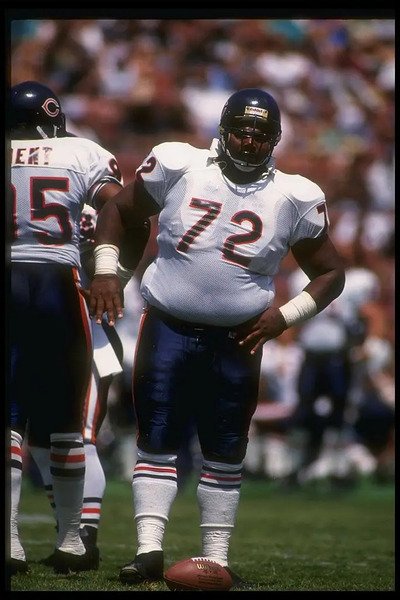
William “Refrigerator” Perry: When the Bears Stopped Laughing
Defensive tackle | Chicago Bears
William Perry’s size helped make him famous. Here was a defensive lineman big enough to earn the nickname “Refrigerator,” yet athletic enough for Chicago to hand him the ball near the goal line. During the Bears’ Super Bowl season, watching him line up in the backfield was part of the entertainment.
A few years later, his weight was a much more serious conversation.
By May 1988, Perry weighed approximately 375–377 pounds. Mike Ditka wanted a substantial reduction before training camp. In July, just before training camp, Perry entered treatment for what the Bears publicly described as an eating disorder.
The team said Perry had chosen treatment with its agreement. Ditka, whose public exchanges with him could be confrontational, struck a different tone.
“It’s not a laughing matter,” he said. “His health is very important.”
Treatment did not settle the problem permanently. UPI reported that Perry began the following year’s training camp around 330 pounds, then reached as much as 360 during the season. Chicago had already tried fines. His 1989 contract omitted weight-loss incentives as the organization tried a less pressurized approach.
By December 1989, Ditka was issuing another ultimatum:
“He’ll weigh 300 pounds or he will not put on a Bear uniform.”
Yet the coach also acknowledged how much Chicago still needed him. After a knee injury sidelined Perry, Ditka said the run defense was worse without him, regardless of his weight.
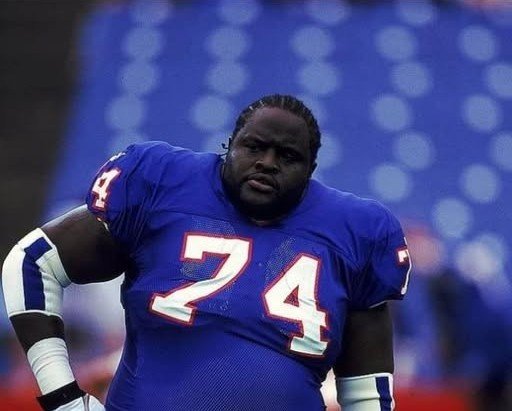
Jamie Nails: A Season Out of Football
Guard | Buffalo Bills and Miami Dolphins
Jamie Nails earned $525,000 with Buffalo in 2000. After Miami released him during the following preseason and no other team picked him up, he worked as a high school assistant coach for $3,500. Even waiting three hours for a doctor’s appointment reminded him that the preferential treatment he had enjoyed as a professional player was gone.
His weight had prompted Miami’s decision. A year later, he returned approximately 50 pounds lighter, at 335 pounds.
Nails already knew what it took to hold a starting position: he had started all 16 games for Buffalo in 2000. Now he needed to convince the Dolphins to trust him with one.
By the summer of 2002, ESPN reported that Miami’s coaches considered him their most improved player. The opportunity became a starting job at left guard, where he started 14 games that season and another 15 the following year.
The year away stayed with him. Speaking in 2003, Nails warned that younger players often did not appreciate how abruptly their careers could end.
“I don’t think a lot of guys here are prepared for life after football,” he said.
He had been given a second chance by the same team that released him. In between, he had experienced what happened when an NFL salary—and the life attached to it—disappeared.
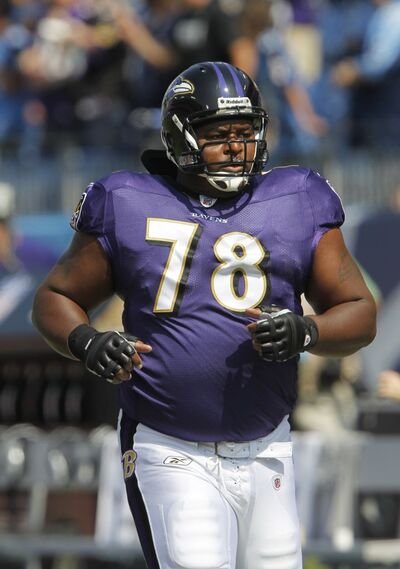
Bryant McKinnie: Too Heavy to Practice
Offensive tackle | Minnesota Vikings and Baltimore Ravens
Bryant McKinnie traced his weight gain during the 2011 lockout to late nights in a recording studio. While overseeing sessions for his music label, he ate late and let his football preparation slip.
When Minnesota released him that August, reports put him close to 400 pounds. McKinnie disputed that figure, although he acknowledged being substantially heavier than his usual playing weight.
Baltimore gave him another opportunity. But changing teams did not end the scrutiny of his conditioning. In June 2012, the Ravens kept him out of minicamp practices to concentrate on conditioning. Other linemen took the first-team repetitions while he worked separately.
His ability remained valuable. McKinnie eventually started all four games of Baltimore’s championship postseason, helping stabilize the offensive line when the stakes were highest.
Then he returned for training camp in July 2013—and was kept out of the first full-team practice because he was too heavy.
“Bryant is just too heavy right now,” John Harbaugh said. “He needs to lose weight.”
The coach acknowledged that McKinnie had worked hard and had good cardiovascular fitness. He still was not comfortable putting him on the field at that weight.
McKinnie returned the following day, but could not finish practice. He participated in team drills before spending much of the second half watching from the sideline. Harbaugh said the extra weight, combined with the heat, had made the session difficult.
Only months earlier, McKinnie had helped Baltimore win a Super Bowl. Now he was trying to get through an entire practice.

Mike Williams: The 111-Pound Comeback
Offensive lineman | Buffalo Bills and Washington
In August 2009, The Washington Post reported that Mike Williams had lost 111 pounds over six months, bringing him down to 339 pounds.
He was still an enormous offensive lineman. But he was finally approaching a size at which an NFL comeback looked possible.
Williams had been Buffalo’s fourth overall draft pick in 2002. When Washington gave him another opportunity in 2009, he had not played a regular-season game since 2005. His largest weight gain had happened during that absence from football.
Washington’s September account covered a different window: around 400 pounds in April and 337 by September. Those reports use different starting dates and should not be read as one standardized series of weigh-ins. Losing the weight was only part of the challenge. He also had to show that he could withstand training camp and still move defenders.
An abdominal injury and an ankle sprain interrupted his preseason. He appeared in only two exhibition games, leaving him uncertain whether he had done enough to survive the final cuts.
When he played, however, the power was still there. Washington executive Vinny Cerrato praised his ability to move opponents off the ball and highlighted a 50-snap performance against Jacksonville.
Williams made the roster as a backup right tackle.
“To lose 100 pounds and have a team take a chance on you—I just came in and showed them that I wanted to be here and I wanted to work,” he said.
The comeback brought him nine appearances and eight starts in 2009: five at right guard and three at right tackle. After years without a regular-season appearance, he was back doing the job that had once made him a top-five pick.
Other players changed their physiques to meet different positional demands, including Lorenzo Alexander’s move from defensive tackle to linebacker, featured in the most remarkable NFL body transformations.

Craig “Ironhead” Heyward: A Running Back With a Lineman’s Weight
Running back | New Orleans Saints, Chicago Bears and Atlanta Falcons
Craig Heyward could make being unusually heavy look useful. He was a powerful runner and blocker, capable of making defenders regret getting in his way. Saints executive Jim Finks once called him the best blocking back in the league.
But there was a considerable difference between the size that made him difficult to tackle and the weight he sometimes carried into an offseason.
A New York Times News Service account described fluctuations from 250 pounds to as much as 340. Heyward later spoke openly about nights of heavy drinking followed by large meals, sometimes arriving at practice only hours afterward. His conditioning problems were part of a wider struggle.
Chicago tried putting a financial incentive in front of him. His reported 1993 agreement included a $200,000 annual bonus for meeting accepted weight levels.
Heyward rushed for 206 yards for Chicago that season. A year later, playing for Atlanta, Heyward rushed for 779. Contemporary reporting described him dropping from 328 pounds to 265 after giving up alcohol.
The improvement continued. In 1995, he rushed for 1,083 yards, averaged 4.6 yards per carry and earned a Pro Bowl selection.
Heyward still brought plenty of size to the position. What changed was how much weight he carried while doing the running. After years of arguments about his condition, his best rushing season came with Atlanta in his eighth NFL season.

Karlos Williams: Other Backs Took His Place
Running back | Buffalo Bills
Karlos Williams finished his rookie season with nine touchdowns, tying Sammy Watkins for Buffalo’s team lead. By the following August, the Bills had released him.
He arrived overweight for the team’s June 2016 minicamp, then began training camp on the active/non-football illness list. ESPN later reported, citing a league source, that his weight had reached 261 pounds during the offseason; that figure was not identified as his minicamp arrival weight. While his teammates practiced, he spent the first two weeks working separately with the strength and conditioning staff to lose weight and rebuild his stamina.
His old role did not stay empty. Mike Gillislee and rookie Jonathan Williams took the repetitions behind LeSean McCoy, while Buffalo also added veteran Reggie Bush.
On August 15, Karlos Williams passed his physical and was cleared to return. Five days later, the Bills cut him.
He was also facing a four-game suspension for violating the NFL’s substance-abuse policy. That was a separate problem, but it added to an offseason in which a promising young player had fallen behind his competition.
General manager Doug Whaley described the release as a performance decision.
“He came in behind the eight ball and never caught up,” Whaley said.
Other running backs had used those weeks of practice to move ahead of him. Clearance to return did not settle the competition for his role.
Karlos Williams later joined Pittsburgh’s practice squad, but never played another NFL regular-season game.
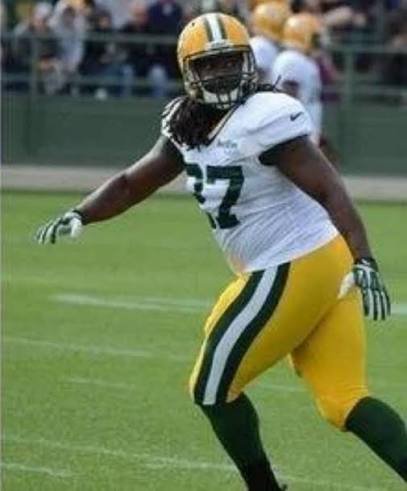
Eddie Lacy: “He Cannot Play at That Weight”
Running back | Green Bay Packers and Seattle Seahawks
Eddie Lacy had already shown Green Bay what he could do as a big running back. He rushed for more than 1,100 yards in each of his first two seasons, combining power with enough quickness to make defenders miss.
Then came 2015. His rushing total fell to 758 yards, his workload declined, and James Starks spent stretches ahead of him on the depth chart.
When the season ended, Mike McCarthy publicly addressed his conditioning.
“His offseason last year was not good enough and he never recovered from it,” the coach said. “He cannot play at the weight he played at this year.”
Lacy responded with an offseason that included P90X workouts, basketball and boxing. By May 2016, he looked lighter, although he declined to discuss specific numbers.
The aim was to preserve what made him effective while improving his burst and ability to sustain it.
“I’m always going to be big, just lighter,” Lacy said.
He found the online discussion of his body annoying, but accepted that the coach’s criticism required a response. Entering the final year of his rookie contract, he had plenty at stake.
The financial stakes became explicit in Seattle in 2017. His Seahawks contract included seven potential weight bonuses totaling $385,000. In May, his agent reported a 253-pound weigh-in, below the 255-pound target and worth $55,000.
Those later numbers do not establish his exact playing weight in 2015. They show how the concern that McCarthy voiced eventually became a set of contractual checkpoints.

Dontari Poe: Size Dallas Wanted, Weight It Would Not Accept
Defensive tackle | Dallas Cowboys
When Dallas agreed to terms with Dontari Poe in March 2020, its own website welcomed the arrival of a 346-pound nose tackle. The Cowboys wanted someone who could occupy space in the middle of their defensive line.
Seven games later, they released him. Jerry Jones identified excess weight and disappointing performance as reasons for the decision.
Poe was “30 pounds overweight,” Jones told ESPN. He did not specify the target behind that comparison; the earlier 346-pound listing does not establish Poe’s weight at his release.
Poe had already encountered financial incentives to manage his weight. In Carolina, his contract offered $125,000 payments for meeting scheduled targets, including a requirement to weigh 330 pounds or less at several checkpoints. Similar provisions had appeared in his Atlanta agreement.
Dallas gave the two-time Pro Bowl selection a starting position, but the expected impact did not follow. By his final game, defensive tackle Justin Hamilton—recently promoted from the practice squad—played more snaps than he did.
The Cowboys were making wider changes to a struggling defense, also parting with Daryl Worley and Everson Griffen that week. Poe was not its only problem. But his weight was one the owner explicitly named when explaining why his opportunity had ended.
Dallas had signed him to a two-year deal. His stay lasted seven games.
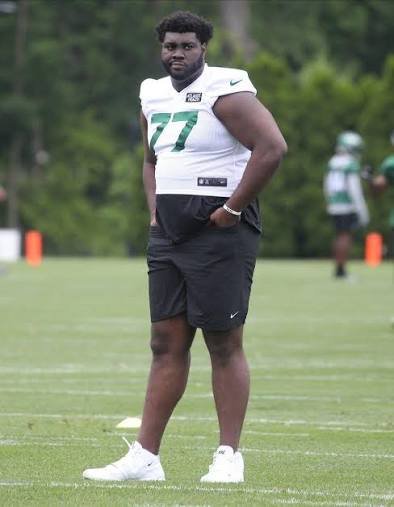
Mekhi Becton: Getting Back From 400 Pounds
Offensive tackle | New York Jets
Mekhi Becton was already 363 pounds when he entered the NFL. At 6-foot-7, he possessed a combination of size and movement that helped make him the 11th pick in the 2020 draft.
The concern came when his weight climbed further during a long, difficult absence from football.
A knee injury in the 2021 opener began a period of rehabilitation, another knee injury and another operation. Across the 2021 and 2022 seasons, he missed 33 of the Jets’ 34 games. His weight reached approximately 400 pounds, and ESPN reported that the team privately questioned his football future.
Behind the criticism was a player struggling with the isolation and frustration of being injured. Former teammate Cameron Clark became an important source of support.
Clark encouraged Becton to change his agent and training arrangements, then moved to New Jersey to help him daily. The Jets hired Clark as a player-development intern, allowing that support to continue inside the team facility. Their work included strength training, nutrition and film study.
By training camp in 2023, Becton was approximately 350 pounds, his lightest since college.
He still had to rebuild confidence in his knee and earn his place. But he won a starting job and went on to start 16 games that season.
There were uneven performances along the way. For someone who had spent almost two full seasons unable to play, however, staying on the field was an achievement in itself.
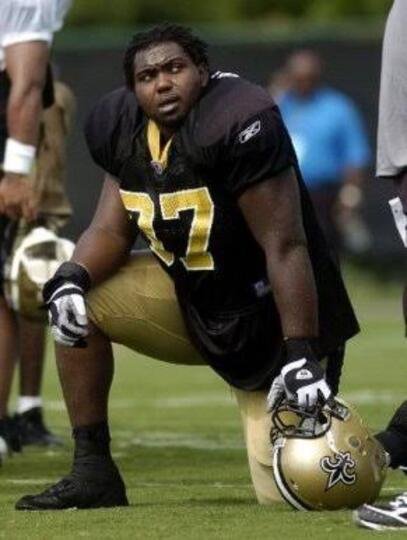
Johnathan Sullivan: Lose the Weight, Regain the Job
Defensive tackle | New Orleans Saints
New Orleans invested heavily in Johnathan Sullivan, trading up to select the Georgia defensive tackle sixth overall in 2003.
By his second preseason, he was trying to recover a starting position he had already lost.
Sullivan arrived out of shape in 2004 and was demoted. A contemporary news item made the requirement clear: he would not start until he lost weight.
The problem persisted beyond that summer. A June 2006 report by Times-Picayune writer Mike Triplett described Sullivan struggling with fatigue during minicamp. Sullivan said he weighed 328 pounds, an improvement from earlier levels of 350–355. His roster-listed weight was 315.
The reduction offered some encouragement, but the new coaching staff still had concerns about his preparation. New Orleans traded him to New England that month.
Sullivan’s difficulties included more than conditioning. His attendance and performance also drew criticism, so weight alone cannot explain every lost opportunity. What distinguishes his case is that getting lighter had been explicitly connected to regaining his place in the starting lineup.
After three seasons with the Saints, Sullivan was traded to New England. The Patriots released him in October 2006.
Weight Clauses and Comeback Attempts
Gilbert Brown
Brown’s size helped make him an important part of Green Bay’s defense. Managing it was another matter. After spending the 2000 season out of football, he worked with former college strength coach Fred Roll and returned to camp in 2001 at approximately 339 pounds. His foundation’s account describes him recovering some of his earlier quickness. His return illustrates the distinction at the heart of these cases: a large playing body could still benefit from better conditioning.
Trent Brown
New England put a substantial price on meeting weight targets. Brown’s contract offered up to $750,000 in weight bonuses in each of 2022 and 2023, with scheduled checkpoints. That is a concrete example of a team making weight management part of a player’s earnings, without establishing the same kind of lost playing opportunity seen in the main profiles.
JaMarcus Russell
Russell’s clearest documented weight-reduction effort came during his attempted comeback. Yahoo reported that he had reached 320 pounds in late 2012. By June 2013, he was reportedly back at 265 and received a workout with Chicago. It did not produce a place at training camp. His playing-career weight reports were disputed, so the later comeback provides a firmer basis for discussing the problem.
When Weight Changed the Opportunity
These figures describe different points in different careers. They are not standardized measurements or estimates of fat gained.
| Player | Reported weight concern | Team intervention or consequence |
| Deuce Lutui | Reported at 381 lb in 2011 | Failed Cincinnati’s physical; agreement collapsed |
| William Perry | Approximately 375–377 lb in May 1988 | Entered treatment; faced repeated weight targets and fines |
| Jamie Nails | Returned approximately 50 lb lighter, at 335 | Miami released him in 2001, then brought him back in 2002 |
| Bryant McKinnie | Substantial gain during the 2011 lockout; exact figures disputed | Released by Minnesota; later restricted from practicing in Baltimore |
| Mike Williams | Around 400 lb in April 2009; 337 by September | Rebuilt his condition and earned a Washington roster spot |
| Craig Heyward | Reports describe fluctuations reaching 340 lb | Chicago attached a substantial bonus to weight requirements |
| Karlos Williams | ESPN reported an offseason high of 261 lb in 2016; minicamp arrival weight not specified | Worked separately before passing his physical; subsequently released |
| Eddie Lacy | Playing weight challenged after 2015; 253 lb at a May 2017 Seattle weigh-in | Seven potential Seattle weight bonuses totaling $385,000; earned $55,000 at the May checkpoint |
| Dontari Poe | Jones described him as 30 lb overweight | Dallas released him after seven games, citing weight and performance |
| Mekhi Becton | Approximately 400 lb during rehabilitation | Team concern and an intensive comeback effort; returned around 350 |
| Johnathan Sullivan | Reported 328 lb in 2006, down from earlier 350–355; roster-listed at 315 | Starting role tied to weight loss; traded to New England and released in October 2006 |
Getting Lighter Did Not Guarantee Getting the Job Back
The interventions varied: a physical could stop an agreement, a coach could withhold practice, and a contract could attach thousands of dollars to a weigh-in. Improving condition addressed one requirement. It did not erase injuries, missed preparation or competition for a roster place.
Becton’s account also shows what a target on the scale leaves out. Cameron Clark’s daily support involved training, nutrition and film study during a difficult rehabilitation. Nails needed another chance from Miami as well as a lighter body. The returns depended on work and opportunity together.
For a player training separately while his teammates practiced, every missed repetition was also a chance for someone else to take his place. That was the career risk behind the numbers.
Which player’s story surprised you most? Share your choice in the comments.
Sources
- Arizona Cardinals — “Cincy Stop Changed Lutui” and ESPN — Lutui’s 381-pound physical, August 2011
- UPI — Perry enters treatment, July 1988 and Ditka’s December 1989 ultimatum
- Alex Marvez — “Nails is getting a second chance” and Associated Press — his 2002 weight reduction
- Baltimore Ravens — McKinnie returns but cannot finish practice
- Washington — “Williams Completes Comeback Story”; Washington — his 2009 appearances and starts and The Washington Post — his reported 111-pound loss
- New York Times News Service — Heyward’s weight struggles; his reported Chicago bonus, April 1993 and Associated Press — his 1994 weight reduction
- Buffalo Bills — Karlos Williams cleared to return and his subsequent release; ESPN — Pittsburgh practice-squad signing, October 2016
- Green Bay Packers — Lacy’s offseason response and ESPN — his Seattle weight bonuses, May 2017
- UPI — Jones’s explanation for Poe’s release
- Rich Cimini — Cameron Clark’s role in Becton’s comeback
- NBC Sports — Sullivan’s archived player news and New England — his October 2006 release
- Honorable mentions: Gilbert Brown Foundation; Trent Brown’s incentives; Russell’s comeback attempt.