I spent years arguing about who jumped highest. Then I looked more closely at what the combine actually measures.
I’ve spent too many late nights arguing about this.
Scrolling through old threads. Rewatching the same dunks. Trying to reconcile what I could see with the numbers attached to each player.
Michael Jordan. Vince Carter. Wilt Chamberlain. Keon Johnson.
One source says 40 inches. Another says 44. Someone else insists it was 48.
I used to treat the disagreement as a problem of finding the right number. Somewhere, I assumed, there must be a measurement that would settle everything.
Then I looked more closely at how vertical jump is measured.
The numbers were answering different questions. And even the reliable ones could tell me less about basketball than I had assumed.
The question behind the argument
“Who jumped highest?” sounds straightforward.
But what do we mean?
The player whose body rose the farthest? The player who touched the highest point? The player who reached the ball first? Or the player who could produce the most spectacular finish against a defender?
Those distinctions rarely survive a basketball argument.
An official combine result gets placed beside a private-workout claim. A dunk-contest performance becomes evidence of a precise vertical. An old estimate gets repeated until it sounds like a measurement.
Eventually, two people can argue about the same player while comparing entirely different things.
Exaggeration contributes to the confusion. So does failing to ask what each number actually represents.
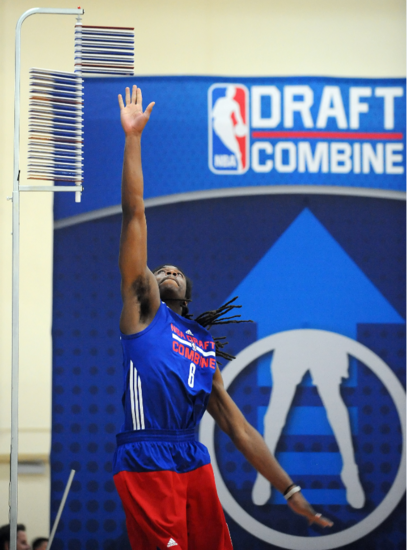
What the combine measures
In a reach-based vertical test, a player first establishes a standing reach: the highest point they can touch while standing flat-footed with an arm extended overhead.
They then jump and touch as high as possible, using a device such as a Vertec with adjustable plastic vanes.
The difference becomes the recorded vertical:
Measured vertical = maximum jump reach − standing reach
There are two familiar versions:
- Standing vertical: no approach steps, although the player can use a countermovement and arm swing.
- Maximum vertical: an approach is allowed before takeoff.
These are useful tests. They describe how much higher a player can reach under particular conditions.
They do not directly track how far the whole body’s centre of mass rises.
That distinction matters because the fingertip is attached to a moving arm, shoulder and trunk. Reaching technique is part of the performance being recorded.
The baseline can change the result
Imagine a player whose maximum jumping touch stays exactly the same across two tests.
In the first, they establish their full standing reach.
In the second, their recorded standing reach is two inches lower because they do not extend as fully.
The second test awards them a vertical two inches higher.
Their maximum touch has not changed. The baseline has.
This is more than a theoretical concern. Research comparing different standing-reach procedures has found that the method used can substantially affect the resulting jump measurement.
That does not mean every combine result is inflated. It means the baseline needs the same attention as the jump.
It also does not mean long arms automatically produce a larger vertical.
Long arms help a player reach higher while airborne, but they also help that player reach higher while standing. When extension is consistent, much of that anatomical advantage cancels in the subtraction.
The concern is inconsistent reaching technique, not simply having unusual proportions.
What Keon Johnson’s 48 inches tells us
Keon Johnson’s 48-inch maximum vertical at the 2021 combine is an official result. It should be recognised as such.
It tells us that his recorded jumping reach exceeded his recorded standing reach by 48 inches during that test.
It does not, by itself, establish that his centre of mass rose 48 inches. Nor does it prove that he jumped higher than every player from earlier eras who never completed the same test.
His standing reach has attracted scrutiny because it appears unusually low for his dimensions. That raises a reasonable question about the baseline.
It does not give us permission to invent a corrected result.
To make that correction responsibly, we would need an independently supported standing reach measured under comparable conditions. Until then, the official result and the uncertainty surrounding its interpretation should remain separate.

Westbrook made me ask a different question
Russell Westbrook was one of the players who made me question how much a single vertical could explain.
Watching him attack a rebound, the remarkable part was often how suddenly he became involved in a play that appeared to belong to someone else.
A gap opened. He moved into it. Then he was challenging for the ball.
It was tempting to describe that as reaching his peak faster.
But several things could be happening: earlier anticipation, a better approach, less preparation before takeoff or a jump timed more effectively to the ball.
Those advantages can look similar in a highlight.
Leaving the floor quickly and reaching the apex quickly are different things.
For a freely airborne jumper, greater upward takeoff velocity produces a higher peak, and a longer ascent to that peak.
The advantage may therefore be getting the jump started sooner, or reaching the height needed for the play before an opponent does. Neither requires reaching maximum height almost immediately.
Researchers measure time to takeoff separately from jump height for precisely this broader assessment of performance.
A single vertical result cannot tell us how Westbrook prepared, anticipated or timed a particular rebound.

Dwight Howard reveals another distinction
Dwight Howard made me think about the difference between jumping far and reaching high.
A smaller player can record a greater vertical while still touching a lower point above the floor.
The relationship is simple:
Maximum jump reach = standing reach + measured vertical
Consider a hypothetical comparison.
A player with a nine-foot standing reach and a 36-inch vertical touches 12 feet.
A player with an eight-foot standing reach and a 44-inch vertical touches 11 feet 8 inches.
The second player jumps eight inches farther above their baseline. The first still reaches four inches higher.
Both results matter. They describe different advantages.
Howard’s combination of standing reach and elevation gave him access to lobs, rebounds and shots in spaces many players could not contest.
The same principle helps explain why LeBron James, Blake Griffin and Giannis Antetokounmpo can produce such imposing aerial plays without needing to top every list of reported verticals.
Smaller players face a different challenge. They often need more elevation to reach the same space, a theme running through 30 short NBA players who soared at 6’3″ and under.
That does not make one kind of athlete automatically more impressive. It helps explain what each athlete must accomplish.
Jordan and the impression of floating
Jordan is where the measurement debate meets memory.
The familiar 48-inch claim circulates as though it settles his place in history. Without an identifiable source and a clear testing method, it should not carry that burden. I would rather leave his exact maximum unresolved than replace it with another confident estimate.
His footage provides a different kind of evidence.
He could elevate, reposition the ball and delay a finish while a defender committed to an earlier contest. Those movements helped create the impression that he was hanging in the air.
He was not suspending gravity.
Once airborne, his centre of mass followed a trajectory governed largely by his takeoff conditions and gravity. Moving his arms and legs changed the arrangement of his body around that trajectory.
His coordination helped him use the time available. It did not stop his descent.
That makes the skill no less remarkable. Watching those clips with this distinction in mind changed what I noticed. The height was still impressive, but so was his ability to find another finish while the play was already unfolding.
A player who can choose an effective release point while airborne has a basketball advantage that a maximum-touch test does not describe.

Why dunks complicate the comparison
Dunks are evidence of jumping ability, but they are difficult to turn into precise measurements.
Body position changes what we notice. A tucked leg, an extended arm or an arched trunk can make particular parts of the body appear unusually high.
A double clutch changes when the ball moves toward the basket. It does not, by itself, prolong the flight of the centre of mass.
A free-throw-line dunk adds another variable: horizontal distance. The player needs enough elevation and time to complete the finish, but the distance travelled does not tell us the peak vertical height.
That is part of what makes Vince Carter so compelling.
His best dunks combine elevation with demanding movements of the ball. Watching them establishes exceptional aerial ability.
Assigning an exact vertical from those clips requires much more: a suitable camera angle, a reliable scale, clear body landmarks and a defined measurement method.
A spectacular dunk can make a strong case for the athlete without settling the number.
What a fuller assessment would measure
I would still keep maximum vertical in the assessment. I would add measurements that answer the questions it leaves open.
| Measurement | What it helps explain |
|---|---|
| Standing reach and maximum touch height | The absolute space a player can access. |
| Centre-of-mass jump height | How far the body rises, using a clearly defined baseline. |
| Time to takeoff | How much time passes between starting the movement and leaving the floor. |
| Takeoff velocity and net impulse | How the player generates upward motion. |
| Power relative to body mass | The rate of mechanical work relative to the size of the athlete. |
| Repeat-jump performance | How effectively the player recovers and jumps again. |
These are not entirely new ideas. Force-plate research already examines jump height, takeoff velocity, force and power as distinct variables.
Head height could provide useful visual context, but head position changes during a jump. Hip tracking can help describe movement, but the hip is not identical to the whole-body centre of mass.
Even sophisticated testing needs careful definitions. Studies distinguish between jump height measured from standing and jump height measured from takeoff; changing that definition can change the reported result.
Then comes the basketball test.
Can the player reproduce the ability with a ball? After changing direction? While catching a difficult pass? When a defender occupies the landing or finishing space?
Controlled testing helps isolate physical qualities. Games reveal how players combine them.
Why ranking greatness is a different task
At some point, I tried separating everything.
Peak elevation. Reach. Quick takeoff. Repeat jumping. Game impact.
The categories helped, but none could explain the whole player.
Westbrook’s timing changes when he can challenge for the ball. Howard’s reach changes which spaces he can access. Jordan’s coordination changes what he can do before landing.
Then there is the career.
An extraordinary test result deserves recognition. So does using exceptional jumping ability across years of NBA competition, building accomplishments and leaving moments people still remember.
That is the logic behind my ranking of the 25 greatest vertical jumpers in NBA history.
It weighs exceptional elevation alongside the ability to use it in basketball situations, and alongside historical significance. Official testing is part of the evidence rather than the entire verdict.
That approach requires honesty about uncertainty.
A combine result deserves its label. A reported private-workout figure needs a source. A footage-based interpretation should be presented as an interpretation.
And an editorial ranking should explain why it values one combination of qualities above another. Readers can understand the approach and still choose a different order.
Why the debate will survive
Better measurement would help us distinguish the highest recorded jump, the greatest absolute reach and the most effective aerial player.
It would not necessarily give all three titles to the same person.
And it would not decide how much we should value Jordan’s versatility, Carter’s peak displays or Johnson’s combine result. That part would still belong to the argument.
I still enjoy the argument.
But now, before accepting a number, I want to know what was measured, how it was measured and what someone is asking that number to prove.