
From Lorenzo Alexander shedding the size of a defensive tackle to Alejandro Villanueva building an offensive tackle’s frame, these players changed their bodies to give their football careers a different future
Lorenzo Alexander once weighed 315 pounds. Looking at the linebacker he later became, it is difficult to picture him carrying the size of a defensive tackle.
Alejandro Villanueva went in the other direction. Before he became an established offensive tackle, he had a much lighter frame. Building the size to protect an NFL quarterback meant changing how he trained, how much he ate and what his body could handle.
Both were trying to find a place in the league. The bodies they started with were not the ones they eventually needed.
That makes an NFL transformation more complicated than simply getting bigger. Size can help a player hold his ground, but carrying more of it can also make moving harder. For someone else, losing weight might reveal athleticism that had been difficult to use. The useful change depends on the player and the job.
The players below made particularly striking physical changes during their careers or preparations for a comeback. Some added substantial size. Others lost enough weight to look—and move—very differently. Behind those changes were altered eating habits, demanding training, setbacks and people who helped them find a way forward.
The weights are drawn from reported measurements, team accounts and player recollections. They describe individual careers, rather than targets for readers to follow.
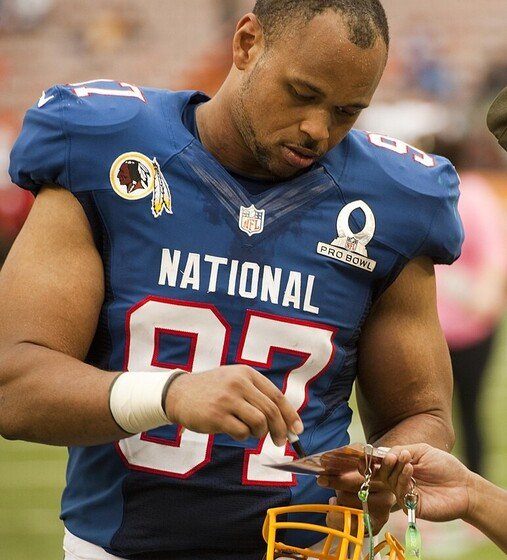
Lorenzo Alexander: From 315-Pound Lineman to Linebacker
Lorenzo Alexander did not enter the NFL looking like someone who would chase quarterbacks from an outside linebacker position. He arrived in 2005 as a 315-pound defensive tackle, trying to find a team willing to keep him.
Early in his career, that meant accepting almost any assignment. After practice-squad stops in Carolina and Baltimore, he found a place in Washington. His first regular-season NFL appearance came in 2007, two years after he entered the league.
In Washington, he moved between offense, defense and special teams. His versatility earned him the nickname “One Man Gang,” but it also exposed a problem: the body suited to one job could make another harder.
Covering kicks required more speed. Alexander stopped drinking alcohol, cut out fast food and introduced training that included cycling and MMA workouts.
Then Washington changed its defensive scheme in 2010. The coaches saw an opportunity for him at linebacker, which meant losing more weight. He eventually reached 240 pounds—a reduction of 75 pounds from his reported entry weight. The position demanded a different kind of movement: pursuing plays away from the line and changing direction in space.
London Fletcher helped him learn both the position and how to take care of his changing body.
The reinvention did not immediately produce a starring defensive role. Alexander explained that he had played behind established linebackers in Washington, with limited opportunities. An injury later interrupted his progress in Arizona.
When Buffalo gave him more defensive snaps in 2016, the preparation finally met the opportunity. At 33, he recorded 12.5 sacks and earned a Pro Bowl selection.
Speaking to Sports Illustrated that October, he emphasized that several things had come together: his reduced weight, recovered health and a much larger role.
He had changed enough physically that people struggled to believe his old playing weight. Alexander said he sometimes had to show them photographs.

Alejandro Villanueva: Building a Body for a Different Job
Connor Barwin remembered watching Alejandro Villanueva eat in Philadelphia’s cafeteria. Meals were part of his attempt to make the team, and the quantities left an impression.
He arrived at the Eagles in 2014 a little over 260 pounds, according to a 2016 Philadelphia Inquirer feature. After three deployments to Afghanistan as an Army Ranger, he was trying to restart his football career.
Philadelphia used him at defensive end. He added size, hoping it would compensate for his limited experience, but the Eagles released him. Pittsburgh offered another chance—and a move to offensive tackle.
By August 2016, the Steelers described him at 320 pounds. Barwin put him higher, at 340, in a separate recollection the following month. Those accounts should not be treated as identical weigh-ins, but both describe a much larger athlete than the one who arrived in Philadelphia.
The additional size was only part of becoming a blocker. Villanueva credited offensive line coach Mike Munchak and his teammates with helping him understand the position and build confidence.
Maintaining his physique was another challenge. After becoming a starter in 2015, he told the Steelers’ website that he had lost considerable weight during the season and needed to rebuild his size and strength.
For someone struggling to gain weight, that detail might sound familiar. Even after reaching an NFL starting lineup, Villanueva still had to work at keeping the body his new position required.

Bruce Smith: The Athlete Beneath the Extra Weight
Bruce Smith was talented enough to become the first pick in the NFL draft before he learned how to take proper care of his body.
That talent brought him to Buffalo in 1985. It did not mean he arrived with the physique—or habits—that would sustain his career.
Smith later recalled reaching 310 pounds after his first season. He recognized that something needed to change if he was going to become the player he wanted to be.
A 1996 profile described the difference. The young man who enjoyed fried chicken, biscuits and gravy had replaced much of that food with baked chicken, pasta, fruit and vegetables. He maintained a much leaner 273-pound playing weight through year-round training.
The change involved more than eating differently. Conditioning became something he maintained throughout the year, alongside detailed preparation for the blockers he would face.
Smith credited Buffalo’s strength and conditioning coach Rusty Jones with helping him understand which foods would support his performance. The purpose was practical: arrive with enough energy and preparation to play four quarters.
By 33, he was still performing at a level that impressed Marv Levy. In that same 1996 profile, the coach praised his reactions, while Smith explained that his eating, training and study habits allowed him to consider himself in his prime.
He was still playing in the NFL at 40, finishing his career with four seasons in Washington after 15 in Buffalo.

Mike Williams: Losing More Than 100 Pounds to Play Again
When Mike Williams made Washington’s roster in September 2009, the achievement involved considerably more than surviving the final cuts.
He had spent months changing a body that had become too heavy for the career he wanted to resume.
Williams, the offensive lineman Buffalo selected fourth overall in 2002, had not played a regular-season NFL game since 2005. During his time away, his weight reportedly reached approximately 450 pounds.
By August 2009, The Washington Post reported him at 339 pounds—a reduction of 111 pounds over roughly six months. Washington’s own September account put him at 337 pounds.
The smaller body still had plenty of power. Team executive Vinny Cerrato highlighted his ability to move defenders and praised a preseason performance in which he played 50 snaps against Jacksonville.
Getting to that point had been uncomfortable. An abdominal injury and an ankle sprain interrupted his preparation, limiting him to two preseason appearances. Williams remained uncertain about his roster place until the cuts were announced.
“This was a very hard process,” he said.
He began the season as a backup right tackle, then went on to make eight starts across tackle and guard.
His story differs from a player gradually filling out after entering the league. The largest gain happened while he was away from football. Reversing it required rebuilding his capacity to do a job he had not performed in years.
By the end of 2009, the comeback had produced something more tangible than a striking photograph: Williams was starting NFL games again.

Craig “Ironhead” Heyward: Still Big, but Moving Differently
At 265 pounds, Craig Heyward was hardly a small running back. For someone who had reportedly weighed 328 pounds the previous year, however, it represented a substantial change.
By October 1994, contemporary reporting described him giving up alcohol and shedding more than 60 pounds.
He had never needed to become slight. Heyward’s power made him difficult to tackle and valuable as a blocker. The challenge was keeping enough of that strength while reducing the weight that had repeatedly concerned his coaches.
The change coincided with a move from Chicago to Atlanta. With the Bears in 1993, he rushed for 206 yards, averaging 3.0 yards per carry. With the Falcons in 1994, those figures rose to 779 yards and 4.3 per carry.
A different team and role also mattered. The weight change was part of the improvement, rather than an explanation for every additional yard.
Then came the best rushing season of his career. In 1995, Heyward gained 1,083 yards, averaged 4.6 per carry and earned a Pro Bowl selection.
His earlier difficulties had included heavy drinking and eating habits he later discussed openly. Changing his physique meant addressing the routine behind it, not simply spending more time exercising.
The result still looked like Ironhead: a large, powerful back who could make an approaching defender hesitate. But the much lighter version was producing the football his size and talent had long suggested he could play.

Mekhi Becton: Finding His Way Back From 400 Pounds
When Mekhi Becton returned to training camp in 2023, he was approximately 350 pounds—his lightest since college.
That was still an enormous body. But he had lost around 50 pounds during preparations for a comeback that had become difficult to imagine.
ESPN reported that Becton’s weight had climbed to around 400 pounds during a prolonged struggle with his right knee. Two operations and almost two full seasons without playing left him dealing with more than rehabilitation. The isolation and public criticism affected him, while ESPN reported that the Jets privately worried about his football future.
Former teammate Cameron Clark helped him find a way forward.
Clark encouraged Becton to change his training arrangements and representation, then moved to New Jersey to support him. The Jets hired Clark as a player-development intern, allowing him to work closely with his friend inside the organization.
Their preparation included nutrition, strength work and film study. Becton needed to rebuild his body and his readiness to use it.
As camp progressed, his practice workload increased gradually. He earned a starting position and ultimately started 16 games in 2023, after appearing in only one across the previous two seasons.
It was not a flawless return. There were difficult performances, and losing weight did not resolve every football problem.
But Becton had moved from long stretches of rehabilitation to a season spent playing. For a young lineman whose career had stalled, the slimmer physique was part of a much larger recovery.

Jamie Nails: Returning to the Team That Released Him
For Jamie Nails, the difference between being in the NFL and being outside it became painfully ordinary.
There was the doctor’s appointment that required a three-hour wait. There was the high school assistant coaching job paying $3,500, after a $525,000 season with Buffalo. The routines and privileges of professional football had disappeared.
Miami released him during the 2001 preseason over his weight. He returned in 2002 approximately 50 pounds lighter, at 335.
Nails already had the experience of an NFL starter. He had started all 16 games for Buffalo in 2000. What he needed was a body that would allow him to earn that responsibility again.
By the summer of 2002, ESPN reported that Miami’s coaches considered him their most improved player. He went on to start 14 games at left guard that season and 15 the following year.
The transformation had brought him back to the same organization that let him go.
Speaking in 2003, Nails warned that many younger players were unprepared for life after football. He understood how quickly the career could disappear because he had already experienced it.
Nails’s release was one example of NFL players’ weight becoming a career problem, with other cases involving failed physicals, restrictions on practicing and contractual weight targets.

Michael Strahan: Getting Bigger, Then Learning He Needed Less
When the Giants told Michael Strahan to gain weight, he followed the instruction enthusiastically.
He later recalled weighing approximately 250 pounds at the combine, then reporting to camp at 265. The coaches wanted more size, so he kept eating until he reached 285.
“They didn’t say how to gain weight, they just said gain,” he told Muscle & Fitness.
Pizza and steak helped him reach the number. Moving comfortably at that weight was another matter.
The same profile described him dropping to approximately 270 pounds the following year, then into the 260s and eventually into the 240s during his final playing seasons.
In a later interview, Strahan explained that improved technique reduced his reliance on extra bulk to compensate when he was out of position. Experience was changing what he needed from his body.
He had arrived believing he needed more weight to compete. Over the course of his career, he learned how to play with less.

George Fant: His Mother Helped With the Meals
George Fant’s mother moved to Seattle to help with her grandchildren. Her cooking also helped her son prepare for his second NFL season.
By June 2017, Fant reported weighing 320 pounds, about 25 pounds heavier than at the end of his rookie year. He had worked with Seattle’s nutritionist and spent considerable time in the weight room; his mother’s Southern cooking helped him eat enough to support the work.
“I mean, I can’t be at 290 getting bull-rushed,” he said.
An offensive tackle could not afford to be driven backward toward his quarterback. Fant wanted more size and strength to hold his ground.
He had already made a substantial transition before entering the league, building up from his college basketball frame. This additional gain followed a rookie season spent learning what NFL blocking demanded.
He also studied film with his wife, Chastity, and sought advice from Walter Jones. His understanding of the position needed developing alongside his body.
The second season he had prepared for never arrived. Fant tore his ACL during the preseason and missed all of 2017. The physical preparation was real, but an injury postponed his chance to put it to use.
Honorable Mentions
These players also made changes worth noting, from comeback preparations to adjustments in speed, size and workload.
Gilbert Brown
After spending the 2000 season out of football, Brown worked with former college strength coach Fred Roll and returned to Green Bay at approximately 339 pounds. His foundation’s account describes a slimmer player with renewed quickness, ready to resume his place in the middle of the defensive line.
Le’Veon Bell
Bell reported weighing approximately 225 pounds before the 2014 season. He said he had begun feeling quicker as he lost weight during his rookie year.
Lamar Jackson
Jackson tried becoming bigger, then reconsidered. After reaching 230 pounds in 2022, he reported weighing 205 in 2024, seeking greater agility. A quarterback already known for making defenders miss was deliberately moving away from the heavier body he had previously built.
Melvin Ingram
Ingram lost approximately 20 pounds before the 2015 season. Contemporary scouting coverage highlighted improved flexibility alongside his existing quickness—useful qualities for an edge rusher trying to work around offensive tackles.
A’Shawn Robinson
Robinson’s teammates noticed a leaner, more explosive player during preparations for the Rams’ 2021 season. The team’s feature documented the change in his physique as he prepared for a more important role on the defensive line.
Jordan Davis
Davis reported losing 26 pounds to reach approximately 330 before the 2025 season. He remained a huge defensive tackle. The aim was to prepare for a greater workload while retaining the strength that made his size valuable.
The Transformations, by the Numbers
| Player | Earlier weight / basis | Later reported weight | Approximate change |
| Lorenzo Alexander | 315 lb entering the league | 240 lb as a linebacker | Lost 75 lb |
| Alejandro Villanueva | A little over 260 lb on arrival in Philadelphia, 2014 | Listed at 320 lb by Pittsburgh, August 2016 | About 60 lb heavier |
| Bruce Smith | Recalled reaching 310 lb after his first season | Reported at 273 lb in 1996 | About 37 lb lighter |
| Mike Williams | Approximately 450 lb before his comeback | 339 lb in August 2009 | Lost approximately 111 lb |
| Craig Heyward | Reported at 328 lb in 1993 | Reported at 265 lb in 1994 | Lost approximately 63 lb |
| Mekhi Becton | Approximately 400 lb during his injury layoff | Approximately 350 lb at 2023 training camp | Lost approximately 50 lb |
| Jamie Nails | About 385 lb before his return, inferred from reported loss | Reported at 335 lb in 2002 | Lost approximately 50 lb |
| Michael Strahan | Recalled reaching 285 lb early in his career | Reported in the 240s during his final playing years | Roughly 36–45 lb lighter |
| George Fant | About 295 lb after rookie season, inferred from reported gain | Reported at 320 lb in June 2017 | Gained approximately 25 lb |
Different Bodies, Different Possibilities
Alexander needed to move away from the body of a defensive tackle. Villanueva needed to build the size of an offensive tackle. Strahan discovered that some of the weight he had been encouraged to gain was weight he could eventually play without.
None could solve the whole problem on a scale. Alexander still needed an opportunity at linebacker. Villanueva needed coaching and confidence. Williams had to show he could handle NFL snaps again, while Becton needed support through a recovery that involved much more than his knee.
The people around them mattered: a teammate teaching a new position, a friend moving closer, a mother helping with meals. The finished physiques can obscure those details. What looks like one dramatic change in a photograph was often a series of smaller adjustments, made until the player could do something he had struggled to do before.
For Williams, that meant starting NFL games after years away. For Alexander, it meant reaching the Pro Bowl at 33 as a linebacker.
If you chose someone from the honorable mentions, tell us who in the comments.
Sources
- Lorenzo Alexander: His first-person account, “How I Got Here”, and Sports Illustrated’s interview about his Buffalo breakthrough; Buffalo’s official 2016 statistics.
- Alejandro Villanueva: Paul Domowitch’s account of his physical development and the Steelers’ feature on maintaining size, strength and confidence, plus Pittsburgh’s August 2016 size listing.
- Bruce Smith: Contemporary 1996 reporting on his physique and preparation, his recollection of reaching 310 pounds, and his discussion of nutrition with the Bills.
- Mike Williams: The Washington Post’s report of his 111-pound reduction and Washington’s account of his return.
- Craig Heyward: Associated Press reporting on his weight reduction and his career statistics.
- Mekhi Becton: Rich Cimini’s account of Cameron Clark’s support and ESPN’s account of his weight reduction and return.
- Jamie Nails: Alex Marvez’s account of his year outside football, Associated Press reporting on his weight loss, and his career starts.
- Michael Strahan: His reported weight progression in Muscle & Fitness and his explanation of technique and playing size in Men’s Health.
- George Fant: Seattle’s June 2017 account of his weight gain, preparation and family support; the team’s preseason injury report.
- Honorable mentions: Gilbert Brown Foundation; Bell’s 2014 interview; Jackson’s explanation; Ingram’s changed movement; Robinson’s team feature; Davis’s reported reduction.