From Wat Misaka’s historic size 7 Converse to modern baseline exceptions, profiling the rare court icons who stood tall on remarkably compact footprints
NBA players are usually built on a different scale from everyone else.
Seven-foot centers can wear shoes that approach the size of a small boat. Even ordinary NBA guards often need footwear that would look enormous outside professional basketball.
But a handful of professional basketball players have gone in the opposite direction.
Some of the shortest players in basketball history wore surprisingly small shoes, including one early professional player whose size-7 Converse sneakers were so unusual that his team let him take them home after he was cut.
This list focuses on the smallest reported shoe sizes associated with NBA and BAA players, rather than simply listing short players with relatively small feet. Where a shoe size is supported by contemporary or named reporting, that evidence is identified. Where a measurement comes mainly from secondary sources, it is described as reported rather than presented as an official league measurement.
There is an important limitation to keep in mind: shoe size has never been an official NBA statistic, and a player’s shoe size is not necessarily identical to the exact size of his feet. Players can size up or down depending on comfort, brand and personal preference, a point we come back to below.
With that in mind, these are the smallest well-supported numbers we found.
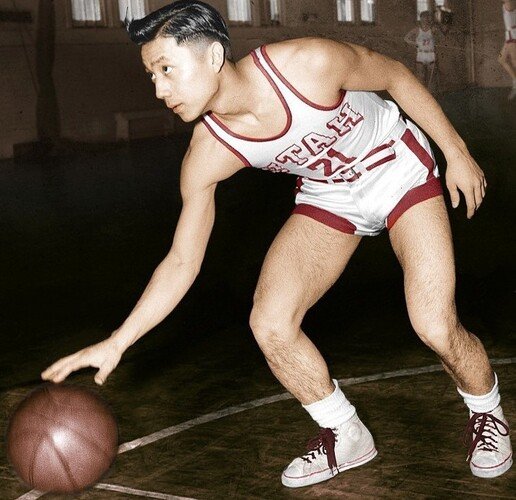
1. Wat Misaka
Reported shoe size: 7
Height: 5’7″
The smallest well-documented shoe size we found belongs to Wat Misaka, the Japanese-American guard who played three games for the New York Knicks during the 1947–48 Basketball Association of America season.
Misaka stood just 5’7″, but his feet were even more unusual by professional basketball standards. The Washington Post reported that after the Knicks cut him, Misaka recalled being allowed to take his size-7 Converse high-tops home, presumably because no one else could wear them.
The detail is particularly notable because it was not simply a shoe-size number copied between modern basketball websites. Misaka himself recalled the incident, and the size-7 Converse story was preserved in later reporting.
Misaka’s professional statistics were modest. He scored seven points across his three games with the Knicks. His historical importance, however, was much greater. His 1947 debut made him the first nonwhite player in the modern history of professional basketball.
The size-7 shoes remain one of the most unusual physical details attached to his brief professional career.
Size 7 is the lowest well-documented shoe size we found for an NBA or BAA player.
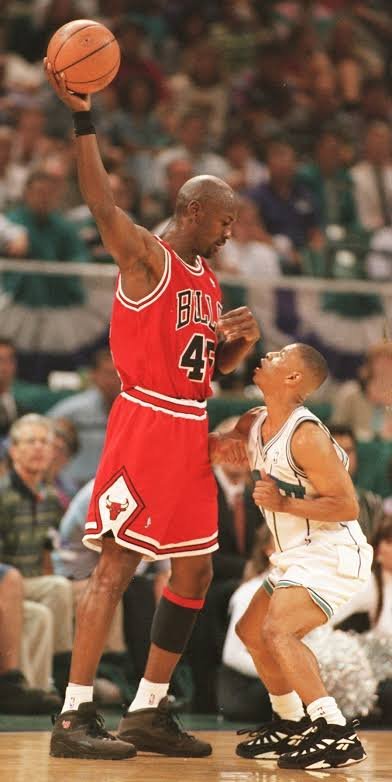
2. Muggsy Bogues
Shoe size: 8.5
Height: 5’3″
Muggsy Bogues is the shortest player ever to appear in an NBA game, standing just 5’3″. His shoe size was also remarkably small for a professional basketball player.
The strongest evidence comes from a 1985 Washington Post profile published while Bogues was at Wake Forest. The article recorded his measurements and specifically stated that his shoe size was 8½.
That makes Bogues one of the rare players on this list whose unusually small footwear was documented in contemporary reporting rather than reconstructed years later.
Bogues eventually became a first-round NBA draft pick and played 14 seasons, spending most of his career with the Washington Bullets and Charlotte Hornets.
His size was one of the defining curiosities of his career, but it never prevented him from becoming a long-term NBA player. He finished with more than 6,000 assists and remains one of the most recognizable undersized players in basketball history.
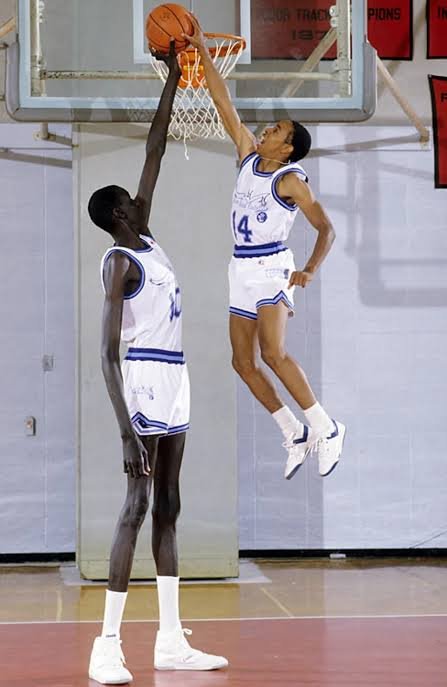
3. Spud Webb
Reported shoe size: 8.5
Height: 5’7″
Spud Webb is another player whose reported shoe size was unusually small even relative to other NBA guards.
Webb was listed at around 5’7″ and became famous for his extraordinary leaping ability. He eventually won the 1986 NBA Slam Dunk Contest despite being one of the shortest contestants in the event’s history.
A number of secondary sources report Webb’s shoe size as 8.5. Because the sourcing is not as strong as the contemporary reporting for Bogues or the historical evidence surrounding Misaka, the figure is presented here as a reported measurement, not as an official record.
Webb is listed at 5’7″ here. Basketball-Reference and some other references list him at 5’6″, and he has said he is 5’6″ barefoot and 5’7″ in shoes.
Whatever the exact listed height, an 8.5 shoe would still be remarkably small for an NBA player.
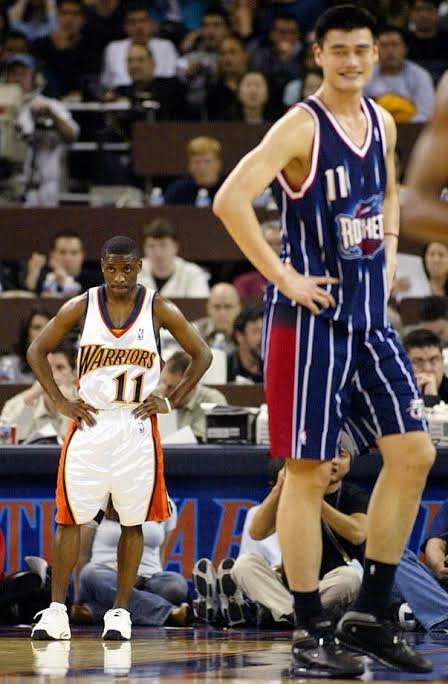
4. Earl Boykins
Shoe size: 9
Height: 5’5″
Earl Boykins spent his career making a mockery of conventional assumptions about NBA size.
Auction records offer the best evidence for his shoe size. A game-worn, signed Boykins shoe from the Elgin Baylor collection, sold through Julien’s Auctions, is listed as size 9.
Many websites report Boykins at 9.5 instead, which illustrates the uncertainty surrounding historical NBA shoe-size figures. Because the auction listing documents a shoe he actually wore, 9 is the figure used here, with 9.5 also widely reported.
Boykins eventually played more than 600 NBA games despite standing barely 5’5″. His career is another reminder that unusual physical measurements do not necessarily prevent a player from succeeding at the highest level.
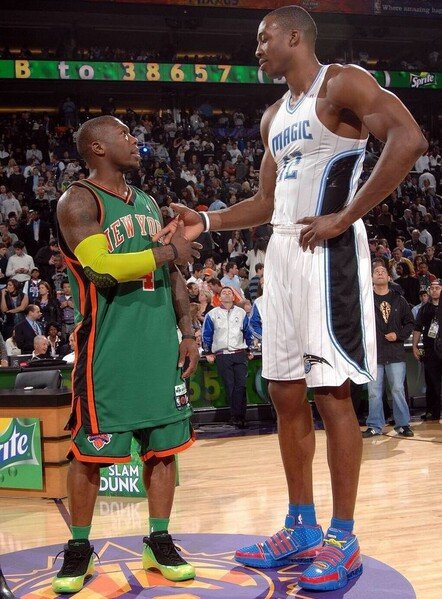
5. Nate Robinson
Shoe size: 10.5
Height: 5’9″
Nate Robinson marks the point where the list starts to move away from genuinely tiny footwear and toward shoes that are simply small by NBA standards.
Robinson stood 5’9″ and was one of the most explosive athletes of his generation. He won the NBA Slam Dunk Contest three times and carved out an 11-season NBA career.
His shoe size is particularly well documented because Boston.com mentioned it directly in a 2015 retrospective of his time with the Celtics. The article noted that Robinson wore 10.5 while Shaquille O’Neal wore size 22, creating a memorable contrast when Robinson attempted to run in O’Neal’s shoes.
A size 10.5 is not extraordinarily small for an adult man. In the NBA, however, it is unusual enough to stand out.
Robinson is therefore a useful cutoff point for the main list. Going much higher would increasingly turn the article into a list of guards with relatively modest shoe sizes rather than players with genuinely small reported footwear.
Honorable Mentions: Small by NBA Standards
The players below do not belong in the main list because their reported shoe sizes are not especially small outside professional basketball. They are included because those figures sit toward the lower end of the NBA range.
| Player | Reported shoe size | Height |
| Tony Parker | 11 | 6’2″ |
| Allen Iverson | 11 | 6’0″ |
| Eric Bledsoe | 11.5 | 6’1″ |
| Kemba Walker | 11.5 | 6’0″ |
| Isaiah Thomas | 12 | 5’9″ |
| Kyrie Irving | 12 | 6’2″ |
| Paul George | 12 | 6’8″ |
| Chris Paul | 12.5 | 6’0″ |
Eric Bledsoe has one of the clearest source trails in this group. A 2015 Phoenix Suns feature specifically described him as wearing size-11.5 shoes.
The other figures are generally reported in media roundups and secondary shoe-size compilations rather than collected through a standardized NBA measurement process. They should therefore be treated as reported footwear sizes, not precise measurements of each player’s feet. Allen Iverson, for example, is commonly listed at size 11, although documented game-worn Reebok pairs from his career have also been tagged size 10.5.
Paul George is the clearest example of why that qualification matters. A 2014 media roundup listed the 6’8″ forward at size 12, which is striking for a player of his height. Later reporting from Nike’s work on the PG 1 found that George had been playing in size 13 shoes, while Nike measured him as a “true” U.S. 14. He subsequently preferred a size-13.5 fit rather than moving fully to size 14.
The size-12 number is therefore best understood as a historical reported listing, not a confirmed measurement. It remains relevant because even George’s later documented 13–13.5 playing range is notably small for a 6’8″ NBA forward.
What Counts as a Small NBA Shoe?
There is an important distinction between small feet and small feet by NBA standards.
A size 12 shoe is not especially small for a man. A size 10.5 is not extraordinarily rare either. But NBA players are generally much larger than the population as a whole, and their footwear reflects that.
That is why this list stops where it does.
Wat Misaka’s size 7 and Muggsy Bogues’ size 8.5 are genuinely unusual measurements. Spud Webb’s reported 8.5 and Earl Boykins’ auction-documented size 9 are also small enough to stand out on their own.
Nate Robinson’s 10.5 is where the distinction becomes more important. His shoes were small for an NBA player, but no longer particularly small in everyday life.
The honorable mentions show how quickly the numbers rise even among relatively undersized NBA guards.
There is also a larger problem with historical shoe-size data: NBA shoe sizes have never been standardized as an official league statistic. Different websites often repeat the same figures without identifying the original source, and individual players can have conflicting measurements depending on the shoe, brand or source being referenced.
There is another complication: the size of a shoe a player wears is not necessarily the same thing as the size of the player’s foot. Shaquille O’Neal provides a striking example. In a Footwear News interview, he said his actual shoe size is 20 but that he likes wearing size 22 because he prefers extra room.
For that reason, this article uses the most defensible reported shoe sizes rather than pretending that every number is an official measurement of foot length.
And at the bottom of the list sits an extraordinary number.
Size 7.
Wat Misaka’s feet were tiny by almost any basketball standard. The fact that the Knicks allowed him to keep his size-7 Converse sneakers after cutting him, apparently because another player was unlikely to fit them, makes the story even more remarkable.
The shoes were small.
The stage was anything but.