A statistical breakdown of the longest leg reaches ever recorded in the UFC and how they influence distance, leverage, and fighting styles in MMA
When people talk about physical advantages in the UFC, the conversation almost always begins with height and arm reach. Taller fighters control distance. Longer arms mean sharper jabs and a safer striking range. But there is another measurement, quietly recorded in fighter statistics, that rarely receives the same attention: leg reach.
Measured from the hip to the heel, leg reach determines far more than how far a fighter can kick. It influences stance width, clinch leverage, takedown entries, and even how much distance an opponent must cover just to get inside. In extreme cases, unusually long legs can subtly reshape the geometry of a fight.
And in UFC history, a handful of fighters have possessed leg lengths that stand far beyond the norm.
Why Leg Reach Matters in MMA
Leg reach does not always receive the same attention as arm span, but its effects show up constantly inside the cage.
Longer legs can influence several aspects of a fight:
Distance control. Fighters with longer legs can manage range more comfortably using front kicks and body kicks, forcing opponents to travel farther before they can land punches.
Clinch leverage. Longer legs make it easier to land knees and maintain pressure in tight exchanges, especially against opponents who are shorter or built more compactly.
Defensive spacing. Extra reach allows fighters to retreat and reset more easily after striking, giving them slightly more room to avoid counters.
Grappling mechanics. In certain situations, longer legs can also improve guard control and create stronger leverage for submissions.
Of course, leg reach alone does not determine success. Speed, timing, and technique still matter far more. But when a fighter’s leg reach pushes well beyond the average for their division, it can quietly change the way fights unfold.
And in the UFC, a few fighters stand out for having legs that stretch far beyond the norm.
Average Leg Reach in Each UFC Division
Leg reach tends to increase as fighters move up in weight classes, but the differences between divisions are actually smaller than many fans expect.
Below is the approximate average leg reach across the major UFC weight classes.
| Division | Average Height | Average Leg Reach |
| Flyweight | 5′ 5″ | 36″ |
| Bantamweight | 5′ 7″ | 38″ |
| Featherweight | 5′ 9″ | 39″ |
| Lightweight | 5′ 10″ | 40″ |
| Welterweight | 5′ 11½” | 41″ |
| Middleweight | 6′ 1″ | 42″ |
| Light Heavyweight | 6′ 2″ | 43″ |
| Heavyweight | 6′ 3″ | 44″ |
In most divisions, fighters tend to fall within one or two inches of the average.
Once a measurement stretches three inches beyond the norm, it starts to stand out. When it reaches four or more inches above the divisional average, the fighter begins to enter rare territory where their physical proportions can noticeably affect range and leverage inside the cage.
The fighters on the following list all fall into that category.
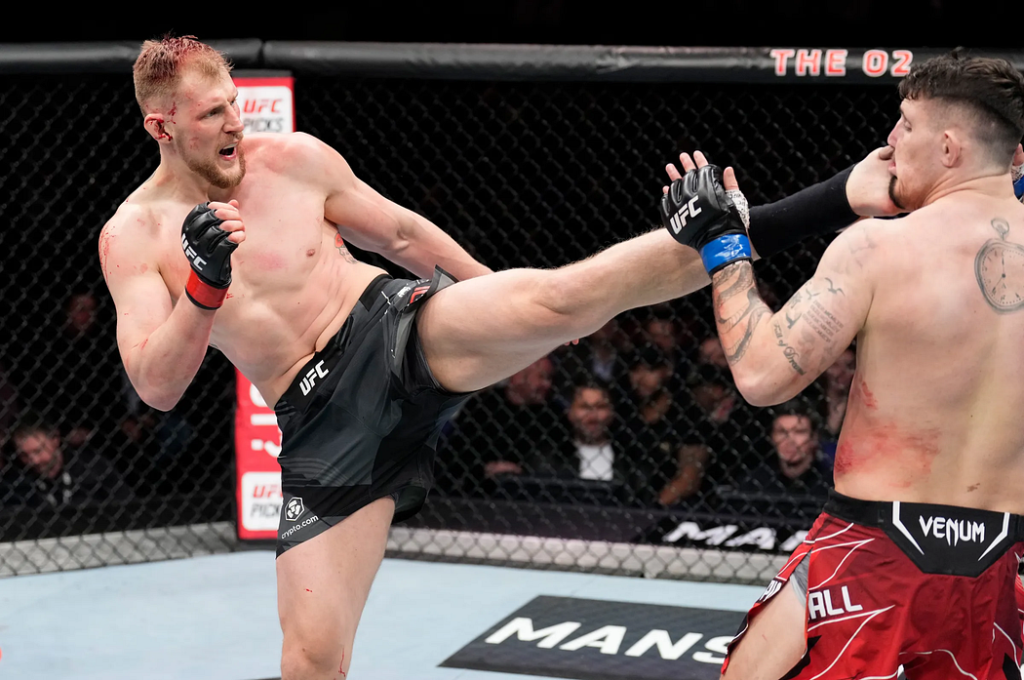
5. Alexander Volkov
A heavyweight built for distance
Height: 6’7″
Division: Heavyweight
Leg Reach: 47″
Division Average: 44″
Statistical Breakdown
- Percent longer than heavyweight average: +6.8%
- Predicted height with this leg reach: ~6’7″
Alexander Volkov is the least surprising name on this list, which makes him a good place to begin.
At 6’7″, long legs are exactly what you would expect. His 47-inch leg reach sits three inches above the heavyweight average, giving him a clear range advantage without making his proportions truly unusual.
Where Volkov becomes interesting is in how naturally that reach fits into his style.
Unlike many heavyweights who rely primarily on power exchanges, Volkov has built much of his approach around distance management. His long legs allow him to control space with front kicks, long body kicks, and measured footwork that forces opponents to cover more ground before they can enter striking range.
At heavyweight, that extra distance matters more than it might in lighter divisions. The pace is slower, the consequences of mistakes are greater, and every additional inch an opponent must close leaves them exposed just a little longer.
Volkov’s leg reach may not be the most shocking on this list, but it remains one of the longest ever recorded in the UFC. More importantly, it perfectly complements a fighting style built around patience, range control, and technical striking.
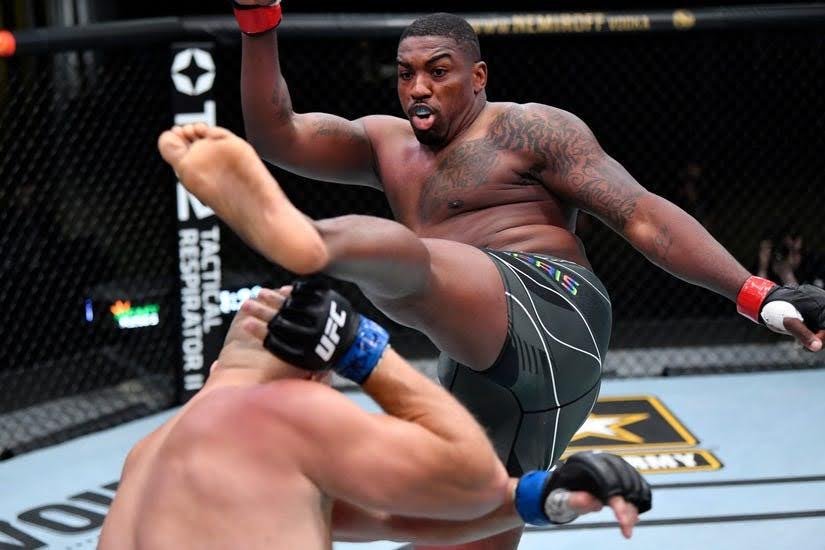
4. Walt Harris
Explosive power with extended range
Height: 6’5″
Division: Heavyweight
Leg Reach: 47″
Division Average: 44″
Statistical Breakdown
- Percent longer than heavyweight average: +6.8%
- Predicted height with this leg reach: ~6’7″
Walt Harris shares the same 47-inch leg reach as Alexander Volkov, but his measurement becomes slightly more impressive when placed next to his height.
At 6’5″, Harris stands two inches shorter than Volkov while possessing the exact same leg length. That means a larger portion of his frame is concentrated in his lower body, giving him reach advantages that are not immediately obvious just by looking at his height.
In Harris’s case, that length pairs with a very different style.
While Volkov often uses his reach in slow, methodical range battles, Harris built his reputation on explosive bursts of offense. His long legs allow him to launch sudden knees in the clinch and close distance aggressively while still maintaining enough range to strike safely.
Those extra inches also make his forward pressure more dangerous. Opponents trying to step inside must cover slightly more distance before they can engage, leaving them vulnerable to kicks and counterstrikes on the way in.
In the heavyweight division, where timing windows are small and mistakes are costly, even a few inches of additional reach can change how exchanges unfold.
Harris’s leg reach may match Volkov’s on paper, but because it comes from a slightly shorter frame, it stands out just a bit more.
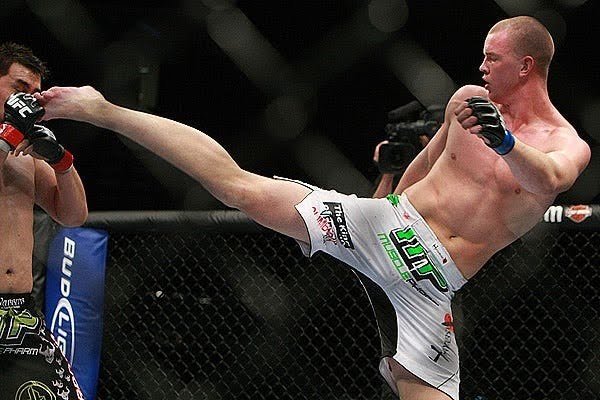
3. Stefan Struve
The tallest fighter in UFC history
Height: 7’0″
Division: Heavyweight
Leg Reach: 48″
Division Average: 44″
Statistical Breakdown
- Percent longer than heavyweight average: +9.1%
- Predicted height with this leg reach: ~6’8″
Stefan Struve is the tallest fighter to ever compete in the UFC, so seeing him near the top of this list should not come as a surprise.
At seven feet tall, long legs are simply part of the package.
His 48-inch leg reach is tied for the longest ever recorded in the promotion, extending roughly four inches beyond the heavyweight average. That extra length gave Struve a natural advantage in areas where leverage and distance are critical.
Opponents had to deal with:
- long front kicks that kept them at bay
- towering knees in clinch exchanges
- submission threats from a guard that could reach farther than expected
Struve’s frame created unique grappling opportunities as well. His long legs allowed him to lock triangles and other submissions from positions that would be difficult for shorter fighters to replicate.
Still, compared with the fighters ranked above him, Struve’s leg reach is not especially unusual relative to his height. When someone stands seven feet tall, long limbs are expected.
What makes Struve notable is not that his proportions are strange, but that his sheer size pushes the limits of what reach can look like inside the heavyweight division.

2. Christian Colombo
Heavyweight length without extreme height
Height: 6’5″
Division: Heavyweight
Leg Reach: 48″
Division Average: 44″
Statistical Breakdown
- Percent longer than heavyweight average: +9.1%
- Predicted height with this leg reach: ~6’8″
Christian Colombo shares the longest recorded leg reach in UFC history, but his proportions make the statistic far more striking than it first appears.
Unlike Stefan Struve, who stands seven feet tall, Colombo measures 6’5″. Yet despite being seven inches shorter, he possesses the exact same 48-inch leg reach.
That difference makes his proportions noticeably more unusual.
With more of his height concentrated in his lower body, Colombo’s reach extends farther than opponents might expect when looking at his frame. In striking exchanges, that length can subtly shift the distance at which engagements happen, forcing opponents to close slightly more space before they can land their own attacks.
Those long legs also become an advantage in the clinch, where knees travel farther and leverage can become easier to generate.
In a division where many fighters rely on power rather than range control, Colombo’s proportions highlight how leg length alone can quietly influence the geometry of a fight.
But even Colombo’s reach is overshadowed by the fighter at the top of this list.

1. Magnus Cedenblad
The most extreme leg proportions in UFC history
Height: 6’3″
Division: Middleweight
Leg Reach: 48″
Division Average: 42″
Statistical Breakdown
- Percent longer than middleweight average: +14.3%
- Predicted height with this leg reach: ~6’8″
Magnus Cedenblad stands at the top of this list not because his legs are longer than everyone else’s, but because of how unusual they are relative to his height and division.
At 6’3″, Cedenblad shares the same 48-inch leg reach as both Stefan Struve and Christian Colombo. The difference is that those fighters compete in the heavyweight division, where long limbs are common and the average leg reach sits around 44 inches.
Cedenblad, however, fought at middleweight, where the average leg reach is closer to 42 inches.
That means his legs extend roughly six inches beyond the divisional norm, an enormous gap in a sport where even one or two inches can change how exchanges unfold.
In practical terms, this gave Cedenblad advantages in several areas:
- Clinch leverage, where longer legs make knees easier to deliver
- Guard control, allowing stronger positional control in grappling exchanges
- Distance management, forcing opponents to travel farther before they could close range
Perhaps the most striking detail is the predicted height associated with his leg reach. Based purely on leg length, a fighter with 48-inch legs would normally stand somewhere around 6’8″.
Cedenblad stands five inches shorter than that estimate, meaning a greater portion of his frame is concentrated in his lower body.
That makes his proportions the most unusual among the fighters on this list.
While leg reach alone does not determine success inside the cage, Cedenblad’s anatomy provides a fascinating example of how limb length can quietly shape the way a fighter moves, strikes, and grapples.
In MMA, inches matter.
But how those inches are distributed may matter even more.