
The height gaps, defining fights and skills that helped boxing’s shorter fighters defeat much taller opponents
Tony Tucker had the height, the reach and the last championship belt Mike Tyson needed. Standing 6’5″, he towered seven inches above the 5’10” Tyson.
In August 1987, Tyson beat him over twelve rounds to unite the WBC, WBA and IBF heavyweight titles. Both men weighed 221 pounds. Their weight was identical; their frames were not.
Almost nine decades earlier, Barbados Joe Walcott had taken that contrast considerably further. At approximately 5’1½”, the welterweight champion defeated accomplished opponents whose height advantages approached ten inches.
But boxing’s long history demands context. A 5’10” heavyweight did not face the same physical landscape in every era. Moving through several divisions also does not automatically mean a boxer repeatedly defeated much taller opponents.
The strongest evidence comes from the fights: the height differences, the quality of the opposition and the results.
These fifteen boxers combined substantial height disadvantages with remarkable achievement. Some won championships across several divisions. Others repeatedly defeated larger contenders or delivered exceptional performances when victory escaped them.
How We Selected and Ranked the Boxers
Four factors guide the ranking:
- Meaningful height disadvantages. Gaps around four inches or more carry particular weight. Repeated success against elite opponents approximately three inches taller also matters.
- Opponent quality at the time. A reigning champion or established contender counts for more than someone whose reputation developed years later.
- Repeated evidence. Sustained success outweighs one unusual matchup. Exceptional draws and competitive defeats strengthen a case; simply lasting the distance does not.
- Division and era. Historical fighters are assessed against their actual opposition, rather than modern divisional averages imposed retrospectively.
Championships strengthen a case, but do not determine the order. Walker’s heavyweight campaign, for example, matters beyond his draw with Sharkey; Matlala’s Carbajal victory followed championship wins over other substantially taller opponents.
Height remains the focus. Reach and weight appear where they help explain a matchup. Racial exclusion also shaped opportunities, particularly for fighters denied access to the world heavyweight championship.
BoxRec supplies the default measurements, with exceptions identified. These are historical listings, not independently verified barefoot measurements. Height gaps are approximate.
This ranks achievement relative to height disadvantage—not overall boxing greatness or the largest height gap alone.
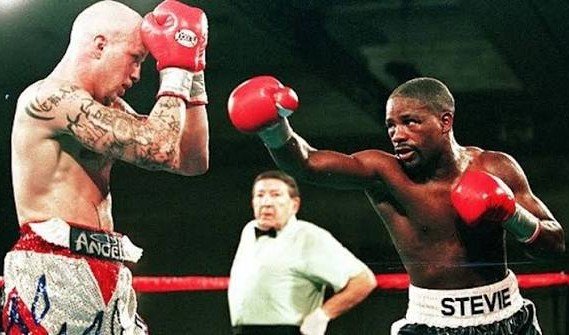
15. Stevie Johnston
Listed height: 5’4½” | Standout mismatch: 6½ inches against César Bazán
Stevie Johnston traveled to Paris and took a world championship from a defending champion five inches taller.
In March 1997, he defeated Jean-Baptiste Mendy, listed at 5’9½”, by split decision to win the WBC lightweight title. He subsequently defended against 5’9″ Saul Duran, winning a unanimous decision despite conceding 4½ inches.
His rivalry with César Bazán presented a greater contrast. Using Bazán’s conservative 5’11” listing, Johnston gave up 6½ inches in height, together with a substantial reach disadvantage.
Bazán won their first meeting by split decision in June 1998, but Johnston returned eight months later and reclaimed the championship through another split decision.
Quick hands, timing and entries behind his jab helped Johnston reach opponents whose longer frames might otherwise have kept him outside.
Across two championship reigns, he made seven successful WBC lightweight title defenses. “Lil’ But Bad” was an unusually appropriate nickname for a fighter whose stature so often understated the problem he presented.
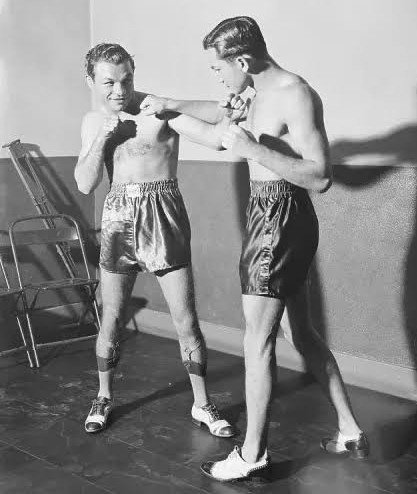
14. Tony Canzoneri
Listed height: 5’4″ | Standout mismatch: Five inches against Jack “Kid” Berg
Three rounds were enough for Tony Canzoneri to reverse a defeat against a man five inches taller.
Jack “Kid” Berg, listed at 5’9″, had beaten him in 1930. In April 1931, Canzoneri knocked Berg out in the third round, adding the junior-welterweight championship to the lightweight title he already held.
Their September rematch confirmed his superiority over fifteen rounds.
Having already been featherweight champion, he had now won titles in three divisions while standing just 5’4″. Against Berg, he produced both an emphatic finish and a long-distance victory after losing their first encounter.
Another demanding opponent was Billy Petrolle, whom Canzoneri defeated over fifteen rounds in November 1932. Petrolle stood 5’7″, creating a smaller height difference, but his roughly 70-inch reach exceeded Canzoneri’s listed 65 inches by five inches.
Petrolle was an established leading contender. Beating him strengthened Canzoneri’s record against accomplished, longer opponents beyond the Berg rivalry.
Canzoneri connected attacks to the body and head, giving taller men more to manage than punches aimed upward at a single target. His championship career demonstrated how much damage a 5’4″ boxer could do once he found his working distance.
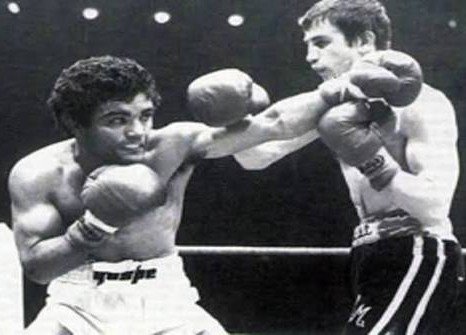
13. Santos Laciar
Listed height: 5’1″ | Standout mismatch: Five inches against Hilario Zapata
Hilario Zapata had already been a world champion when Santos Laciar defeated him over fifteen rounds in December 1984.
Zapata stood approximately 5’6″, five inches taller than the Argentine flyweight champion. His listed reach exceeded Laciar’s by about 5½ inches, compounding the difficulty of reaching him.
Laciar had also overcome a more extreme height difference. In July 1983, he stopped 5’7″ Hi-Sup Shin in the first round.
Shin later became an IBF flyweight champion, but that achievement still lay ahead when Laciar beat him. The Zapata victory carries greater established championship weight; the Shin fight illustrates the larger physical contrast.
Laciar’s second flyweight reign began in 1982 and included nine successful defenses before he moved up. A fifteen-round victory over Raymond Montero, standing around 5’4½”, added another successful defense against a substantially taller challenger.
He subsequently won a super-flyweight championship against Gilberto Román in 1987. Román was only about two inches taller, making that result more relevant to Laciar’s championship range than to the scale of his height disadvantage.
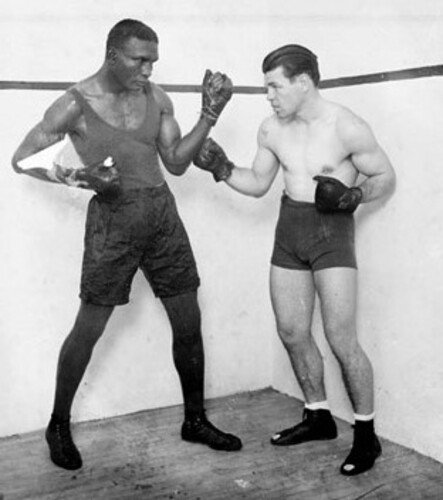
(Credit: Chicago Daily News / Library of Congress / Public Domain)
12. Mickey Walker
Listed height: 5’7″ | Standout mismatch: Approximately five inches against Jack Sharkey
A former welterweight champion weighing around 170 pounds had little obvious business troubling a leading heavyweight. Mickey Walker nevertheless fought Jack Sharkey to a fifteen-round draw in July 1931.
Sharkey weighed 198 pounds and stood approximately five inches taller. He was already an established contender and would become world heavyweight champion the following year.
The fight was competitive, although contemporary observers did not unanimously believe Walker deserved victory. The draw itself remains substantial evidence: a much shorter former welterweight champion had held a leading heavyweight across fifteen rounds.
Walker’s campaign also included victories over Johnny Risko, Paulino Uzcudun and King Levinsky. Their height advantages varied, but the repeated quality of the opposition gives his heavyweight work substance.
For a larger visual contrast, there was Arthur De Kuh, listed around 6’3½”. Walker stopped him in December 1932 while conceding approximately 8½ inches. Sharkey and the established contenders provide the more demanding evidence of his heavyweight standing.
Walker’s pressure and close-range punching allowed him to contest exchanges against longer men. Those attributes could not solve every assignment: Max Schmeling stopped him in eight rounds in September 1932.
His welterweight and middleweight championships were remarkable enough. Becoming a credible heavyweight contender at 5’7″ extended his career into a different kind of physical challenge.
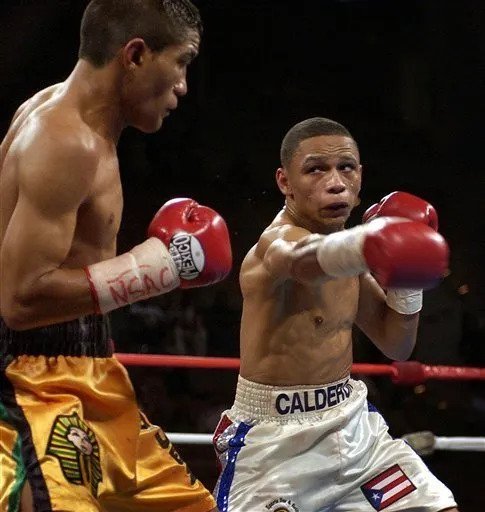
11. Iván Calderón
Listed height: 5’0″ | Standout mismatch: Five inches against Hugo Cázares
Iván Calderón could be the much shorter boxer and still make the taller man chase him.
After eleven successful defenses of his minimumweight championship, he moved up to challenge Hugo Cázares at junior flyweight in August 2007. Cázares stood approximately 5’5″, creating a five-inch difference.
An eighth-round knockdown threatened Calderón’s challenge. He recovered, completed the fight and won a split decision to become champion in a second division.
His footwork, timing and distance control complicated the assumption that a shorter fighter must spend every round forcing his way inside. Calderón could score and move, leaving longer opponents with the problem of catching him cleanly.
He defeated Cázares again in 2008, winning a unanimous technical decision after an accidental clash of heads ended the contest in the seventh round.
Between those meetings, he defended against Nelson Dieppa, a former junior-flyweight champion standing around 5’4″. Calderón won every round on all three scorecards.
At five feet tall, he repeatedly made accomplished, longer opponents fight at a pace and distance he could manage.

10. Canelo Álvarez
Listed height: 5’7½”–5’8″ | Standout mismatch: Seven to 7½ inches against Callum Smith
Callum Smith entered his December 2020 championship fight with a height advantage approaching eight inches. He left with a unanimous-decision defeat.
The 6’3″ super-middleweight champion lost to Canelo Álvarez by scores of 119–109, 119–109 and 117–111.
Smith’s listed 78-inch reach also exceeded Álvarez’s 70½ inches by about 7½ inches. Canelo advanced behind head movement and pressure, drove him toward the ropes and attacked the body and arms.
The victory began a sequence against taller champions. Billy Joe Saunders, standing around 5’11”, retired after eight rounds in May 2021. Caleb Plant, listed at 6’1″, was stopped in the eleventh round that November.
Depending on Álvarez’s height listing, Saunders was approximately three to 3½ inches taller and Plant five to 5½ inches taller. Beating Plant made Álvarez the first undisputed super-middleweight champion of the four-belt era.
He had also knocked out defending WBO light-heavyweight champion Sergey Kovalev in the eleventh round in 2019.
Canelo’s patience helped him cross distance without rushing every exchange. Once close, his body punching forced taller opponents to protect more than their heads.
Smith represents the largest championship contrast. The broader sequence gives the record its depth: several taller titleholders, different styles and repeated successful entries into punching range.

9. James Toney
Listed height: 5’9″ | Standout mismatch: Five inches against Vassiliy Jirov
James Toney often remained exactly where a shorter boxer was supposed to be uncomfortable: within punching distance of a larger opponent.
Shoulder turns, upper-body movement and short counters allowed him to stay close enough to answer rather than continually retreat. Taller men could discover that extending their punches exposed them to his return.
In April 2003, Toney challenged unbeaten IBF cruiserweight champion Vassiliy Jirov, listed at 6’2″. He won a unanimous decision after dropping Jirov in the final round. The Boxing Writers Association of America selected the contest as Fight of the Year.
The achievement came almost twelve years after Toney’s first world championship. In May 1991, he stopped Michael Nunn in the eleventh round to win the IBF middleweight title. Using Nunn’s conservative 6’1″ listing, Toney conceded four inches.
He then defeated 6’1″ Iran Barkley—also four inches taller—for the IBF super-middleweight championship in 1993. Barkley’s corner stopped the contest after nine rounds.
His heavyweight record requires a separate distinction. Toney initially appeared to win a title against John Ruiz in 2005, but the result became a no contest following a positive nandrolone test. It does not count as a championship victory here.
The Nunn, Barkley and Jirov victories remain central: three reigning champions, substantial height differences and successful performances across three divisions.
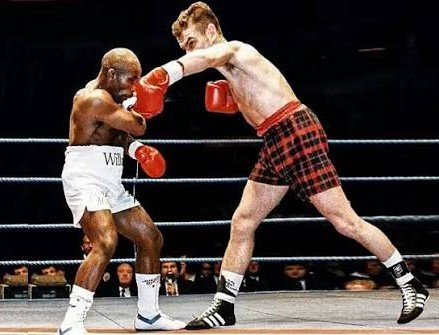
8. Jacob Matlala
Listed height: Approximately 4’10¼” | Standout mismatch: About seven inches against Michael Carbajal
Michael Carbajal stood around seven inches taller than Jacob Matlala. In July 1997, Matlala’s sustained attacks overwhelmed him, bringing a ninth-round stoppage.
The belt was the IBA junior-flyweight title, outside the four major sanctioning organizations. Carbajal’s quality gives the victory its importance: Matlala had defeated an accomplished champion through an unusually large height difference.
His success against taller championship opposition was already established. In 1993, he stopped Pat Clinton in the eighth round in Glasgow to win the WBO flyweight championship. Using Clinton’s conservative 5’3″ listing, the gap was about five inches.
Matlala subsequently moved down to junior flyweight and defeated Paul Weir, also listed around 5’3″, for the WBO championship in 1995.
Their first meeting ended in a technical decision following an accidental clash of heads. Matlala stopped Weir in the tenth round of the rematch.
Constant activity and combinations to the body and head made taller opponents defend repeatedly once he reached them. Against Carbajal, that pressure became the defining feature of the contest.
Matlala won major championships in two divisions at a height unusual even among the lightest professional boxers. The Carbajal performance demonstrated how much trouble he could create once the distance closed.
(Credit: Revista El Gráfico / Public Domain)
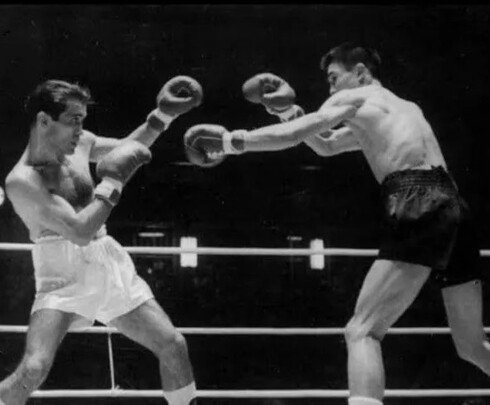
7. Pascual Pérez
Listed height: 4’11” | Standout mismatch: Six inches against Dai Dower
Pascual Pérez won his world championship in the defending champion’s home country, then returned and beat him more decisively.
In November 1954, the 4’11” Argentine defeated Yoshio Shirai over fifteen rounds in Tokyo to become world flyweight champion. Shirai stood around 5’4½”, approximately 5½ inches taller.
Pérez worked through the champion’s jab and early success, becoming more effective as the contest developed. A late knockdown and strong finish helped him secure the decision.
He returned to Tokyo in May 1955 and knocked Shirai out in five rounds.
Against Dai Dower, the contrast was greater. Dower stood around 5’5″ and had held British, Empire and European flyweight championships. Pérez knocked him out in the first round in March 1957.
Other defenses demanded much longer work. He defeated Leo Espinosa and Kenji Yonekura on points, while a thirteenth-round knockout of Sadao Yaoita avenged an earlier non-title defeat.
His championship reign lasted from 1954 to 1960 and included nine successful defenses.
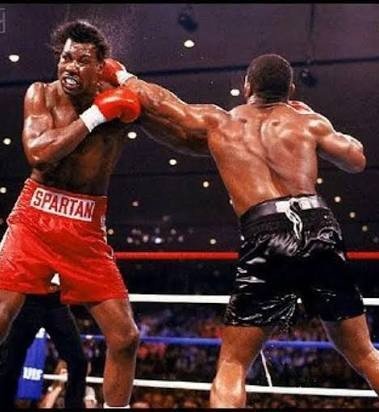
6. Mike Tyson
Listed height: 5’10” | Standout mismatch: Seven inches against Tony Tucker
A twelve-round decision over Tony Tucker completed Mike Tyson’s collection of the WBC, WBA and IBF heavyweight belts.
Tucker stood 6’5″, seven inches taller, while contemporary reporting listed Tyson with a 71-inch reach. Both weighed 221 pounds at the weigh-in—a reminder that being shorter did not make Tyson physically slight.
Tyson’s championship campaign repeatedly brought him against taller heavyweights.
He stopped 6’3″ Pinklon Thomas in six rounds in May 1987, overcoming a five-inch height difference against a former champion and highly ranked contender.
That October, he stopped 6’5″ Olympic gold medalist Tyrell Biggs in seven rounds. Biggs’s listed 80-inch reach exceeded Tyson’s by nine inches.
Michael Spinks still held the lineal championship until Tyson stopped him in 91 seconds in June 1988.
Tyson’s crouch, head movement and explosive combinations helped him pass extended punches and reach positions where hooks and uppercuts could arrive together.
His strength and compact build were advantages of their own. The height disadvantage existed alongside exceptional physical tools, which he repeatedly converted into championship victories.
The later defeats also belong in the account. Buster Douglas, Evander Holyfield and Lennox Lewis all defeated him. Those losses came under different circumstances and cannot be explained by height alone.
During his 1987 championship campaign, however, Tyson repeatedly solved opponents who possessed the longer frames to keep him away. Tucker, Thomas and Biggs form a particularly concentrated run of evidence.

5. Roberto Durán
Listed height: 5’7″ | Standout mismatch: Six inches against Iran Barkley
Iran Barkley had knocked out Thomas Hearns to become middleweight champion. Eight months later, he lost that championship to a 37-year-old Roberto Durán—a former lightweight champion standing six inches shorter.
Barkley’s listed 6’1″ height and 74-inch reach created a substantial contrast with Durán’s 5’7″ frame and 66-inch reach. The challenger surrendered eight inches in reach while pursuing a championship in his fourth weight division. Even relative to his own height, Durán’s measurements place him among boxers with unusually short arms.
Durán repeatedly countered and landed his right hand inside. In the eleventh round, he dropped Barkley with a combination. The champion recovered, but Durán won a split decision to take the WBC middleweight title in The Ring’s Fight of the Year for 1989.
He had already beaten Sugar Ray Leonard for the welterweight championship in 1980 and stopped Davey Moore for a junior-middleweight title in 1983.
Moore stood 5’10”, three inches taller, and had made three successful defenses before Durán stopped him in the eighth round. That was a smaller height gap than Barkley presented, but another victory over a reigning champion above Durán’s original championship division.
The setbacks were substantial, too. Leonard won their immediate rematch, while Hearns knocked Durán out in two rounds in 1984.
Nearly seventeen years separated Durán’s first lightweight championship from the Barkley victory. Beating a much taller middleweight champion so late in that journey remains one of the most extraordinary achievements in his career.

4. Manny Pacquiao
Listed height: 5’5½” | Standout mismatch: Approximately 5½ inches against Antonio Margarito
One judge awarded Manny Pacquiao every round against Antonio Margarito. The other two had him winning eleven and ten.
That November 2010 victory came against a 5’11” opponent. Using Pacquiao’s 5’5½” listing from BoxRec and Premier Boxing Champions, the difference was approximately 5½ inches.
Pacquiao landed 474 punches to Margarito’s 229, winning the vacant WBC junior-middleweight championship in a fight held at a 150-pound catchweight.
Margarito was a former welterweight champion contesting a vacant belt, rather than an established champion defending at the division’s full 154-pound limit. Pacquiao nevertheless overwhelmed a considerably taller opponent across twelve rounds.
The victory completed his eight-division championship record, a distinction built from major sanctioning-body titles and lineal/Ring championships.
In 2014, 5’10” Chris Algieri challenged for Pacquiao’s welterweight championship after winning a junior-welterweight title against Ruslan Provodnikov. Pacquiao conceded about 4½ inches, scored six official knockdowns and won a lopsided unanimous decision.
Against Oscar De La Hoya in 2008, speed and accurate straight lefts repeatedly beat the taller man to the target. De La Hoya’s corner stopped the fight after eight rounds.
Margarito and Algieri provide the clearest substantial gaps. Alongside the De La Hoya performance, they demonstrate how effectively Pacquiao could attack taller opponents long after leaving the divisions where his stature was ordinary.

3. Dwight Muhammad Qawi
Listed height: 5’6½” | Standout mismatch: 4½ inches against Matthew Saad Muhammad
Dwight Muhammad Qawi’s championship breakthrough came against a man whose reputation had been built through punishing title fights.
Matthew Saad Muhammad, standing 5’11”, was making the ninth defense of his WBC light-heavyweight championship in December 1981. Qawi stopped him in the tenth round, then won their rematch in six.
The 4½-inch difference did not leave Qawi waiting helplessly outside. He made Saad Muhammad’s jab miss and answered with forceful jabs, right hands and uppercuts. His pressure carried an attacking threat as he crossed the distance.
After losing a light-heavyweight unification fight to Michael Spinks, Qawi moved up and defeated Piet Crous for the WBA cruiserweight championship in 1985.
He defended against Leon Spinks in March 1986, dominating before a sixth-round stoppage. Leon’s 6’1″ listing created an even larger height difference of about 6½ inches. By then, the former heavyweight champion was eight years removed from his victory over Muhammad Ali.
Four months later, Qawi pushed Evander Holyfield through fifteen punishing rounds before losing a split decision.
Holyfield entered at 11–0, still an emerging professional rather than the established great he would become. Their contest nevertheless became one of cruiserweight’s defining fights, later selected by The Ring as the division’s best of the 1980s.
The two Saad Muhammad victories established Qawi against an accomplished taller champion. His cruiserweight championship and the Holyfield contest extended that success into a division where his height was even more unusual.

2. Barbados Joe Walcott
Listed height: Approximately 5’1½” | Standout mismatch: Approximately 9½ inches against Joe Choynski
Joe Walcott was exceptionally short even among welterweights. One of his most remarkable victories came against a dangerous puncher accustomed to fighting leading heavyweights.
In February 1900, he stopped Joe Choynski in the seventh round.
Using BoxRec’s measurements, Walcott stood about 5’1½” and Choynski about 5’11”, creating a gap of approximately 9½ inches. Choynski had already faced established heavyweight opposition; his famous victory over Jack Johnson followed the next year.
Walcott then defeated George Gardner over twenty rounds in September 1901. Gardner was about nine inches taller, while his 76-inch reach exceeded Walcott’s 65 inches by almost a foot.
Gardner became world light-heavyweight champion in 1903. That achievement still lay ahead when Walcott beat him, and Gardner won their return encounter in 1902.
Walcott’s own world welterweight championship came through a fifth-round stoppage of Rube Ferns in December 1901. Ferns stood 5’8″, approximately 6½ inches taller.
Contemporary reporting described Walcott breaking him down with body punches and swings to the head. The victory secured the recognized world welterweight championship.
His opponents establish the scale of the challenge without any need for a modern divisional average. Walcott beat a reigning welterweight champion and accomplished larger fighters whose height advantages would be remarkable in any era.
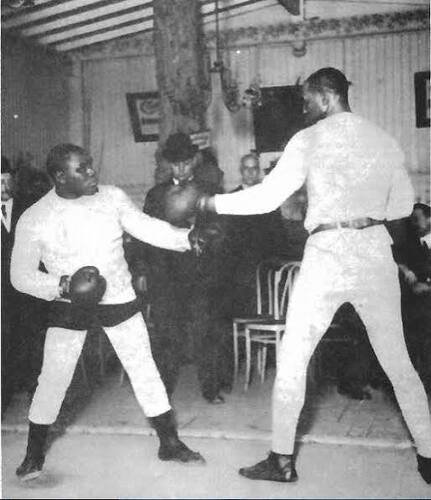
1. Sam Langford
Listed height: 5’7½” | Standout mismatch: Approximately eleven inches against Bill Tate
Sam Langford knocked out a man almost a foot taller to regain the World Colored Heavyweight Championship.
Bill Tate, listed at 6’6½”, had beaten him over twelve rounds in January 1917. When they met again that May, Langford stopped him in five.
This article uses Langford’s 5’7½” listing, supported by BoxRec and the WBC, rather than the 5’6½” measurement found in other accounts.
His record extended far beyond Tate. Langford repeatedly faced Harry Wills, Joe Jeannette and Sam McVea, recording victories over all three.
These were leading Black heavyweights whose opportunities were restricted by boxing’s racial barriers. Their demanding rivalries produced defeats and draws alongside Langford’s victories.
The November 1914 Wills fight illustrates the difficulty. Against a 6’2″ opponent, approximately 6½ inches taller, Langford suffered four knockdowns in the opening two rounds.
He recovered and knocked Wills out in the fourteenth. Contemporary reporting credited his judgment, improving footwork and accumulated punishment with gradually turning the contest.
Langford’s 74-inch reach mitigated some of his height disadvantage. His arms were unusually long, although Tate and Wills still exceeded him substantially in both measurements. That combination also places Langford among boxing champions with exceptionally long arms for their height.
The World Colored Heavyweight Championship brought together formidable fighters denied equal access to the world heavyweight title.
Jack Johnson decisively defeated a lighter Langford in 1906, before becoming world champion. He never granted Langford a championship rematch.
Langford’s case rests on years of heavyweight competition and repeated victories over substantially taller men. The championship opportunity he never received does not erase the opponents he beat.
Honorable Mentions
These five also produced championship success or exceptional performances against taller opposition. They narrowly missed the main fifteen under the combined criteria.
Humberto González — 5’1″
González conceded approximately 4½ inches to Michael Carbajal, yet won two of their three championship meetings. After losing their first fight by knockout, he won both encounters in 1994, reclaiming and retaining the unified junior-flyweight championship.
Aaron Pryor — 5’6″
Pryor twice stopped Alexis Argüello, the 5’10” three-division champion seeking a fourth championship at junior welterweight. He won their first fight in fourteen rounds in 1982 and the rematch in ten in 1983. Those victories followed his championship-winning knockout of Antonio Cervantes.
Carmen Basilio — 5’6½”
Already a welterweight champion, Basilio defeated Sugar Ray Robinson for the middleweight championship in September 1957. Robinson’s usual 5’11” listing creates a 4½-inch difference. Their fifteen-round split decision was followed by another demanding encounter, which Robinson won by split decision in 1958.
Nick Ball — Approximately 5’2″
Ball drew with Rey Vargas in March 2024, then defeated Raymond Ford by split decision that June to win the WBA featherweight title. Vargas’s height listings vary; using BoxRec’s 5’10” figure, also supported by PBC reporting, the gap was about eight inches. Ford’s 5’7″ listing creates a five-inch difference.
Brian Castaño — 5’7½”
The WBO junior-middleweight champion held 6’0″ Jermell Charlo to a split draw in their 2021 undisputed championship contest, conceding about 4½ inches. Castaño had also drawn with Erislandy Lara in 2019. Charlo stopped him in their 2022 rematch, but the first encounter remains a substantial performance against an established, much taller champion.
The Height Disadvantages at a Glance
These examples emphasize meaningful opposition rather than automatically selecting each boxer’s largest height gap. Walker’s draw with Sharkey appears alongside the winning performances.
| Rank | Boxer | Representative height gap |
| 15 | Stevie Johnston | 6½” vs. César Bazán |
| 14 | Tony Canzoneri | 5″ vs. Jack “Kid” Berg |
| 13 | Santos Laciar | 5″ vs. Hilario Zapata |
| 12 | Mickey Walker | About 5″ vs. Jack Sharkey |
| 11 | Iván Calderón | 5″ vs. Hugo Cázares |
| 10 | Canelo Álvarez | 7–7½” vs. Callum Smith |
| 9 | James Toney | 5″ vs. Vassiliy Jirov |
| 8 | Jacob Matlala | About 7″ vs. Michael Carbajal |
| 7 | Pascual Pérez | 6″ vs. Dai Dower |
| 6 | Mike Tyson | 7″ vs. Tony Tucker |
| 5 | Roberto Durán | 6″ vs. Iran Barkley |
| 4 | Manny Pacquiao | 5½” vs. Antonio Margarito |
| 3 | Dwight Muhammad Qawi | 4½” vs. Matthew Saad Muhammad |
| 2 | Barbados Joe Walcott | 9½” vs. Joe Choynski |
| 1 | Sam Langford | 11″ vs. Bill Tate |
What Height Could Not Decide
Taller opponents could establish distance, force a shorter boxer to cross open space and punish unsuccessful entries. These fighters found different ways through that problem.
Pressure and body work helped Qawi, Matlala and Durán deny opponents comfortable exchanges. Movement and timing allowed Calderón and Pacquiao to reach targets or escape before the taller man could respond. Close-range defense and counterpunching helped Toney stay productive where a longer opponent expected to control the action.
Most combined several tools. Tyson’s pressure depended on movement before the attack; Canelo’s body punching worked alongside the head movement that helped him get close.
None was guaranteed to succeed. Durán lost to Hearns, Walker to Schmeling and Tyson to Douglas. Their records contain victories and defeats because the physical challenge remained real, even for exceptional fighters.
Langford’s long reach adds another reminder: height describes part of a boxer’s body, not everything he brings into the ring.
What distinguishes this group is the evidence left behind—championship victories, repeated success against taller opposition and fights in which skill changed what the measurements seemed to promise.
Voted “Someone else”? Name your choice in the comments and tell us which fights make his case.