I spent years arguing about who jumped highest. Then I looked at how the combine actually works
I’ll admit it.
I’ve spent too many late nights arguing about this.
Scrolling through old threads. Rewatching the same clips. Trying to line up what I’m seeing with what the numbers say.
Michael Jordan. Vince Carter. Keon Johnson.
At some point, it stops adding up.
Because the numbers don’t agree with each other. And they don’t always match what you’re watching either.
I used to think that was just noise.
It isn’t.
The question that never settles
The argument always circles back to the same thing.
Who actually jumped the highest in NBA history?
The names don’t really change.
Jordan. Carter. Wilt. Spud Webb. Ja Morant. Keon Johnson.
The numbers shift by inches, sometimes by almost a foot, depending on the source.
Enough that two people can be talking about the same player and not even be using the same reality.
People blame exaggeration.
But the deeper problem is simpler.
What we think is being measured isn’t what’s actually measured.
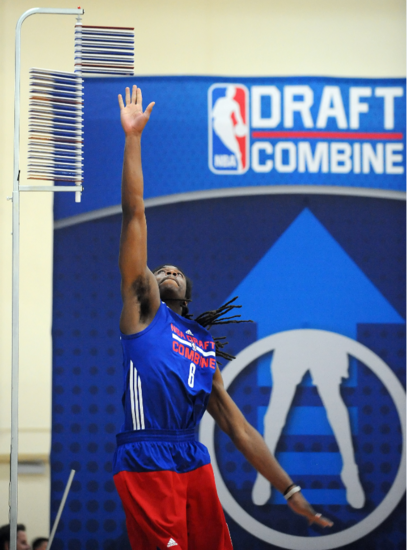
The NBA doesn’t measure how high you jump
I didn’t really understand that until I looked closely at how the combine works.
Two tests.
Standing vertical. No steps.
Max vertical. Short run-up.
Both use a Vertec. Plastic vanes. You jump, reach, and the highest one you hit becomes your number.
But the number isn’t your jump.
It’s the gap between two reaches:
Standing reach
Peak fingertip reach
And both can move.
Standing reach changes with posture. How much you extend. How seriously you treat the measurement.
Peak reach depends on wingspan, hand size, and how far you can extend your fingers.
Nothing in that process tells you where the body actually is.
Not your head.
Not your hips.
Not your center of mass.
You don’t have to jump higher to post a bigger number.
You just have to change the gap.
That’s how you end up with something like Keon Johnson’s 48-inch vertical — a real number from a clean measurement.
And still not what people think it is.

The first time the numbers stopped making sense
Westbrook was the one that broke it for me.
I remember looking up his combine numbers and thinking they were decent, not remarkable.
Then watching him play and realizing it didn’t line up at all.
He wasn’t just getting high.
He was already there.
Rebounds that didn’t look available suddenly were. Putbacks coming from underneath people, not above them.
That’s not just height.
It’s how quickly he gets there.
Morant, Zion, Sharpe — same problem, different bodies.
Some players rise gradually. Others arrive before you notice the jump.
The measurement treats both the same if they end up at the same point.
In games, they’re not the same at all.
That’s the speed problem.

There’s a second one.
Dwight Howard is where it shows up.
Around 39 inches — real, but not what wins arguments.
But he’s 6’11”, with long arms and a huge standing reach.
So his actual working height — where he catches the ball, where he finishes — sits in a space most players never reach, even with higher verticals.
LeBron fits the same pattern. So does Blake Griffin.
A smaller player might need 45 inches just to meet them there.
The question stops being about raw height.
It becomes about where players operate.
Michael Jordan: where the myth comes from
Jordan is where everything gets distorted.
Because the number people repeat — 48 inches — sounds precise enough to settle the debate.
But when you look closer, it separates.
Analysis from his playing years, including televised breakdowns and training-era measurements, tells a different story.
Standing vertical in the mid-30s.
Running jumps pushing into the high-30s, sometimes low-40s.
At full extension, fingertip reach climbing into the mid-40s.
That last number is the one that gets repeated.
Because it looks like height.
But it isn’t just the jump. It’s the jump plus reach plus timing plus extension.
I remember watching old clips again after seeing that and noticing something different.
It wasn’t how high he got.
It was how long he stayed there, adjusting midair and finishing plays he had no business finishing.
None of that shows up in a number.

Why dunking makes it harder to see clearly
Dunking distorts the comparison.
A leg kick stretches the body and makes the jump look higher than it is.
A double clutch holds you in the air longer than the jump actually does.
Free throw line dunks cover distance more than height.
Watching Vince Carter as a kid, it felt obvious he had to be the highest jumper ever.
Going back now, something else stands out.
He loaded quickly off two feet and got to full extension almost immediately, which is why defenders always looked late.
The elevation was real.
But the timing and the way he used his reach changed how that elevation was perceived.
The problem with trying to rank it cleanly
At some point I tried to sort it.
Pure vertical. Reach. Explosiveness. Game impact.
What broke it wasn’t the categories themselves.
It was how much each category depended on the others.
Westbrook’s explosiveness changes his effective reach.
LeBron’s size changes what his vertical means.
Jordan’s control changes how long he operates at his peak.
You can’t separate those things without losing what actually happens — Jordan’s hang time turns into a number, Westbrook’s explosiveness flattens into an average vertical.
That’s why every list ends up feeling slightly off.
A more accurate measurement would start somewhere else entirely.
Not one number.
A set of them.
Head height at the peak tells you where the body actually gets to, not just the fingertips.
Hip displacement shows how much the core of the body rises, separating the jump from wingspan.
Time to takeoff shows how quickly force turns into elevation, which is why Westbrook feels different even at similar heights.
Force production measures how much power is generated relative to body weight, which is where players like Zion become difficult to compare.
With a ball. In traffic. Off balance.
I used to think the disagreement meant the data was bad.
Now it feels like the opposite — the data exists, it just doesn’t measure the right things.
So the rest gets filled in with memory, highlights, and whatever version of them stuck first.
And that’s probably why it never settles.
Because once everything is measured perfectly, there’s nothing left to argue about.