A statistical breakdown of the UFC’s most extreme short-leg fighters and how they adapt
When fans talk about physical advantages in the UFC, the conversation almost always starts with height, reach, and wingspan. Long limbs are associated with distance control, kicking dominance, and defensive safety. But buried deep in the UFC’s statistics is a far rarer and more overlooked phenomenon: fighters whose legs are unusually short for their height and division.
Leg reach, measured from the hipbone to the heel, wasn’t officially tracked by the UFC until late 2015. Even today, it remains one of the least discussed measurements in MMA analysis. That’s understandable. Leg reach alone doesn’t determine kicking ability. Speed, flexibility, timing, and technique matter far more.
Yet extreme deviations from the average are never meaningless.
Just as freakishly long legs can create unusual advantages, exceptionally short leg reach can reshape a fighter’s entire style, from stance and footwork to takedown defense and striking range.
Below are the five shortest leg reaches ever recorded in UFC history, along with a statistical breakdown of just how extreme these proportions really are.
Average Leg Reach by UFC Division (for reference)
| Division | Avg Height | Avg Leg Reach |
| Flyweight | 5’5″ | 36″ |
| Bantamweight | 5’7″ | 38″ |
| Featherweight | 5’9″ | 39″ |
| Lightweight | 5’10” | 40″ |
| Welterweight | 5’11½” | 41″ |
| Middleweight | 6’1″ | 42″ |
| Light Heavyweight | 6’2″ | 43″ |
| Heavyweight | 6’3″ | 44″ |

1. Demetrious Johnson
The shortest leg reach ever recorded in UFC history
- Height: 5’3″
- Division: Flyweight
- Leg Reach: 34″
- Division Average: 36″
Statistical Breakdown
- Percent shorter than division average: –5.6%
- Predicted height with this leg reach: ~5’1″
Demetrious “Mighty Mouse” Johnson possesses the shortest leg reach ever measured in the UFC. At just 34 inches, his leg reach sits two full inches below the flyweight average, a massive deviation in a division where differences are usually measured in fractions.
What makes this remarkable is that Johnson is not unusually short for his division. At 5’3″, he stands only two inches below the average flyweight height. His legs, however, are proportioned as if he were shorter than his listed height.
This means a greater percentage of Johnson’s height is concentrated in his torso, a build that favors:
- Explosive level changes
- Elite balance
- Exceptional scrambling ability
Rather than relying on kicks or range management, Johnson built his dominance around speed, timing, and transitional grappling, effectively neutralizing what might otherwise be considered a physical disadvantage.

2. Dustin Ortiz
Compact proportions in a speed-driven division
- Height: 5’5″
- Division: Flyweight
- Leg Reach: 35″
- Division Average: 36″
Statistical Breakdown
- Percent shorter than division average: –2.8%
- Predicted height with this leg reach: ~5’3″
Dustin Ortiz’s leg reach aligns more closely with a shorter flyweight, despite him standing exactly at the division’s average height.
In a weight class dominated by movement and foot speed, Ortiz’s shorter legs subtly limit:
- Outside kicking range
- Defensive check timing
- Long-range striking exchanges
However, they also provide advantages in:
- Lower center of gravity
- Stability during clinch exchanges
- Wrestling-based entries
Ortiz’s build reinforces a recurring theme among short-legged fighters: pressure beats range when mechanics are efficient.

3. Drew Dober
One of the shortest legs ever seen at lightweight
- Height: 5’8″
- Division: Lightweight
- Leg Reach: 35″
- Division Average: 40″
Statistical Breakdown
- Percent shorter than division average: –12.5%
- Predicted height with this leg reach: ~5’3″
Drew Dober’s leg reach is arguably the most extreme case on this list relative to division.
At lightweight, a 35″ leg reach is five inches shorter than the division average, a deviation rarely seen outside of heavyweight anomalies.
To put this into perspective:
- Dober has roughly the same leg reach as Demetrious Johnson
- Demetrious Johnson is five inches shorter and fights two weight classes below
This extreme proportion forces Dober into a compact, forward-driven style, emphasizing:
- Pocket boxing
- Explosive hooks
- Durability over distance management
It also explains why Dober thrives in chaotic exchanges while rarely relying on kicks to establish range.
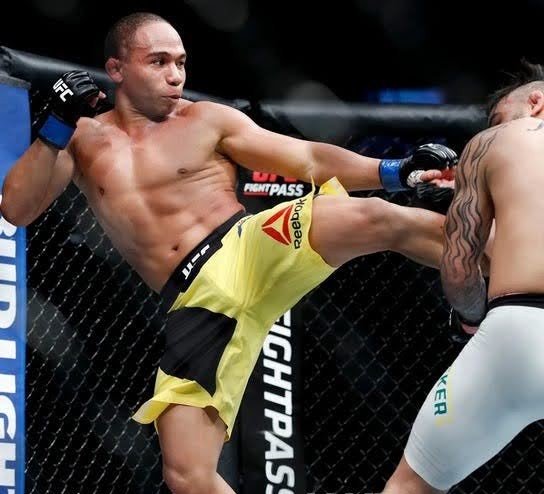
4. John Dodson
Elite speed, minimal leverage
- Height: 5’3″
- Division: Flyweight
- Leg Reach: 35″
- Division Average: 36″
Statistical Breakdown
- Percent shorter than division average: –2.8%
- Predicted height with this leg reach: ~5’3″
John Dodson’s leg reach is modestly below average, but its impact is magnified by his fighting style.
Dodson is one of the fastest flyweights in UFC history, relying on:
- Blitz entries
- Sudden angle shifts
- Counterpunching
Shorter legs reduce the effectiveness of long-range kicking but enhance:
- Reaction-based footwork
- Explosive lateral movement
- Balance during rapid directional changes
In Dodson’s case, shorter leg reach complements his speed-first approach rather than limiting it.

5. Ian Entwistle
A bantamweight built like a flyweight
- Height: 5’5″
- Division: Bantamweight
- Leg Reach: 35″
- Division Average: 38″
Statistical Breakdown
- Percent shorter than division average: –7.9%
- Predicted height with this leg reach: ~5’3″
Ian Entwistle’s leg reach is three inches shorter than the bantamweight average, effectively placing him in flyweight territory from a limb-length perspective.
This creates a natural disadvantage in:
- Kicking exchanges
- Distance striking
- Defensive range management
But, as seen repeatedly in MMA, compact builds often translate to:
- Improved grappling leverage
- Stronger clinch pressure
- Easier level changes
Entwistle’s proportions reinforce how body mechanics often dictate style more than skill preference.
What Short Leg Reach Really Means in MMA
Short leg reach does not doom a fighter but it does impose structural realities.
Fighters with unusually short legs tend to:
- Fight at closer range
- Rely less on kicking volume
- Develop pressure-heavy or wrestling-centric styles
Interestingly, some of the most successful fighters in UFC history, including Demetrious Johnson, demonstrate that elite skill can completely override anatomical limitations.
Leg reach may be one of the UFC’s least discussed measurements, but at the extremes, it quietly shapes everything from stance width to tactical decision-making.
In a sport where inches matter, how those inches are distributed may matter even more.