Mapping the NFL’s most extreme anatomical anomalies and the data tracking how severe wingspan-to-height discrepancies create unblockable field leverage
In the NFL, a few inches can make or break a career. These players weren’t just tall or strong; they were anatomically exceptional
Height and weight dominate scouting reports, but arm length quietly separates the good from the extraordinary. Some players arrive with natural leverage that rewrites the rules of the game. In the NFL, a few inches of reach can be the difference between a sack and a screen pass, a block and a missed tackle, a career and a footnote.
Why Arm Length Matters in the NFL
In the trenches of the NFL, battles are won inch by inch, literally. A player’s arm length determines leverage, reach, and the ability to control an opponent before contact even begins.
- Offensive linemen use their arms to keep pass rushers at bay. A few extra inches allow them to engage defenders before they can reach the quarterback’s body.
- Defensive linemen rely on long arms to maintain separation, shed blocks, and disrupt plays in the backfield. Longer reach means you can touch your target while staying out of their grasp.
- Receivers and defensive backs gain a subtle but critical advantage: the ability to snatch passes, swat the ball, or maintain separation without overextending.
Even for elite athletes, arm length is a rare trait. While most NFL players measure between 31 and 34 inches, the giants on this list operate on a completely different scale, arms so long they give them a physical edge few can match.
What Is the Arm Length Index (ALI)?
The Arm Length Index (ALI) measures how much a player’s arms exceed or fall short of the norm for their height. Think of it as a “stretch multiplier” that turns raw inches into context.
How it works:
- Take a player’s actual arm length.
- Compare it to the expected average arm length for their height.
- The difference, measured in inches, is the ALI.
For example, a 6’4” lineman with 36-inch arms has an ALI of roughly +3.27, meaning his arms are more than three inches longer than expected for someone his height.
Why it matters:
- +3.0 and above: Players in this range aren’t just long; they’re freakishly disproportionate, giving them a real advantage in leverage and reach.
- Below +3.0: Still impressive, but within the range of normal elite length.
The ALI gives fans, analysts, and scouts a way to quantify something that’s often just “felt” on the field: who truly has freakish reach and who simply looks long on paper.
Cutoff Explanation: The 3.0+ Rule
Not every long-armed player makes the list. To separate the merely tall from the truly exceptional, we use the 3.0+ ALI cutoff.
Why 3.0?
Because three full inches beyond the expected arm length for a player’s height isn’t normal variation; it’s anatomical separation. In a league where fractions of an inch matter, a three-inch surplus is massive.
Across this list, ALI scores now range from +3.0 at the threshold to +4.14 at the extreme end. That upper boundary isn’t just rare; it’s almost unheard of.
In NFL terms, that difference can be the margin between winning at the line of scrimmage or getting locked out, between collapsing the pocket or being washed out of the play.
Players who clear this threshold don’t just look different; they operate in a physically elite category. Only those with 3.0 inches or more beyond the expected arm length are included, and anything below that is impressive but not extreme enough to make the cut.
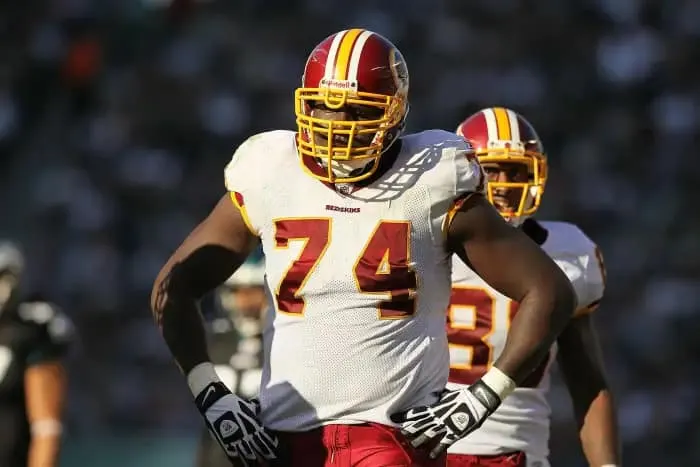
19. Stephon Heyer (ALI: +3.05″)
At 6’6”, Stephon Heyer had arms that gave him a subtle but important edge along the offensive line. Measuring 36.88 inches, his reach was more than three inches longer than the average player of his height, providing extra leverage in both pass protection and run blocking.
Arm Length: 36.88″
Height: 6’6″
Expected Arm Length: 33.83″
Arm Length Index: +3.05″
While not as extreme as some of the league’s top freaks, Heyer’s arms were long enough to give him a consistent advantage at the line of scrimmage, helping him control defenders and maintain proper distance, making him a reliable presence on every play.
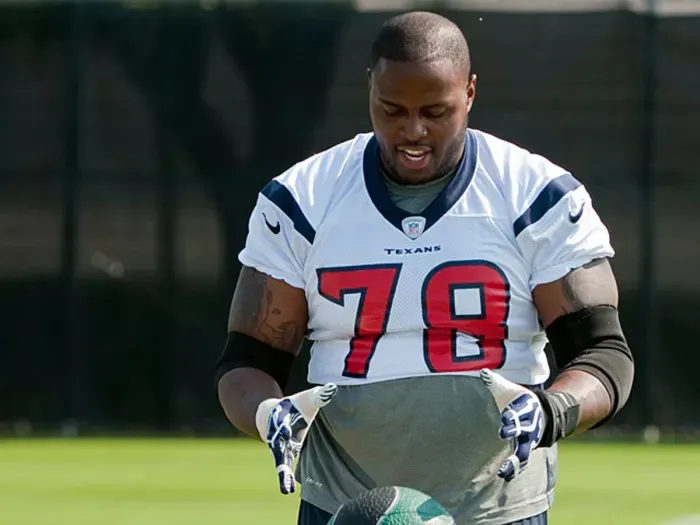
18. Rashad Butler (ALI: +3.27″)
At 6’4”, Rashad Butler had the prototypical height for an offensive lineman, but his arm length set him apart. Measuring 36 inches, his arms were 10% longer than the average player at his height, giving him an Arm Length Index of +3.27 inches.
Arm Length: 36.00″
Height: 6’4″
Expected Arm Length: 32.73″
Arm Length Index: +3.27″
That extra reach allowed Butler to engage defenders before they could gain leverage, helping him hold the line in both pass protection and run blocking throughout his career.
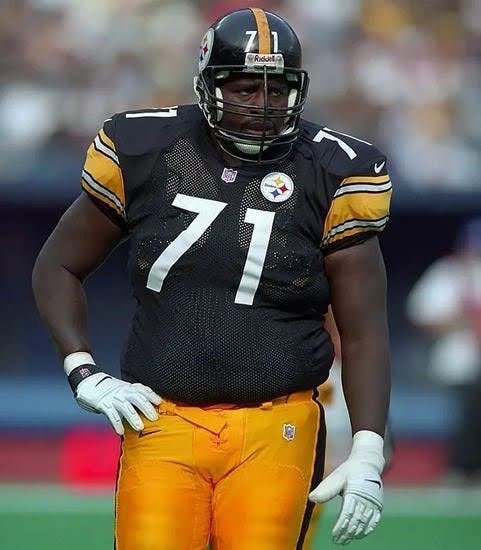
17. Larry Tharpe (ALI: +3.27″)
At 6’4”, Larry Tharpe possessed the ideal height for an offensive tackle, but his arm length made him exceptional. Measuring 36 inches, his reach was 10% longer than the average player of his height, giving him an Arm Length Index of +3.27 inches.
Arm Length: 36.00″
Height: 6’4″
Expected Arm Length: 32.73″
Arm Length Index: +3.27″
Tharpe’s extra extension helped him anchor against powerful pass rushers, giving him a rare advantage in both run blocking and pass protection throughout his NFL career.
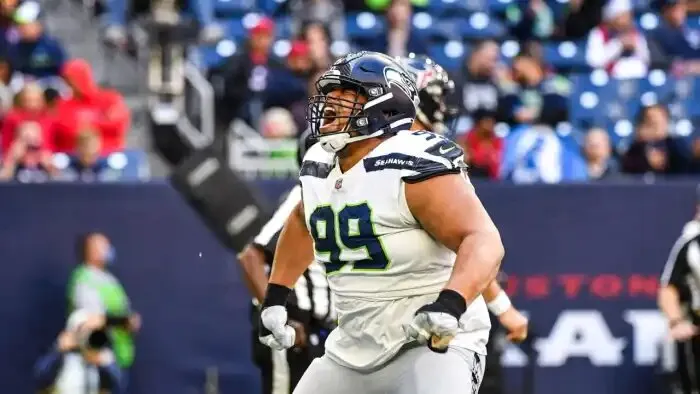
16. Al Woods (ALI: +3.27″)
At 6’4”, Al Woods was built like a prototypical NFL interior lineman, but his arm length set him apart. With 36-inch arms, he measured 10% longer than the average player of his height, giving him an Arm Length Index of +3.27 inches.
Arm Length: 36.00″
Height: 6’4″
Expected Arm Length: 32.73″
Arm Length Index: +3.27″
Woods’ unusually long reach allowed him to control the line of scrimmage, maintain leverage on blockers, and maximize his effectiveness as a defensive tackle across multiple NFL teams.
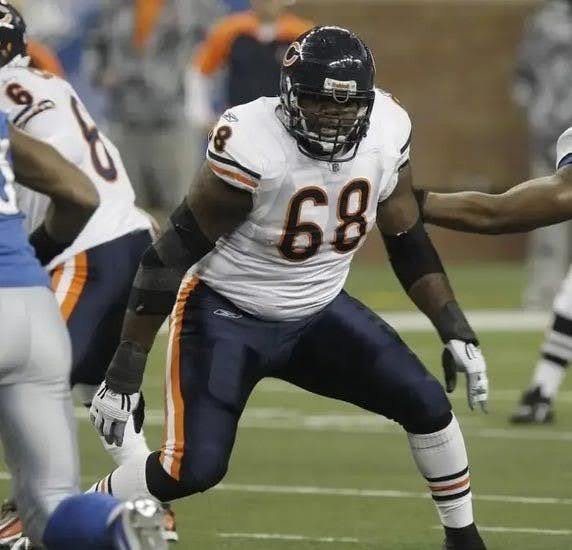
15. Frank Omiyale (ALI: +3.27″)
At 6’4”, Frank Omiyale had the size of a prototypical offensive tackle, but his arm length gave him a distinct advantage. Measuring 36 inches, his reach was 10% longer than the average player of his height, giving him an Arm Length Index of +3.27 inches.
Arm Length: 36.00″
Height: 6’4″
Expected Arm Length: 32.73″
Arm Length Index: +3.27″
Omiyale’s extended reach helped him create separation from defenders at the line of scrimmage, allowing him to protect the quarterback effectively and contribute across multiple NFL teams during his career.
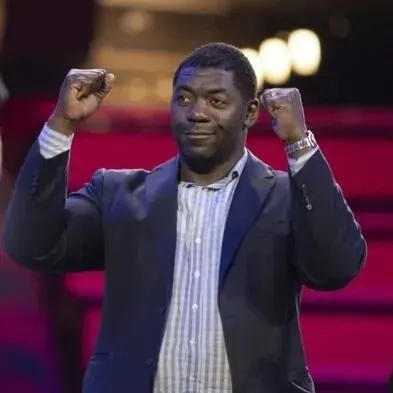
14. Roman Oben (ALI: +3.27″)
At 6’4”, Roman Oben was already the prototype for an NFL offensive tackle, but his arms set him apart. Measuring 36 inches, his reach was 10% longer than the average player his height, giving him an Arm Length Index of +3.27 inches.
Arm Length: 36.00″
Height: 6’4″
Expected Arm Length: 32.73″
Arm Length Index: +3.27″
That extra extension allowed Oben to dominate at the line of scrimmage, giving him the leverage to control defenders and excel over a 12-year NFL career.
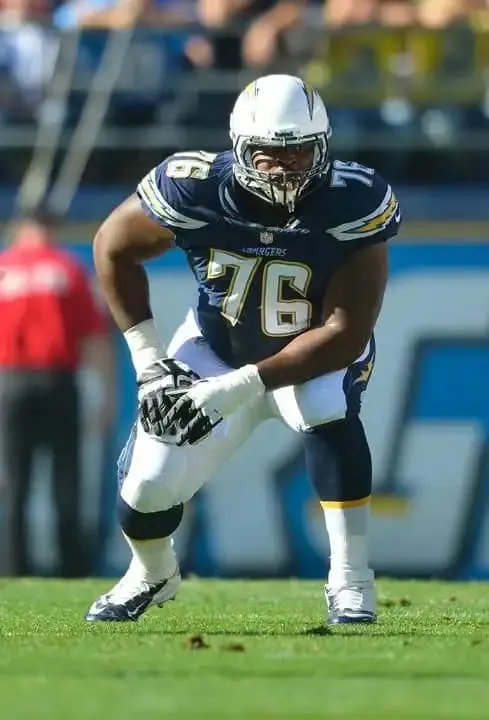
13. D.J. Fluker (ALI: +3.34″)
At 6’5”, D.J. Fluker had prototypical size for an NFL offensive tackle, but his arm length gave him an even bigger advantage. Measuring 36.75 inches, his reach was roughly 10% longer than the average player of his height, giving him 3.34 inches of extra extension.
Arm Length: 36.75″
Height: 6’5″
Expected Arm Length: 33.41″
Arm Length Index: +3.34″
That extra reach made Fluker a nightmare for defenders trying to penetrate the pocket, helping him maintain leverage and dominate matchups on the offensive line.
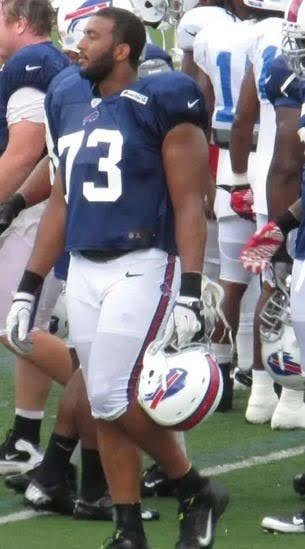
12. Jarron Gilbert (ALI: +3.34″)
At 6’5”, Jarron Gilbert combined rare height with exceptional arm length. His 36.75-inch reach was about 10% longer than the average for his height, giving him an additional 3.34 inches of extension over most players.
Arm Length: 36.75″
Height: 6’5″
Expected Arm Length: 33.41″
Arm Length Index: +3.34″
This extra reach allowed Gilbert to engage blockers early and maintain control on the edge as a defensive end, making him a disruptive presence in the backfield during his time in the NFL.
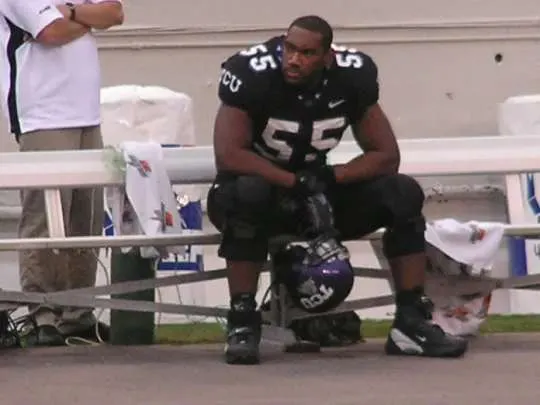
11. Anthony Alabi (ALI: +3.34″)
Standing 6’5”, Anthony Alabi possessed the ideal size for an offensive tackle, but his arms gave him an even bigger advantage. Measuring 36.75 inches, his reach was roughly 10% longer than the typical player at his height, translating to an ALI of +3.34 inches.
Arm Length: 36.75″
Height: 6’5″
Expected Arm Length: 33.41″
Arm Length Index: +3.34″
Alabi’s extended reach helped him keep defenders at bay, allowing him to maintain leverage and protect the quarterback effectively during his NFL career.
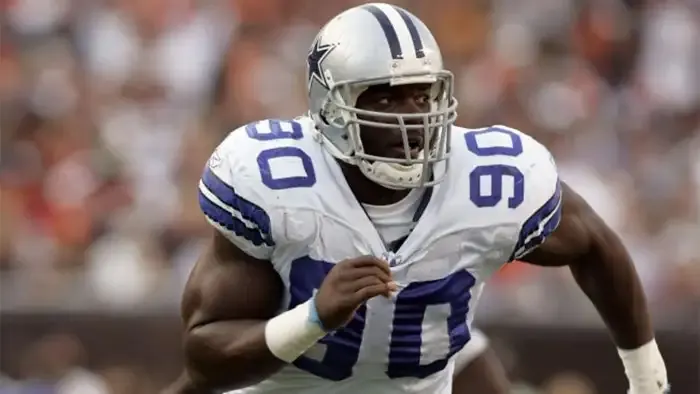
10. Eric Ogbogu (ALI: +3.52″)
At 6’4”, Eric Ogbogu had ideal height for a defensive end, but his arms gave him a significant edge. Measuring 36.25 inches, his reach was about 9% longer than the average player of his height, giving him 3.52 inches of extra extension.
Arm Length: 36.25″
Height: 6’4″
Expected Arm Length: 32.73″
Arm Length Index: +3.52″
That extra reach allowed Ogbogu to engage blockers earlier, control the line of scrimmage, and keep quarterbacks in his sights. Off the field, he became a memorable personality with his famous Under Armour catchphrase: “We must protect this house!”
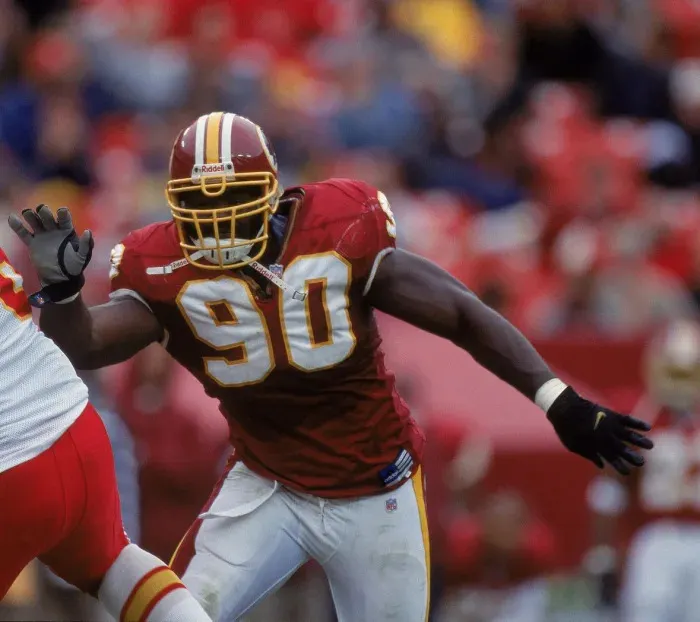
9. Kenard Lang (ALI: +3.57″)
Defensive end Kenard Lang was a classic example of how arm length can redefine a player’s physical presence. At 6’3” with 36.00-inch arms, Lang’s reach exceeded the norm by 11%, giving him an ALI of +3.57″.
- Arm Length: 36.00″
- Height: 6’3″
- Expected Arm Length: 32.43″
- Arm Length Index: +3.57″
Lang’s long arms helped him control offensive tackles, extend his pass-rush, and dominate at the line of scrimmage. Even when facing technically superior blockers, that extra leverage often made all the difference.
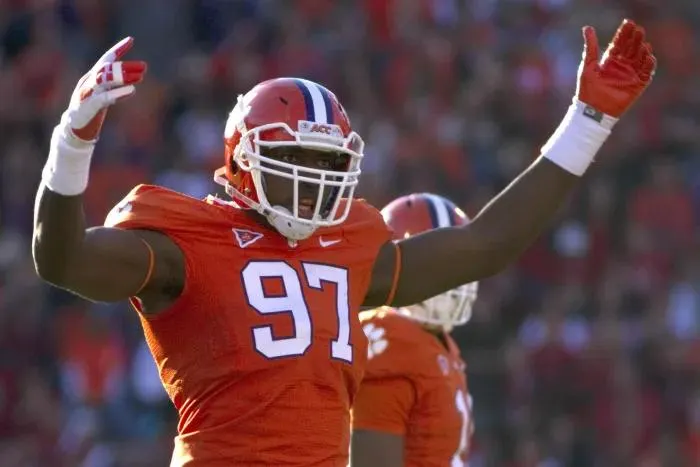
8. Malliciah Goodman (ALI: +3.65″)
Malliciah Goodman had a brief NFL career as a defensive end, playing a total of 37 games across five seasons. At 6’4”, his arms measured an astounding 36.38 inches, 3.65 inches longer than what’s typical for someone his height.
- Arm Length: 36.38″
- Height: 6’4″
- Expected Arm Length: 32.73″
- Arm Length Index: +3.65″
That extra reach gave Goodman a natural advantage at the line of scrimmage, allowing him to keep blockers at bay and extend his influence on passing lanes. While his time in the league was short, his freakish arm length placed him firmly in the “Elite Disproportion” tier of NFL anatomical anomalies.
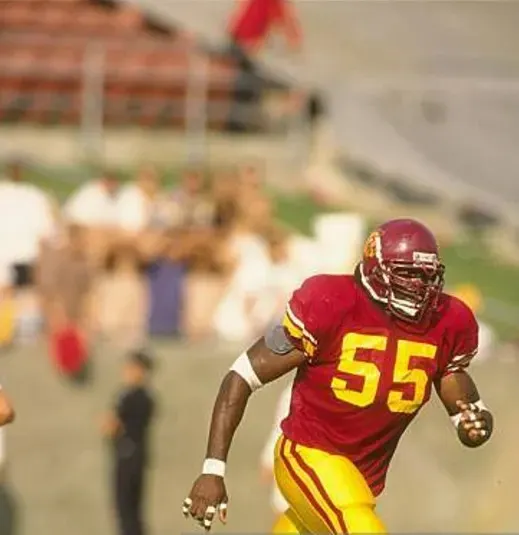
7. Israel Ifeanyi (ALI: +3.70″)
Defensive end Israel Ifeanyi had an arm length that immediately drew attention when he entered the NFL. Standing 6’3” with 36.13-inch arms, he measured 9.2% longer than the average for his height, giving him an ALI of +3.70″.
- Arm Length: 36.13″
- Height: 6’3″
- Expected Arm Length: 32.43″
- Arm Length Index: +3.70″
That extra reach allowed Ifeanyi to engage offensive linemen early, keeping them off balance and giving him a distinct advantage as a pass rusher. His arms weren’t just long, they were game-changing tools in the trenches.
6. Antonio Anderson (ALI: +3.92″)
Defensive lineman Antonio Anderson spent two seasons in the NFL, but his astonishing arm length immediately set him apart. At 6’6” with 37.75-inch arms, Anderson’s reach was 11% longer than the average for his height, giving him an ALI of +3.92″.
- Arm Length: 37.75″
- Height: 6’6″
- Expected Arm Length: 33.83″
- Arm Length Index: +3.92″
Those arms gave Anderson a rare advantage at the point of attack, allowing him to engage blockers from a distance and dominate the line of scrimmage, an edge even compared to taller peers like Lane Johnson.
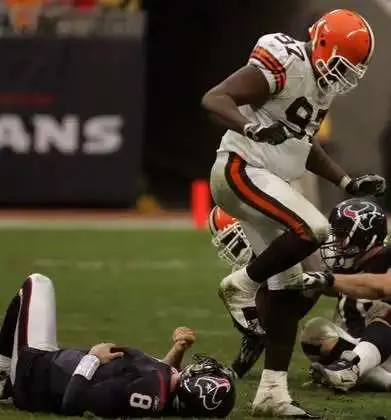
5. Alvin McKinley (ALI: +4.07″)
Defensive tackle Alvin McKinley spent eight seasons in the NFL, but what really set him apart on the line was his exceptional reach. Standing 6’3” with 36.5-inch arms, McKinley’s length was 10% above the average for his height, giving him an ALI of +4.07″.
- Arm Length: 36.50″
- Height: 6’3″
- Expected Arm Length: 32.43″
- Arm Length Index: +4.07″
On both run and pass plays, those extra inches allowed McKinley to engage blockers before they could get their hands on him, giving him leverage and control in the trenches across his stints with Carolina, Cleveland, Denver, and New Orleans.

4. Dallas Baker (ALI: +4.07″)
Wide receiver Dallas Baker may not have had a long NFL career, but his arm length was exceptional for his height. At 6’3” with 36.5-inch arms, Baker measured 10% longer than the average player his height, giving him an arm length index of +4.07″.
- Arm Length: 36.50″
- Height: 6’3″
- Expected Arm Length: 32.43″
- Arm Length Index: +4.07″
Baker’s freakish reach helped him stand out, literally, on the field. Even as a practice squad player and short-term roster member, his arms gave him an edge in catching radius and contested plays, traits that later served him in the CFL, Arena League, and National Arena League.
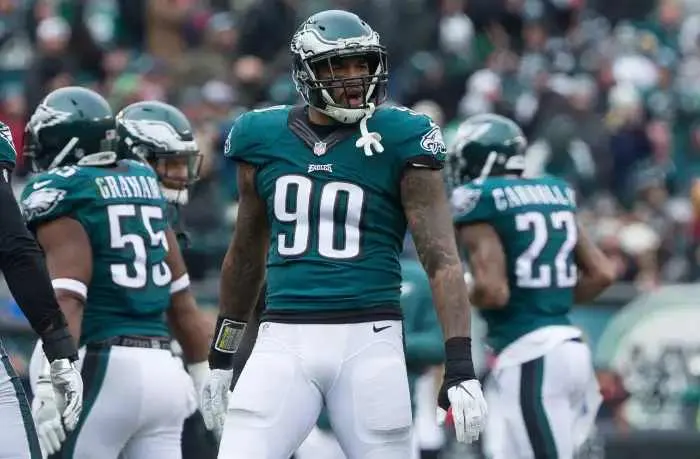
3. Jon Harris (ALI: +4.12″)
Defensive end Jon Harris likely boasts the longest arms ever measured in NFL history. Standing 6’7” with 38.5-inch arms, his reach is a staggering 12% longer than the average player his height, giving him an arm length index of +4.12″.
- Arm Length: 38.50″
- Height: 6’7″
- Expected Arm Length: 34.38″
- Arm Length Index: +4.12″
Harris’s freakish length allowed him to dominate at the point of attack, controlling offensive linemen and disrupting plays before opponents could even get their hands on him. To put it in perspective, Calais Campbell, an inch taller, has arms nearly three inches shorter. Harris wasn’t just long; he was in a tier of his own.
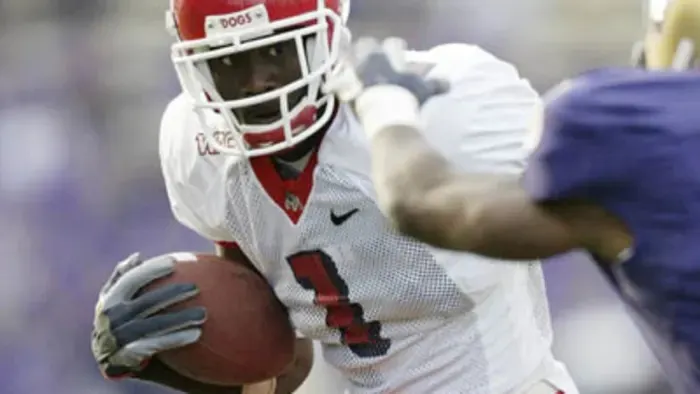
2. Paul Williams (ALI: +4.14″)
At 6’1”, Paul Williams already had the height of a prototypical wide receiver, but his arms gave him a rare edge. Measuring 36 inches, his reach was 13% longer than the average player of his height, giving him over four inches of extra extension.
- Arm Length: 36.00″
- Height: 6’1″
- Expected Arm Length: 31.86″
- Arm Length Index: +4.14″
That extra reach made Williams a natural at creating separation and securing contested catches, allowing him to stand out in the NFL despite not being the tallest receiver. Beyond the field, athleticism runs in the family; he’s the uncle of three-time NWSL champion Lynn Williams.
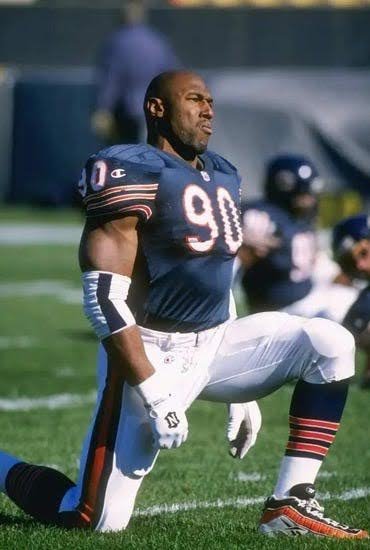
1. Alonzo Spellman (ALI: +4.15″)
Defensive lineman Alonzo Spellman spent nine seasons in the NFL, and his exceptional arm length made him a rare physical specimen. At 6’4” with 36.88-inch arms, Spellman’s reach was 11% longer than average for his height, giving him an ALI of +4.15″.
- Arm Length: 36.88″
- Height: 6’4″
- Expected Arm Length: 32.73″
- Arm Length Index: +4.15″
Those extra inches weren’t just for show: Spellman could extend his hands before blockers could engage, giving him unmatched leverage on the defensive line. Even after leaving the NFL in 2001, his frame and reach allowed him to play one season in the Arena Football League in 2006.
Average NFL Arm Length by Height
Based on NFL Combine measurements and historical player data, arm length tends to scale consistently with height across positions. The table below reflects established averages from verified measurements between 6’1” and 6’8”, with proportional extrapolation used for heights slightly outside that range.
| Height | Average Arm Length |
| 5’9″ | 30.18″ |
| 5’10” | 30.60″ |
| 5’11” | 31.02″ |
| 6’0″ | 31.44″ |
| 6’1″ | 31.86″ |
| 6’2″ | 32.25″ |
| 6’3″ | 32.43″ |
| 6’4″ | 32.73″ |
| 6’5″ | 33.41″ |
| 6’6″ | 33.83″ |
| 6’7″ | 34.38″ |
| 6’8″ | 34.83″ |
| 6’9″ | 35.25″ |
| 6’10” | 35.67″ |
| 6’11” | 36.09″ |
| 7’0″ | 36.51″ |
Honorable Mentions
Just below the 3.0-inch cutoff, these players still possess rare length for their height. While they don’t cross into freak-tier territory, their reach is well above the NFL norm.
| Player | Height | Arm Length | Expected | ALI |
| Tyron Smith | 6’5″ | 36.38″ | 33.41″ | +2.97″ |
| Jarriel King | 6’5″ | 36.38″ | 33.41″ | +2.97″ |
| Jason Jones | 6’5″ | 36.38″ | 33.41″ | +2.97″ |
| Ryan Clady | 6’6″ | 36.75″ | 33.83″ | +2.92″ |
| Alex Barron | 6’8″ | 37.75″ | 34.83″ | +2.92″ |
| Clifton Geathers | 6’8″ | 37.75″ | 34.83″ | +2.92″ |
| Simeon Rice | 6’5″ | 36.25″ | 33.41″ | +2.84″ |
Closing Thoughts
Arm length isn’t just a measurement, it’s a tool that can define a player’s impact on the field. The Arm Length Index (ALI) helps put those numbers in perspective, showing how some players’ reach isn’t merely above average, but truly extraordinary.
With an ALI of +3.0 or more, a player’s arms provide leverage, separation, and blocking power that few can match. From Paul Williams’ +4.14 ALI at 6’1” to Jon Harris’ +4.12 ALI at 6’7”, these athletes operate in a league of their own. Even small differences matter in the NFL, where fractions of an inch can be the difference between a sack and a completed pass, a pancake block and a failed play.
The players highlighted here aren’t just tall or strong, they have arm length that changes the game, creating opportunities most players can only dream of. The ALI gives fans and analysts a simple way to recognize these freakish advantages, turning raw numbers into a tangible measure of on-field impact.
In a sport built on inches, these 19 NFL players remind us that sometimes, a little extra reach can make all the difference.