
Chris Nikic once needed a walker because of low muscle tone. Years later, he swam 2.4 miles, cycled 112 miles and ran a marathon in a single day. His story is usually told as an example of perseverance. But his progression raises a more unusual question: how much could training change?

With roughly 16 miles left in the marathon, Chris Nikic was beginning to break down.
The swim was behind him. So were 112 miles on a bicycle.
He had fallen from his bike. Ants had swarmed his feet. And the finish line was still hours away.
Nikic wasn’t simply trying to cover an Ironman. He had to finish before the clock reached 17 hours.
Nobody with Down syndrome had officially done it before.
At 16 hours, 46 minutes and 9 seconds, Chris Nikic crossed the finish line of Ironman Florida.
He finished with 13 minutes and 51 seconds to spare.
He was 21 years old.
The athlete who had once struggled to walk had completed one of endurance sport’s most recognizable challenges.
But perhaps the strangest part of Chris Nikic’s Ironman isn’t how far he traveled.
It’s how far the athlete himself had changed.
No Extra Time, One Accommodation
An Ironman combines a 2.4-mile (3.8 km) swim, a 112-mile (180 km) bike ride and a 26.2-mile (42.2 km) marathon.
Total:
140.6 miles, or 226.3 kilometers.
Nikic still had to complete the race inside the 17-hour limit.
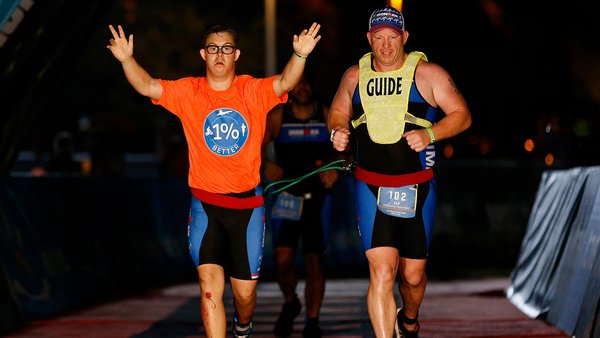
He did race with an accommodation. Nikic and his coach and guide Dan Grieb were tethered during the swim and tethered again during the run. On the bike, they rode separate bicycles, with Grieb staying nearby.
The arrangement did not change the core physical requirement. Nikic still had to propel himself through all three disciplines.
As Grieb explained to Special Olympics Florida:
“I’m not pushing or pulling him. He has to do all the work.”
On November 7, 2020, at Panama City Beach, Florida, the two entered the water.
The clock was already part of the challenge.
His First Problem Wasn’t Endurance. It Was Movement
The finish becomes more remarkable when set against where Nikic started.
Chris was born in 1999 with Down syndrome. At five months old, he underwent open-heart surgery. As a young child, low muscle tone and poor balance made basic movement difficult.
At three, he still used a walker. He didn’t walk independently until around four.
Swimming came much later. He first got into swimming around age nine but reportedly didn’t learn the actual strokes until he was 16.
Cycling presented another problem: balance.
When Nikic learned to ride as a teenager, it took months before he could cycle even 100 feet.
In an inspirational story, these are obstacles.
In an athletic story, they are data.
How does someone whose early physical development made walking, balancing and swimming unusually difficult eventually combine those movement demands across a 140.6-mile endurance event?
Motivation alone cannot explain how a body that once struggled to balance eventually remained on a bicycle for more than eight hours.
Something more specific than motivation had changed.
Down Syndrome Still Mattered
Down syndrome is associated with several characteristics relevant to exercise performance, although there is considerable variation between individuals.
One is hypotonia, or lower muscle tone, something Nikic experienced from childhood.
In a 2003 study by Guerra M, Llorens N and Fernhall B, researchers compared 20 participants with Down syndrome with 20 controls during maximal treadmill exercise. The Down syndrome group reached an average peak heart rate of approximately 165 beats per minute, compared with roughly 192 bpm among controls. Peak oxygen consumption was lower as well.
The researchers found that the heart-rate results were indicative of chronotropic incompetence in the Down syndrome group, a clinical term for a blunted heart-rate response during exercise, not a judgment of athletic ability.
Exercise economy may present another challenge.
A review by Mendonca, Pereira and Fernhall concluded that reduced exercise capacity in people with Down syndrome appears to reflect an interaction between lower peak oxygen uptake and poorer exercise economy. The authors linked poorer economy to altered gait kinetics and kinematics associated with joint laxity and muscle hypotonia.
In simple terms, moving at a particular external speed may sometimes require more energy.
At the same time, these starting disadvantages do not mean performance capacity is fixed.
A 2023 systematic review and meta-analysis covering 10 randomized controlled trials found significant improvements in relative VO₂peak, time to exhaustion and peak minute ventilation following exercise programs for people with Down syndrome. It did not find statistically significant improvements in absolute VO₂peak, peak heart rate or respiratory exchange ratio.
For Nikic, the crucial distinction is that this research describes populations, not one individual.
We don’t have his laboratory-measured VO₂peak, maximum heart rate or running economy. Population averages cannot simply be assigned to him.
But the research changes the context of the performance.
An Ironman is not a VO₂peak test. It does not ask how much oxygen an athlete can consume for a few minutes at maximum effort. It asks whether useful output can be sustained far below that maximum for an extraordinary length of time.
A lower aerobic ceiling matters. So do movement economy, strength and coordination.
The useful question isn’t whether those constraints existed.
It’s how much capacity could be built underneath them.
He Started by Finishing Last
Nikic did not immediately reveal himself as an endurance prodigy.
After returning to training when Special Olympics Florida added a triathlon program, Nikic completed five sprint triathlons and finished last in all five.
The athlete who would eventually become famous for finishing an Ironman didn’t begin by dominating shorter races.
He began by losing.
Repeatedly.
In a 2021 Authority Magazine interview, Nikic looked back on finishing last at the Special Olympics championships and drew a striking conclusion:
“Sometimes finishing last is the best thing that can happen to you.”
His reasoning was simple. He thought he had worked hard, but he hadn’t improved enough to earn a medal. So he decided he needed to work harder and longer.
Around the time he restarted serious training, accounts describe a modest fitness base. He could barely swim one lap and could barely run 100 yards without stopping. Cycling had taken months just to reach 100 feet.
There was no early result announcing a future Ironman.
What emerged instead was trainability.
His Races Became a Staircase
Nikic didn’t jump directly from a sprint triathlon into an Ironman.
The distances increased in stages.
Chris Nikic’s Climb Toward Ironman
| Stage | Result |
| Sprint triathlon, August 2019 | 1:41 |
| Olympic-distance triathlon, January 2020 | 4:25 |
| Half-Ironman distance, May 2020 | 8:25 |
| Full Ironman, November 2020 | 16:46:09 |
Nikic’s own account records the progression: a sprint in August 2019, an Olympic-distance event the following January and a 70.3-mile half-Ironman-distance effort in May before the full Ironman in November.
Each step enlarged the problem: longer swimming, longer cycling, longer running, more fueling, more fatigue and more time requiring concentration.
The progression was complicated further by the COVID-19 pandemic. Pools and gyms closed. Organized races disappeared. The half-Ironman event intended to test the next stage of Nikic’s development was cancelled.
So Nikic and his team measured out their own course and completed the distance anyway.
On paper, the progression looks neat:
sprint → Olympic → half-Ironman → Ironman
In reality, it wasn’t.
Yet that staircase became the clearest large-scale expression of the philosophy Nikic and his father called:
1% Better.

One Percent Better
The concept was deliberately simple.
Don’t confront the entire Ironman every morning.
Make the next task manageable.
One more lap. One more repetition. A little farther running. A little farther cycling.
Then repeat.
The phrase was never a literal physiological equation. Human performance does not compound upward by one percent every day.
Its value was behavioral:
make the next improvement small enough to attempt.
Then accumulate the attempts.
Eventually, the increments stopped looking small.
Nikic described his Ironman training schedule as three to eight hours each day, six days a week.
U.S. Masters Swimming described his progression as beginning with one swimming lap and increasing the distance until he could swim 10,000 yards. The same account says he progressed from neighborhood laps until he could bike 120 miles and run 26.2 miles.
The source describes these as distances Nikic eventually became capable of covering rather than weekly totals.
How Far the Individual Capacities Changed
| Earlier limitation | Later reported training capacity | Ironman requirement |
| Barely one swimming lap | 10,000 yd / 9.14 km | 3.8 km |
| ~100 ft cycling | 120 mi / 193 km | 112 mi / 180 km |
| ~100 yd running without stopping | 26.2 mi / 42.2 km | 42.2 km |
By race day, the individual distances were no longer entirely unknown. Nikic had reportedly built his swimming capacity to more than twice the Ironman swim distance, cycled farther than the race’s bike leg and covered marathon distance.
The same incremental pattern appeared in strength training. Nikic has described beginning with one push-up, one sit-up and one squat, eventually reporting 200 of each, alongside pull-ups, weights and other strength work.
The unanswered question had changed.
It wasn’t simply whether he could swim 2.4 miles, cycle 112 or cover a marathon.
It was whether he could stack all three capacities together.
Swim first.
Then bike.
Then ask already-fatigued legs to produce a marathon.
Was He Becoming Better at Learning?
Something else may have been changing alongside Nikic’s fitness.
In a 2021 profile published by Johns Hopkins Engineering, Nik Nikic said he had noticed changes extending beyond his son’s endurance:
“He has so much more confidence, his memory is better, he learns more quickly.”
That observation is anecdotal. There was no controlled before-and-after testing demonstrating that exercise accelerated Nikic’s cognitive or motor-learning rate, and fitness, experience, confidence and years of practice were all changing simultaneously.
What is clearer is that Nikic’s progression involved more than extending endurance in movements he had already mastered. Walking, balancing, cycling and swimming had themselves required substantial learning. Ironman then demanded that those skills remain reliable under fatigue.
His transformation was therefore not simply cardiovascular and muscular. It also required years of motor learning and technical practice.
If practice was making later skills easier to acquire, that would add another layer to Nikic’s progression. But without longitudinal testing, it remains a possibility rather than a demonstrated adaptation.
Training Changed the Athlete, Not the Diagnosis
Exercise wasn’t going to make Nikic stop having Down syndrome.
But many characteristics surrounding athletic performance are trainable.
Strength can improve. Aerobic fitness can improve. Movement skill can improve. Balance can be practiced. Swimming technique can become more efficient. Cycling can become more automatic. Time to exhaustion can increase.
Nikic remained the same athlete, but became a much more trained one.
The chromosomes didn’t change.
The performance capacity did.
And some of the clearest evidence comes from the limitations that never completely disappeared.
He Could Ride 112 Miles but Still Struggled to Drink
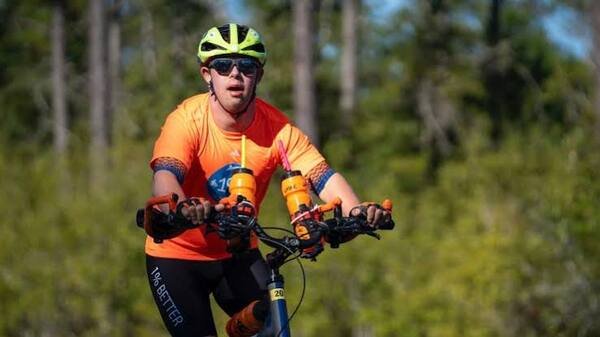
Even after Nikic developed enough cycling capacity for an Ironman, his father said he still could not mount the bicycle and begin riding entirely by himself. Someone had to steady him until he gained enough speed to maintain his balance.
Another limitation was even more revealing.
Nik Nikic said Chris could not drink and maintain his balance at the same time, meaning he had to get off the bike periodically to drink.
The contradiction is remarkable:
He could ride 112 miles.
But one of cycling’s most ordinary actions could still force him off the bike.
He had built enough ability around that limitation to perform anyway.
And during Ironman Florida, the limitation had consequences.
The Ant Attack Wasn’t Completely Random
During one of those hydration stops, Nikic put his feet down in a mound of fire ants.
They bit him, and his leg swelled.
The causal sequence was unusually direct:
balance limitation
↓
difficulty drinking while cycling
↓
required hydration stop
↓
fire-ant mound
↓
bites and swelling
↓
marathon still waiting
A limitation that had existed long before Ironman had created a new obstacle during the race.
The limitation was still there. So was the athlete.
Cycling Required More Than Endurance
Nikic’s team also worked on reaction time, gear shifting, riding in wind, steering and responding to hazards.
For him, becoming an Ironman cyclist wasn’t simply a matter of building stronger legs and a larger aerobic engine.
He had to make a complicated movement system increasingly reliable.
A 112-mile cycling leg contains thousands of small corrections: steer, balance, brake, shift, accelerate, avoid another rider, respond to wind, choose a line.
Then repeat them for hours.
His cardiovascular system had to endure the distance. His nervous system had to keep solving the movement.
And Nikic already knew what could happen when cycling went wrong.
During training before his half-Ironman progression, he reportedly crashed three times. One accident required roughly a dozen stitches in his chin, injured his elbows, knees and hands and cost him around 10 days of training.
Accounts describe him developing a mental block about getting back on the bicycle.
Yet he returned.
Months later, during Ironman Florida, the bike threw him to the ground again.
According to Special Olympics Florida, Nikic fell twice. Grieb later told Triathlete that one crash came while Nikic was descending at approximately 19 mph.
The post-race Special Olympics Florida account reported blood dripping from his knee.
The marathon was still waiting.
Nikic knew what a serious cycling crash felt like. He had already needed stitches after one and experienced the fear of getting back on the bike afterward.
Now it had happened during the race he had spent years preparing to finish.
And he remounted.
The Bike Was Still His Hardest Part
Nikic spent more than eight hours completing the cycling leg.
Grieb rode nearby. He could communicate, guide and help Nikic manage the race, but Nikic still had to balance, steer and pedal across 112 miles.
The movement that had once taken months to sustain for 100 feet now had to remain functional for almost an entire working day.
The race splits show how close the overall attempt came to the limit.
Chris Nikic’s 2020 Ironman
| Segment | Time |
| Swim | 1:54:39 |
| Bike | 8:12:37 |
| Run | 6:18:47 |
| Transitions (calculated) | 20:06 |
| Official reported total | 16:46:09 |
| Ironman cutoff | 17:00:00 |
| Margin | 13:51 |
Endurance Data lists Nikic 1,125th overall in its Ironman Florida results, with Grieb immediately behind him at 1,126th.
But placement had almost stopped mattering.
His opponent had become:
17:00:00.
Every stationary minute mattered. Every slowdown mattered. Every problem on the bicycle mattered.
The question was whether Nikic could preserve enough forward movement before the clock ran out.
Then the Marathon Plan Stopped Working
Nikic and his team entered the marathon with a strategy:
run for six minutes, walk for 30 seconds, repeat.
Deep into the Ironman, the system stopped working.
Around mile 10, Nikic was struggling badly. The distance still ahead was becoming too large to be useful.
So the problem was reduced.
The Florida Bar’s account describes the team switching to short visual targets such as nearby signposts and orange cones. Special Olympics Florida gives the strategy more specifically: Grieb counted the orange cones, asking Nikic to run for 10 and walk for two, then repeat.
Suddenly the problem wasn’t:
How do I finish the rest of an Ironman?
It wasn’t even:
How do I run another mile?
It was:
Can I reach ten cones?
Make the problem smaller.
Complete it.
Then do it again.
A Bad Stretch Didn’t Have to Become the End
Nikic’s race wasn’t a smooth deterioration toward the finish.
Recorded cycling speeds varied substantially between sections, dropping sharply in some stretches before later rising again. His marathon data show a similar pattern: recorded pace deteriorated badly in sections, then improved.
Wind, terrain, aid stations, walking, nutrition, stops and timing-point placement make those segments impossible to interpret as clean physiological measurements.
But Nikic could have a bad stretch without that stretch becoming permanent.
His marathon took 6:18:47.
From the outside, that may look slow.
But physiologically, “slow” and “easy” are not synonyms. Exercise economy describes how much energy an athlete requires to move at a particular speed, and research suggests that people with Down syndrome can experience poorer movement economy.
We do not have metabolic measurements from Nikic’s race, so his individual energy cost cannot be calculated.
In an event lasting almost 17 hours, the revealing number isn’t his marathon speed.
It’s that after the swim and more than eight hours cycling, he could continue producing enough movement for another 6 hours, 18 minutes and 47 seconds.
Sustaining movement as fatigue accumulates also runs through Cliff Young’s Sydney-to-Melbourne victory, where faster runners could not necessarily maintain the greatest progress across several days.
His Guide Couldn’t Do the Ironman for Him
Dan Grieb’s role was substantial.
When Grieb became Nikic’s guide, he had never met a person with Down syndrome, according to U.S. Masters Swimming.
He was an experienced Ironman athlete, but this was a different coaching problem. Grieb initially wasn’t even sure how best to communicate with Nikic. Over time, the two learned how to work together.
During the Ironman, Grieb helped with communication, safety, pacing and the cognitive demands of managing the race.
But assistance and propulsion are different things.
As Grieb had explained before the race, Nikic still had to do the work himself.
Grieb couldn’t produce Nikic’s cardiovascular output. He couldn’t contract his muscles or absorb the impact of the marathon for him.
He could help Nikic manage the task.
He could not supply the physical capacity required to cover 140.6 miles.
The guide helped solve problems surrounding the athlete.
The athlete still had to solve the distance.
Then the Clock Reached 16:46
Night had fallen when Nikic approached the finish.
Afterward, he described what the crowd had meant during the run:
“The run was really awesome because of all the people cheering for me.”
Near the end, Nikic said, the cheering made him start running faster.
Detailed timing data support the observation. His final recorded one-kilometer segment was approximately 8:27, faster than several of the preceding sections.
The clock stopped at:
16:46:09.
Thirteen minutes and 51 seconds remained.
Chris Nikic had become the first person with Down syndrome to complete an Ironman.
Then Came Kona
Florida established that Nikic could finish an Ironman.
Kona asked whether he could do it again.
Before the 2022 Ironman World Championship, Nikic worked for months with physical therapist Trevor Hicks. Their work targeted balance, mobility and coordination, along with his core, hip mobility and lumbopelvic region to make prolonged cycling more comfortable.
Hicks said that across approximately seven months Nikic had built substantial balance, mobility and coordination.
In 2020, balance could still interfere with something as ordinary as drinking while riding.
Two years later, balance and coordination were still being deliberately trained.
Becoming an Ironman hadn’t made Nikic a finished athlete.
Two Years Later, He Got Faster
At the 2022 Ironman World Championship in Kona, Nikic completed another 140.6 miles.
This time:
16:31:27.
Fourteen minutes and 42 seconds faster than Florida.
But Florida and Kona were different courses raced under different conditions. The individual split changes therefore cannot be treated as a controlled before-and-after experiment.
The splits can show where time was gained and lost.

Florida vs. Kona
| Segment | Florida 2020 | Kona 2022 | Change |
| Swim | 1:54:39 | 1:42:41 | −11:58 |
| Bike | 8:12:37 | 8:05:36 | −7:01 |
| Marathon | 6:18:47 | 6:29:01 | +10:14 |
| Transitions (calculated) | 20:06 | 14:09 | −5:57 |
| Total | 16:46:09 | 16:31:27 | −14:42 |
Nikic didn’t improve everywhere.
His marathon was 10 minutes and 14 seconds slower. He was almost 12 minutes faster in the swim, just over seven minutes faster on the bike and nearly six minutes faster across the calculated combined transitions.
The overall improvement therefore wasn’t simply a faster swim and bike. Time was gained in several parts of the race and partly surrendered during the marathon.
Nor can we say that physical therapy caused the cycling difference. Course, conditions, training, experience and numerous other variables changed between the two races.
The safer conclusion:
Florida wasn’t a one-off.
One Race Became an Endurance Career
Nikic kept racing: New York, Boston, Chicago, London, Berlin and Tokyo.
On March 3, 2024, he completed the Tokyo Marathon and became the first person with Down syndrome to complete all six World Marathon Major races, earning his Six Star medal.
That changes the shape of the story.
One Ironman could be one extraordinary day.
Two Ironmans make that explanation harder.
Six major marathons make it harder still.
The question shifts from:
How did Chris Nikic survive one extraordinary race?
to:
What kind of endurance athlete had he become?
The Athlete Hidden Inside the Inspiration Story
Chris Nikic is easy to write about as an inspirational figure.
A child with Down syndrome struggles to walk. He grows up, dreams big, trains and becomes an Ironman.
Millions are inspired.
But that version can accidentally hide the athlete.
Nikic didn’t complete 140.6 miles because inspiration somehow replaced physiology. He trained until his body could complete 140.6 miles.
He learned movements that had once been unusually difficult. He accumulated endurance and strength. He practiced balance and coordination. He extended swimming, cycling and running capacities that had once been extremely limited.
Then he did it again.
Then he kept running marathons.
The simplified story says:
He refused to accept limits.
The athletic story is more precise:
Some of those limits changed. Others had to be managed.
What stands out is the breadth of change: endurance, strength, movement skill, balance, coordination and race management.
We cannot measure the relative contribution of every adaptation. Nikic did not undergo a longitudinal laboratory study tracking his physiology, strength, balance and motor learning throughout the years in which he became an endurance athlete.
But his performance shows how dramatically the scale of the problems changed.
Years earlier, learning to cycle had been reduced to:
100 feet.
Deep into an Ironman marathon, when the remaining distance had become too large to be useful, the problem became:
ten orange cones.
Then ten more.
Then ten more.
Until there were no cones left.
Sources
Guerra M, Llorens N, Fernhall B. “Chronotropic Incompetence in Persons with Down Syndrome.” Archives of Physical Medicine and Rehabilitation. 2003;84(11):1604–1608.
Controlled treadmill study of 20 participants with Down syndrome and 20 controls. Source for the peak-heart-rate, peak-oxygen-consumption and chronotropic-response discussion.
Mendonca GV, Pereira FD, Fernhall B. “Reduced Exercise Capacity in Persons with Down Syndrome: Cause, Effect, and Management.” Therapeutics and Clinical Risk Management. 2010;6:601–610.
Review supporting the discussion of reduced exercise capacity, exercise economy, gait mechanics, joint laxity and hypotonia.
Bahiraei S, Ghaderi M, Sharifian E, Shourabadi Takabi S, Sepehri Far S, Oviedo GR. “Effects of Exercise Programs on Cardiovascular Responses in Individuals With Down Syndrome: A Systematic Review and Meta-analysis.” Preventive Medicine Reports. 2023;36:102521.
Meta-analysis of 10 randomized controlled trials supporting the discussion of exercise-related changes in relative VO₂peak, time to exhaustion and peak minute ventilation, as well as the outcomes that did not reach statistical significance.
Chris Nikic. “About.” ChrisNikic.com.
Nikic’s own account of his progression through a 1:41 sprint triathlon in August 2019, a 4:25 Olympic-distance triathlon in January 2020 and an 8:25 half-Ironman-distance effort in May 2020.
U.S. Masters Swimming. “USMS Member Chris Nikic Is Breaking Barriers.”
Source for Nikic’s childhood development, early swimming and cycling, five last-place sprint triathlons, later training capacities, strength progression and Grieb’s early experience working with Nikic.
Special Olympics Florida. “Chris Nikic Wants to Be the First Ironman Finisher With Down Syndrome.”
Pre-race source for the planned swim and run tether, the unchanged race distances and cutoff, and Grieb’s explanation that he would not push or pull Nikic.
Special Olympics Florida. “Ironman Chris Nikic Gives Us a Welcome Reason to Cheer.”
Detailed race account supporting the fire-ant incident, marathon crisis and Grieb’s run-10-cones/walk-two strategy.
Special Olympics Florida. “Chris Nikic Shatters Stereotypes Making History as the First Special Olympics Athlete and Person With Down Syndrome to Be an IRONMAN.” November 7, 2020.
Post-race source confirming the 16:46:09 finish, two bicycle falls and blood dripping from Nikic’s knee.
Associated Press. “Florida Man With Down Syndrome Competes in Ironman Triathlon.” November 2020.
Source for the 17-hour requirement, race logistics, separate bicycles and the independently staged half-Ironman after the planned event was cancelled.
Authority Magazine. “How Chris Nikic, Nik Nikic & Dan Grieb Optimize Their Minds & Bodies for Peak Performance.” 2021.
Source for Nikic’s reflection on finishing last in Special Olympics competition.
Johns Hopkins Engineering. 2021 profile of Nik Nikic and Chris Nikic.
Source for Nik Nikic’s direct observation that Chris had more confidence, better memory and was learning more quickly. These are his father’s observations rather than controlled evidence of cognitive adaptation.
Down Syndrome Resource Foundation. “Ironman.” Spring 2021 interview with Chris and Nik Nikic.
Source for Nikic’s description of training three to eight hours per day, six days per week, and additional background on his Ironman preparation.
Süddeutsche Zeitung Magazin. Interview with Chris and Nik Nikic. German-language source.
Source for Nik Nikic’s account of Chris’s mounting difficulty, balance limitation, need to dismount to drink, fire-ant incident and reaction-time training. English descriptions used here are translations or paraphrases of the German-language interview.
Triathlete. “Three Athletes’ Perspectives on Ironman Florida: Chris Nikic, Matt Hanson, and Eric Reichart.” November 2020.
Source for Chris’s direct description of the cheering during the marathon and Grieb’s account of the approximately 19 mph cycling crash.
The Florida Bar. “Judge Helps Guide a Young Athlete to a World Record.”
Source for the initial six-minute-run/30-second-walk marathon strategy and the later use of short visual targets including signs and orange cones.
Endurance Data. “Chris Nikic | Ironman Florida 2020.”
Detailed Florida timing and placement source. Lists Nikic 1,125th overall, with splits of 1:54:39, 8:12:37 and 6:18:47 and a database total of 16:46:08. It also records his final one-kilometer segment in 8:27.
Endurance Data. Ironman Hawaii 2022 results.
Timing source for Nikic’s Kona swim, bike, run and overall time. Combined transition time in the article is calculated from those figures.
AdventHealth. “Iron Sharpens Iron: Chris Nikic’s Triathlon Training and Competition.”
Source for Trevor Hicks’s work with Nikic before Kona, including balance, mobility, coordination, core strength, hip mobility and the lumbopelvic region.
Guinness World Records. Chris Nikic’s Ironman record.
Record documentation for Nikic becoming the first person with Down syndrome to complete an Ironman.
Guinness World Records. “First Person with Down’s Syndrome to Complete All World Marathon Major Races.”
Record documentation confirming Nikic completed the Tokyo Marathon on March 3, 2024 and became the first person with Down syndrome to complete all six World Marathon Majors.
Timing Note
Nikic’s 2020 finish is widely reported as 16:46:09, including by Special Olympics Florida. Endurance Data displays 16:46:08, a one-second discrepancy that does not affect the analysis. The article uses the widely reported 16:46:09 finish time.